
| 1. | PROLOGUE |
| 2. | BACKGROUND |
| 3. | PERCEPTIONS - THEN & NOW |
| 3.1. | Enes Zlatar Bure |
| 3.2. | Nedžad Begović |
| 3.3. | Una Bejtović |
| 3.4. | Amina Begović |
| 3.5. | Adi Sarajlić |
| 3.6. | Sabrina Begović-Ćorić |
| 3.7. | Srđan Jevđević |
| 3.8. | Haris Pašović |
| 3.9. | Vesna Mišanović |
| 3.10. | Amra Zulfikarpašić |
| 3.11. | Amina Begović |
| 3.12. | Fuad Babić |
| 3.13. | Riad Ljutović |
| 3.14. | Prof. Rešad Arnautović |
| 3.15. | Arijana Saračević Helać |
| 3.16. | Selma Hodžić / Sanina Rizvanbegović |
| 3.17. | Prof. Ognjenka Finci |
| 3.18. | Ferida Duraković |
| 3.19. | Dr. Bakir Nakaš / Dr. Vesna Čengić |
| 3.20. | Mladen Jeličić Troko |
| 3.21. | Maja Tulić |
| 3.22. | Dragan Rokvić |
| 3.23. | Šemsa Mehmedović |
| 3.24. | Adnan Harambašić |
| 4. | INTERACTIVE SURVIVAL MAP |
| 5. | REFERENCES |
|
The Art of Survival #2
AHEAD OF FEAR |
|
The Art of Survival #1
MAPPING A BESIEGED CITY |
| 1. | PROLOGUE |
| 2. | BACKGROUND |
| 3. | PERCEPTIONS - THEN & NOW |
| 3.1. | Enes Zlatar Bure |
| 3.2. | Nedžad Begović |
| 3.3. | Una Bejtović |
| 3.4. | Amina Begović |
| 3.5. | Adi Sarajlić |
| 3.6. | Sabrina Begović-Ćorić |
| 3.7. | Srđan Jevđević |
| 3.8. | Haris Pašović |
| 3.9. | Vesna Mišanović |
| 3.10. | Amra Zulfikarpašić |
| 3.11. | Amina Begović |
| 3.12. | Fuad Babić |
| 3.13. | Riad Ljutović |
| 3.14. | Prof. Rešad Arnautović |
| 3.15. | Arijana Saračević Helać |
| 3.16. | Selma Hodžić / Sanina Rizvanbegović |
| 3.17. | Prof. Ognjenka Finci |
| 3.18. | Ferida Duraković |
| 3.19. | Dr. Bakir Nakaš / Dr. Vesna Čengić |
| 3.20. | Mladen Jeličić Troko |
| 3.21. | Maja Tulić |
| 3.22. | Dragan Rokvić |
| 3.23. | Šemsa Mehmedović |
| 3.24. | Adnan Harambašić |
| 4. | INTERACTIVE SURVIVAL MAP |
| 5. | REFERENCES |
|
The Art of Survival #2
AHEAD OF FEAR |
|
The Art of Survival #1
MAPPING A BESIEGED CITY |
3.24.
Adnan Harambašić
"Our museum is an infrastructure for the production of knowledge"
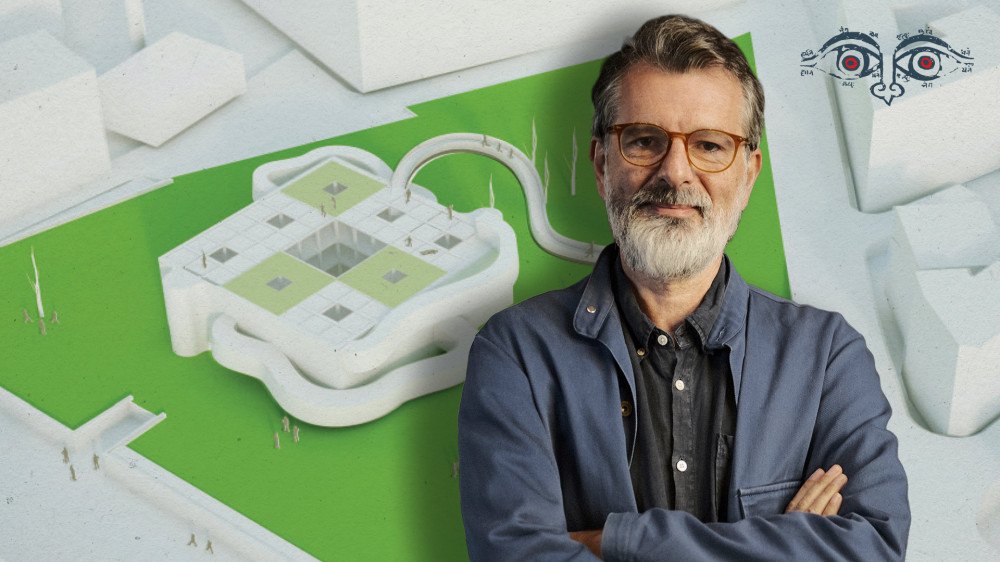
Architectural conceptual design: STUDIO ZEC + ahA + FILTER
FAMA authors have worked diligently to preserve the memory and integrity of the siege phenomenon since 1992, with the aim of creating a permanent "Siege of Sarajevo Museum". The idea of building a museum developed from 1992, when the "Bosnian House" was built in the middle of the siege, then in 1994, when the same structure was reconstructed in smaller dimensions in front of the National Theatre - until 2012, when the multimedia architectural project of the Museum of the Art of Survival (FAMA + Studio Zec + ahA + Filter) was presented to the public.
"The visitor moves through a labyrinthine, dynamic space that reflects the experience of life under siege: there is no clear centre, no safe path, but there is a structure - the structured chaos of human survival. (...) The architecture of this museum, therefore, does not only serve to house the content, but is an active participant in the transfer of knowledge. It forces visitors to find their own way, to create their own narrative, to experience fragmentation and connection at the same time. Exactly as the inhabitants of Sarajevo had to do between 1992 and 1996 - each for himself, all together."
"When we started thinking about the Siege of Sarajevo Museum, also known as "The Art of Survival 1992-1996", we were faced with perhaps the most difficult task of contemporary museology: how to spatially articulate an experience that is both deeply personal and collectively traumatic? How to design a framework for a memory that is both fragment and whole, individual and collective, rational and irrational?
In the work of our team – Studio Zec + ahA + Filter – we started from the fundamental paradox of the war in Bosnia and Herzegovina: while propaganda built a story about collective identities, ethnic groups and common enemies, the reality of the siege was always experienced "on one's own skin" – in a hungry stomach, frozen hands, a fear that is unique and untransferable. Every inhabitant of Sarajevo experienced the same siege, but each in their own way. Every house, every family, everybody remembers a different version of the same 1425 days.
This project fits into the broader context of contemporary museum architecture, which faces the question of how to represent trauma, how to memorialize suffering, while avoiding spectacle or banalization. From Daniel Libeskind and his Jewish Museum in Berlin to Peter Eisenman and the Memorial to the Murdered Jews of Europe, contemporary architects are looking for new spatial languages for the unspeakable. In this context, our project differs - we are not only dealing with memorialization, but we are trying to capture and transmit the knowledge that came from the trauma."
Fractal geometry as the answer
"We found an architectural solution in fractal geometry - more precisely, in the Menger-Sierpinski sponge, a three-dimensional object that simultaneously has an infinite surface and contains zero volume. This choice is not a mere formal game, but a direct translation of a philosophical problem into spatial language.
A fractal, as defined by the mathematician Mandelbrot, is a form in which each part represents a reduced copy of the whole. In the context of the siege of Sarajevo, this definition takes on a new, deep meaning: each individual story of survival contains the entire siege; every improvised stove, every can turned into a lamp, every chicken coop on the balcony – is not only a personal artifact but also a fragment of collective experience. The city collective was under siege, but people lived through it in their own individual ways.
The use of fractal geometry in architecture has its own tradition - from the organic forms of Gaudí's Sagrada Familia to the parametric experiments of contemporary digital architecture. But here the fractal is not an ornament or a formalistic experiment; it is a structural principle that enables the museum to function on multiple scales simultaneously. The Menger-Sierpinski sponge, with its paradoxical nature (infinite surface area, zero volume), becomes the perfect metaphor for the experience of siege: infinitely rich in the details of human survival in exceptional circumstances.
This spatial logic allows the museum to avoid the classic museum hierarchy - where there is a clear narrative line, beginning and end, main story and side stories. Instead, we designed 60 themed boxes that form a meaningful whole in which all parts communicate simultaneously, but where no part loses its specificity. The visitor moves through a labyrinthine, dynamic space that reflects the experience of life under siege: there is no clear centre, no safe path, but there is a structure - the structured chaos of human survival.
This approach represents a radical departure from traditional museology. While the classical museum organizes knowledge linearly and hierarchically - from entrance to exit, from less important to culmination - our museum functions as a network, as a rhizome in the Deleuze-Guattari sense. Every point can be an entrance, every path through the museum is valid, every interpretation is legitimate. This is not relativism, but an acknowledgment of the complexity of the experience we are documenting."
Spatial diversity as an architectural principle
"In designing the museum, we deliberately used radically different spatial scales – from urban and public to private and intimate proportions. This spatial diversity is not an aesthetic decision but a direct representation of the "infinity of the human mind in all its rational and irrational powers".[1]
The history of architecture knows several examples where the play with scale is used as a narrative tool. Piranesi used monumental scale in his Carceri (Dungeons) to create a sense of threat and alienation. In our project, the constant change of scale – from large, collective spaces to small, almost claustrophobic "rooms" – reflects the very rhythm of life under siege.
Architecturally, this manifests itself through the relationship between structure and infill, between the skeleton and the organs of the museum. The fractal structure represents the collective framework – it is given, inevitable, as the siege itself was. But within that structure, 60 thematic boxes represent individual spatial articulations, each with its own character, its own atmosphere, its own unique relationship to the visitor. Some boxes are tall and narrow (like corridors in Sarajevo buildings where people moved in fear of snipers), others are low and wide (like shelters where life took place horizontally), others are completely closed with controlled light entry (like basements that have become homes).
This dichotomy – the closed, irrational collective mind versus the open, creative individual mind – lies at the heart of our architectural concept. The museum celebrates neither collectivity nor individual heroism; it documents the tension between them, the space where both manifest."
Boundaries as membranes
"In the architectural concept, we pay special attention to the boundaries of the museum - Entrance/Exit - conceived as membranes "in which the experience is stored".[2] This is not a random choice of terminology. The membrane is a permeable boundary, a place of exchange, not a wall. Entering the museum is not a transition to another world, but a transformation of the perception of this world.
The membrane concept has a rich history in architectural theory. Gottfried Semper in his work "Der Stil" (1860-63) identified the textile fence as the first and primary architectural action – before the construction, before the roof, comes the membrane that defines inside and outside. This idea of textiles as an original architectural material, as a flexible membrane between interior and exterior, has had a profound impact on architectural expression throughout history – from nomadic tents to contemporary tension structures and double skin facades. In our project, the entrance/exit is not a monumental gate (as in classical museums where architecture is used to impress and establish authority), but a transformation zone, a transitional space where the visitor prepares for a different way of perception.
Physically, this zone is projected as a series of semi-transparent layers – the material equivalent of transitioning between states of consciousness. The visitor does not come to "learn about the siege" as a finished historical event, but to change, if only for a moment, his way of thinking. We designed the museum as an infrastructure – it is not a static object but a system that can be dynamically filled with knowledge, memories and creativity that changes over time.
This approach is different from the monumental memorials we know. While traditional memorials - from ancient mausoleums to modernist monuments - have always strived for permanence, static, imprinted in stone or concrete as a lasting testimony, our museum accepts fluidity, changeability, adaptability. This is not accidental - it is a direct lesson from the siege: survival depends on the ability to adapt, on accepting change as a constant.
Here we return to the paradox of the individual and the whole: each visitor will have his own experience of the museum, create his own path through the labyrinth, focus on different boxes, build his own narrative. But at the same time, they all participate in the same structure, they are all part of the same system. Just as the citizens of Sarajevo during the siege developed individual survival strategies within the same closed system of the city."
Museum as Infrastructure
"The central question of the project is: how can the architectural space simultaneously preserve the material artifacts of the siege and transmit the immaterial knowledge of the philosophy of survival that created these artifacts?
We find the answer in a radical redefinition of what a museum as a type of institution can be. The traditional museum - from the British Museum to the Louvre - functions on the principle of accumulation, classification, preservation. The objects are taken out of their original context, placed in a neutral, controlled space and presented as part of a larger story created by the institution.
Our museum does the opposite. Instead of taking objects out of context, we try to reconstruct the context - not physically (that would be Disneyland falsification) but cognitively and experientially. Each thematic box is not just a display but a micro-environment that activates different ways of perception and thinking.
The heritage of Sarajevo is not a collection of objects but a collection of knowledge. Not a siege museum, but a survival museum. Not a retrospective of suffering, but a prospective of resilience. In the 21st century, when terms like "art of living", "recycling", "adaptation to change" and "freedom from fear" are high on the global agenda, Sarajevo offers empirically tested answers.
Here we return to the idea of the museum as infrastructure. Infrastructure is a system that enables something else - the road enables transport, the electrical network enables lighting, the water network enables hygiene. Our museum is an infrastructure for the production of knowledge, for the transformation of experience, for the transfer not only of information but of ways of thinking.
Cedric Price, a British architect known for his radical ideas (Fun Palace, Potteries Thinkbelt), spoke about architecture as an enabling force - a force that enables, not imposes. Our museum follows this logic: it does not tell the visitor what to think, but gives him the tools to reconstruct the experience himself, to interpret it himself, to draw his own conclusions.
That is why we are not designing the museum as a traditional building, but as a system that enables the transmission of not facts but ways of thinking. "Living history", philosophy, technology through time - all these make up layers of experience that the visitor needs to "experience as it was and as he can understand and learn"."[3]
Materialization of the concept
"The materials we choose are not neutral - each carries a meaning. Recycled elements, taken from real buildings from the time of the siege, become part of the structure - not as museum installations but as constructive elements. Wood from old Bosnian houses becomes part of the skeleton of the museum. Bricks from demolished buildings become part of the entrance membrane. This is not sentimentality but an architectural principle: material as a carrier of memory.
But at the same time, we also use modern materials and technologies. Glass surfaces that enable controlled transparency, LED systems that can simulate different light regimes (from complete darkness to glaring sun - like during a siege), acoustic panels that enable different sound environments (from silence to the sounds of grenades). Technology here is not a spectacle but a tool for creating an experience.
This combination of old and new, authentic and simulated, analog and digital - reflects the very act of survival in the siege where old knowledge and new conditions had to be combined into creative hybrid solutions. Burning wood in a makeshift stove (old technology) while listening to the radio on batteries (new technology). Cooking traditional food (cultural heritage) with a minimum of ingredients (crisis).
Spatially, the fractal structure is materialized through a modular system of metal frames that are repeated at different scales – from structural elements that support the building to smaller frames that define individual boxes. This system enables flexibility: boxes can be added, replaced, redefined without disturbing the basic structure. It is an architecture that anticipates change, that is designed to evolve.
Light becomes a key architectural element. Different parts of the museum have different lighting regimes – some are completely naturally lit (like the rooftop gardens that were vital during the siege), others use only artificial light that simulates improvised candles and lamps, others play with contrasts of light and shadow to recreate the atmosphere of life under constant threat. The light here is not only functional - it is narrative, emotional, experiential."
The context of contemporary museum architecture
"If we place this project in the wider context of museum architecture of the 21st century. After the Guggenheim effect - where museums like Gehry's Guggenheim in Bilbao became above all spectacular objects, icons, tourist magnets - there was a critical reflection. Is the museum first an architecture or an institution? Does the architecture serve the content or the content for the architecture?
Our museum is trying to find a third way. Architecture is not a neutral background (as in the white cube gallery), but it is not a dominant spectacle either (as with Gehry or Hadid). Architecture is an active participant in the creation of experience - it guides, suggests, enables, but does not dictate.
Perhaps the closest relative to our museum is Sou Fujimoto's concept of "architecture as a forest" - where the space is organized not as clearly defined rooms but as a system of possibilities, where the visitor makes his way through a denser or sparser forest.
In the context of museums dealing with trauma and memory, our approach also represents an alternative. Libeskind's Jewish Museum in Berlin uses architectural form to create a powerful emotional impact – sharp angles, disorientation, emptiness. Eisenman's Memorial to the Murdered Jews of Europe in Berlin uses the repetitive geometry of concrete blocks to create a sense of disorientation. Our museum does not want to shock or disorient - it wants to enable understanding through experience, to convey knowledge, not just emotion."
Conclusion: Bridge between Fear and Hope
"In the end, the Museum of the Siege of Sarajevo was designed as a bridge - between the individual and the collective, between local trauma and universal lessons, between fear and hope. His architecture does not provide definitive answers but "articulates a framework for something so complex, incomplete and infinite".[4]
In this sense, the museum reflects the essence of the experience we are documenting: life under siege was both collective and extremely individual, rational and irrational, organized and chaotic. People have accepted that "abnormal is normal", that change is a constant, that energy should not be spent on questions but on action.
The fractal structure of the museum, with its 60 thematic boxes, does not try to homogenize the experience, but quite the opposite - to preserve its complexity, diversity, and even contradiction. Because if anything, the siege of Sarajevo proved that the human mind under pressure produces an endless variety of responses - from the most irrational hatred to the most creative solidarity.
The architecture of this museum, therefore, does not only serve to house the content, but is an active participant in the transfer of knowledge. It forces visitors to find their own way, to create their own narrative, to experience fragmentation and connection at the same time. Exactly as the inhabitants of Sarajevo had to do between 1992 and 1996 - each for himself, all together."
Footnotes:
[1] Studio Zec + ahA + Filter, "The Siege of Sarajevo Museum - The Art of Living 1992-1996 Fama Collection", ArchDaily, published on: https://www.archdaily.com
[2] Ibid.
[3] Internal project document of the Museum of the Siege of Sarajevo, guidelines for conceptual development, 2010-2012
[4] Studio Zec + ahA + Filter, "The Siege of Sarajevo Museum - The Art of Living 1992-1996 Fama Collection", ArchDaily, published on: https://www.archdaily.com
More on this topic in our Macro Story.