
| 1. | PROLOGUE |
| 2. | BACKGROUND |
| 3. | PERCEPTIONS - THEN & NOW |
| 3.1. | Enes Zlatar Bure |
| 3.2. | Nedžad Begović |
| 3.3. | Una Bejtović |
| 3.4. | Amina Begović |
| 3.5. | Adi Sarajlić |
| 3.6. | Sabrina Begović-Ćorić |
| 3.7. | Srđan Jevđević |
| 3.8. | Haris Pašović |
| 3.9. | Vesna Mišanović |
| 3.10. | Amra Zulfikarpašić |
| 3.11. | Amina Begović |
| 3.12. | Fuad Babić |
| 3.13. | Riad Ljutović |
| 3.14. | Prof. Rešad Arnautović |
| 3.15. | Arijana Saračević Helać |
| 3.16. | Selma Hodžić / Sanina Rizvanbegović |
| 3.17. | Prof. Ognjenka Finci |
| 3.18. | Ferida Duraković |
| 3.19. | Dr. Bakir Nakaš / Dr. Vesna Čengić |
| 3.20. | Mladen Jeličić Troko |
| 3.21. | Maja Tulić |
| 3.22. | Dragan Rokvić |
| 3.23. | Šemsa Mehmedović |
| 3.24. | Adnan Harambašić |
| 4. | INTERACTIVE SURVIVAL MAP |
| 5. | REFERENCES |
|
The Art of Survival #2
AHEAD OF FEAR |
|
The Art of Survival #1
MAPPING A BESIEGED CITY |
| 1. | PROLOGUE |
| 2. | BACKGROUND |
| 3. | PERCEPTIONS - THEN & NOW |
| 3.1. | Enes Zlatar Bure |
| 3.2. | Nedžad Begović |
| 3.3. | Una Bejtović |
| 3.4. | Amina Begović |
| 3.5. | Adi Sarajlić |
| 3.6. | Sabrina Begović-Ćorić |
| 3.7. | Srđan Jevđević |
| 3.8. | Haris Pašović |
| 3.9. | Vesna Mišanović |
| 3.10. | Amra Zulfikarpašić |
| 3.11. | Amina Begović |
| 3.12. | Fuad Babić |
| 3.13. | Riad Ljutović |
| 3.14. | Prof. Rešad Arnautović |
| 3.15. | Arijana Saračević Helać |
| 3.16. | Selma Hodžić / Sanina Rizvanbegović |
| 3.17. | Prof. Ognjenka Finci |
| 3.18. | Ferida Duraković |
| 3.19. | Dr. Bakir Nakaš / Dr. Vesna Čengić |
| 3.20. | Mladen Jeličić Troko |
| 3.21. | Maja Tulić |
| 3.22. | Dragan Rokvić |
| 3.23. | Šemsa Mehmedović |
| 3.24. | Adnan Harambašić |
| 4. | INTERACTIVE SURVIVAL MAP |
| 5. | REFERENCES |
|
The Art of Survival #2
AHEAD OF FEAR |
|
The Art of Survival #1
MAPPING A BESIEGED CITY |
3.21.
Maja Tulić
"I can do it all myself"
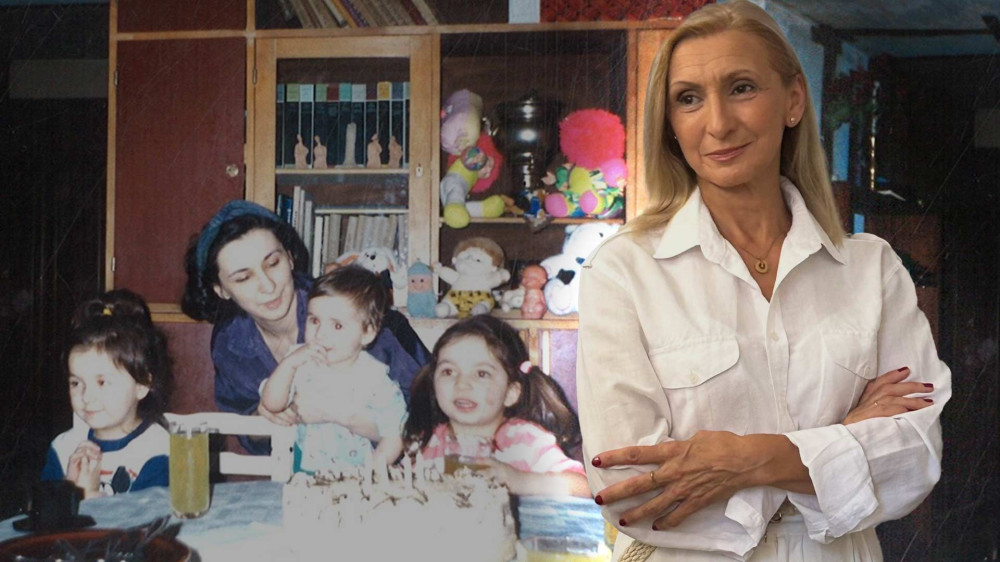
Maja Tulić - Then (The Siege of Sarajevo 1992-96) and now (personal archives)
During the siege of Sarajevo, women were the driving force of survival. They continued to deal with their daily tasks, responsibly and courageously. They came up with new ways to travel long distances to their offices, schools, hospitals, places for humanitarian aid, in basic conditions and under constant risk of injury or death, and how to effectively organize and implement daily tasks. At the same time, they worried about the safety of their family members and their colleagues and friends. They risked their lives so that life in Sarajevo would not stop. Some of them gave birth during the siege. Maja Tulić writes about the symbolism and reality of giving birth in the midst of destruction and death.
"After leaving the hospital, everyday life in our house continued as it had already been established. The baby became part of that machinery for which, like all other family members, it was necessary to bring its share of water, milk and diapers. My mom and I couldn't bring the amount of water that was needed by ourselves, but many neighbours always brought one of our canisters when they went to get their water. (...) At that time my husband left the hospital with both amputated legs after 6 months."
02.05.1992 - I entered the war in the 6th month of pregnancy with my wife and daughter Srna, who was 10 months old. From that day on, we lived in readiness and with a bag ready to go to the basement, so I didn't even think much about the pregnancy because it was a part of me, and there was a baby who was not even one year old, who needed to be provided with food, water and a safe place.
Maja Tulić: Already in the second month of the war, on June 10, 1992, my husband was wounded by an aggressor's grenade and lost both legs. From that day and the next 6 months, my husband was in the hospital, and I was in the 7th month of pregnancy with Srna, who was 17 days away from her first birthday. We survived that period with great help from neighbours, friends, family and many people I had only just met.
The three months of the war pregnancy were thus spent in a daily struggle for survival. I did the check-ups on the way when I managed to get to the hospital to visit my husband, that's how we spent Srna's first birthday: we visited dad and had a check-up.
The day came when the baby was due on August 11, 1992. year. In the morning, with the help of my two friends who brought a barrel of water from the neighbourhood, I started getting ready for the hospital. My mom stayed alone at home with Srna. So ready, I first asked my neighbours to observe the situation from the top floor, because you can see the Military Hospital where they organized a small labour room. It was a room all in concrete and it was the safest, in which there were four beds, four baskets for babies and a table for childbirth. One screen was a dividing wall, because everything took place in that room, from giving birth to leaving the hospital. The birth was very easy and fast with wonderful and professional doctors. I must mention Dr. Jasna Gutić and Dr. Mirsad Puzić who worked 24 hours a day.
And so my second daughter Emina was born. In that uncertain and difficult time, the most important thing for me was to ensure the safety of my daughters and to preserve these two little beings.
How did everyday life go in your house with a new family member? How did everyday life change? What did everyday care for a newborn mean from the perspective of a woman/mother/wife, taking care of food, water, electricity, and heating for the entire family? What do you remember in particular?
Maja Tulić: After leaving the hospital, everyday life in our house continued as it had already been established. The baby became part of that machinery for which, like all other family members, it was necessary to bring its share of water, milk and diapers. My mom and I couldn't bring the amount of water that was needed by ourselves, but many neighbours always brought one of our canisters when they went to get their water. Of course, even that couldn't wash the huge diapers of two babies, but that's where a wonderful friend of our family, Mirsad Ibrić, stepped in, who brought a barrel of 50 liters of water every night after curfew. For the first 5-6 months in the building, we cooked in the basement on an improvised hearth, and as autumn and winter arrived, box stoves appeared, which were lit. Then my husband left the hospital with both amputated legs after 6 months. That first winter, we got the first wood late, so we burned a lot of books, tapes, records, rugs...
How would you describe your role as a mother and wife during the siege of Sarajevo?
Maja Tulić: During the siege, probably due to the specific situation in our house, I became very tough and simply started living with the attitude "I can do it all myself."
During the siege of Sarajevo, women were faced with numerous challenges, difficulties and sufferings, and they took on a key role in maintaining the family and community, providing aid, and defending the city. Women were mothers, wives, sisters. Women continued to engage in their professions, if possible, and bore the burden of family survival, taking into account that many men were on the city's defence lines, wounded or killed. From your own experience and from today's perspective, how would you describe the everyday life of a woman during the siege of Sarajevo? How would you explain, from today's perspective, the strength, endurance, fearlessness and rebellion of a woman under siege?
Maja Tulić: Women in war, besides being mothers and wives, also did their jobs, if possible. Women under siege became the greatest improvisers of normal life, because they created all sorts of things from nothing.
Do you remember any other situation from your life or the lives of your fellow citizens that particularly stuck in your memory and that also undoubtedly demonstrates the courage of women?
Maja Tulić: By the way, towards the end of the war, I became a mother for the second time and gave birth to my third daughter, Esme, on August 26, 1994. I think that was my bravest decision because it was already the second year of the war, and the end was not in sight at that time.
In the FAMA Collection, in the Oral History 'Siege of Sarajevo 1992-1996', another statement of yours has been archived, in which you describe the moment when you happened to be on the street while going to get water and when the shelling started. You say that after that experience, in which you avoided death, you were haunted by images of killing in your sleep. From today's perspective, how do you explain the mental strength of Sarajevo men and women to continue their daily life and fight for survival after such experiences, and to start building their lives from the ground up after the siege?
Maja Tulić: After the massacre at the Sarajevo brewery where we went to get water, everyone who survived, survived by chance. For a long time, even after the war, the sound of that shell used to wake me up because somehow that sound was "special" for me, even though I had heard thousands of shells. Probably because it was the first time I was outdoors and so close to death. That sound was always the same, but the locations were different.
Describe your day during the siege of the city?
Maja Tulić: The siege of Sarajevo lasted 1,425 days, and for most citizens, including me, every day was about securing water, fire, and food. However, during the extremely difficult wartime, many beautiful moments happened and new friendships were made that will last a lifetime.
More on this topic in our Macro Story.