
| 1. | PROLOGUE |
| 2. | BACKGROUND |
| 3. | PERCEPTIONS - THEN & NOW |
| 3.1. | Enes Zlatar Bure |
| 3.2. | Nedžad Begović |
| 3.3. | Una Bejtović |
| 3.4. | Amina Begović |
| 3.5. | Adi Sarajlić |
| 3.6. | Sabrina Begović-Ćorić |
| 3.7. | Srđan Jevđević |
| 3.8. | Haris Pašović |
| 3.9. | Vesna Mišanović |
| 3.10. | Amra Zulfikarpašić |
| 3.11. | Amina Begović |
| 3.12. | Fuad Babić |
| 3.13. | Riad Ljutović |
| 3.14. | Prof. Rešad Arnautović |
| 3.15. | Arijana Saračević Helać |
| 3.16. | Selma Hodžić / Sanina Rizvanbegović |
| 3.17. | Prof. Ognjenka Finci |
| 3.18. | Ferida Duraković |
| 3.19. | Dr. Bakir Nakaš / Dr. Vesna Čengić |
| 3.20. | Mladen Jeličić Troko |
| 3.21. | Maja Tulić |
| 3.22. | Dragan Rokvić |
| 3.23. | Šemsa Mehmedović |
| 3.24. | Adnan Harambašić |
| 4. | INTERACTIVE SURVIVAL MAP |
| 5. | REFERENCES |
|
The Art of Survival #2
AHEAD OF FEAR |
|
The Art of Survival #1
MAPPING A BESIEGED CITY |
| 1. | PROLOGUE |
| 2. | BACKGROUND |
| 3. | PERCEPTIONS - THEN & NOW |
| 3.1. | Enes Zlatar Bure |
| 3.2. | Nedžad Begović |
| 3.3. | Una Bejtović |
| 3.4. | Amina Begović |
| 3.5. | Adi Sarajlić |
| 3.6. | Sabrina Begović-Ćorić |
| 3.7. | Srđan Jevđević |
| 3.8. | Haris Pašović |
| 3.9. | Vesna Mišanović |
| 3.10. | Amra Zulfikarpašić |
| 3.11. | Amina Begović |
| 3.12. | Fuad Babić |
| 3.13. | Riad Ljutović |
| 3.14. | Prof. Rešad Arnautović |
| 3.15. | Arijana Saračević Helać |
| 3.16. | Selma Hodžić / Sanina Rizvanbegović |
| 3.17. | Prof. Ognjenka Finci |
| 3.18. | Ferida Duraković |
| 3.19. | Dr. Bakir Nakaš / Dr. Vesna Čengić |
| 3.20. | Mladen Jeličić Troko |
| 3.21. | Maja Tulić |
| 3.22. | Dragan Rokvić |
| 3.23. | Šemsa Mehmedović |
| 3.24. | Adnan Harambašić |
| 4. | INTERACTIVE SURVIVAL MAP |
| 5. | REFERENCES |
|
The Art of Survival #2
AHEAD OF FEAR |
|
The Art of Survival #1
MAPPING A BESIEGED CITY |
3.5.
Adi Sarajlić
"Only this box existed, with little people living in it, who were talking, or playing music..."
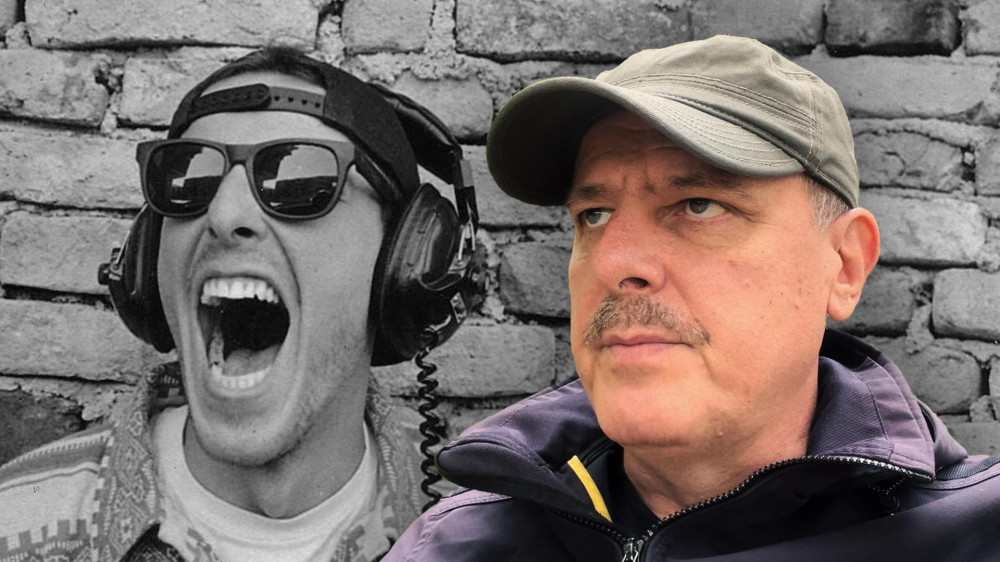
Without the basic resources for survival, during the siege, the citizens of Sarajevo had to focus on everything that would help them preserve endurance and mental health: music, film, exhibitions, theatre, hobbies, sports. There was no electricity in the besieged city, so they listened to radio stations on small battery transistors. During the long nights, under candles, or during the day, the city listened to radio station hosts who told the citizens of Sarajevo with their voices that they were not alone. Their words encouraged them, and the music they played took the listeners to some other spheres and worlds, where there is no war.
Adi Sarajlić talks about what it meant to him to be a radio host and what his motivation was to host a radio program, often 24 hours a day. Thirty years later, he compares Sarajevo as it was and as it is now.
Then...
"With no TV, no MTV, no news, no food, no nothing, except a world which for a moment helps you to forget what is happening and creates indirectly or directly some kind of false sense of reality."
Now...
"We have become a horrible, overly commercial society in which everything that revolves around us exudes complete nonsense."
© FAMA Collection; Oral History: 'The Siege of Sarajevo 1992-1996'
Then...
“My favorite film was ‘Goodbye Vietnam’ that’s about an American DJ sent to Vietnam to do a program; he did the morning program every morning. It began with the words 'Good morning Vietnam' and James Brown’s song 'I Feel Good'. I felt it must be an ideal thing to be a radio presenter. And to find yourself in such an inspirational position. But when the war came and I found myself in a situation like that - to be a radio presenter during a war, and to do more or less what that guy in the film was doing. Then the film stopped being my favorite. I don’t believe that I’ll ever look at it again, though I used to look at it endlessly. The reason is that you come to see that what the film showed was - well - twisting the truth - lying actually. Every morning when I came to work I had to sprint over the intersection and then on Sunday morning, when I did the morning program I would say ‘Good morning all of you, listeners young and old, I’m still alive, let's go if you’re still alive’. You simply had nothing to do. Only the box existed with little people living in it who were talking, or playing music, or singing and so on, and so on. And there was no electricity, you had to get contact through the telephone or find an accumulator, and live your life through others. With no TV, no MTV, no news, no food, no nothing, except a world which for a moment helps you to forget what is happening and creates indirectly or directly a feeling of it being a lie.” - Adi Sarajlić, Journalist - Radio „Zid“ (August 1994)
© FAMA Collection; Macro Story: 'The Siege of Sarajevo - Then & Now'
Now...
„I am Adi Sarajlić. I look a little different than in the first video from the war, I'm a few years older and a few kilos plumper. What else has changed in relation to the period of the siege of Sarajevo and the current one, apart from my physics? Basically, back in the days, my friend Karim Zaimović wrote about the rock and roll that flourished at the time or the alternative scene that flourished in Sarajevo that it was, in fact, the swan song of a generation. He asked it as a question, whether it is the swan song of one generation or something more. And we all knew then, as he did, that it was just the swan song of a generation. So, everything is completely different. Actually, everything is basically the same as it was before the war. Our music is commercial, capitalism is all around us, there are no quality radio stations, everything has lost that deeper meaning than the one we had during the war. At that time, we had no water, no electricity, no gas, no food, but we didn't think about that, we looked at how to upgrade ourselves spiritually or how to replace that food and that water with other things. And that kept us alive. And now we are in a daily struggle for food, for the payment of bills, electricity, gas, which is available in abundance, but simply life is trampling you and you don't even have time to record this video and send it, so on this occasion I apologize for that. Simply, the thing that is somehow the saddest and most regrettable to me - ok, we ran into that capitalism, we lived in some hippie commune during the war - is that, if I look at it from the perspective of the radio, I think that this city, not to say this country, they deserve a quality radio. So, we had an advertisement, a jingle on the radio during the war that said: 'This nation and this army have no other alternatives'. Simply, everything has become way too commercial. Media that no one watches anymore, serve more as decor in some spaces. It's not the internet's problem. Simply, the problem is that we are... We have become a horrible, overly commercial society in which everything that revolves around us exudes complete nonsense. It was much better during the war.“ - Adi Sarajlić, Journalist (May 2024)
More on this topic in our Macro Story.