
| 1. | PROLOGUE |
| 2. | BACKGROUND |
| 3. | PERCEPTIONS - THEN & NOW |
| 3.1. | Enes Zlatar Bure |
| 3.2. | Nedžad Begović |
| 3.3. | Una Bejtović |
| 3.4. | Amina Begović |
| 3.5. | Adi Sarajlić |
| 3.6. | Sabrina Begović-Ćorić |
| 3.7. | Srđan Jevđević |
| 3.8. | Haris Pašović |
| 3.9. | Vesna Mišanović |
| 3.10. | Amra Zulfikarpašić |
| 3.11. | Amina Begović |
| 3.12. | Fuad Babić |
| 3.13. | Riad Ljutović |
| 3.14. | Prof. Rešad Arnautović |
| 3.15. | Arijana Saračević Helać |
| 3.16. | Selma Hodžić / Sanina Rizvanbegović |
| 3.17. | Prof. Ognjenka Finci |
| 3.18. | Ferida Duraković |
| 3.19. | Dr. Bakir Nakaš / Dr. Vesna Čengić |
| 3.20. | Mladen Jeličić Troko |
| 3.21. | Maja Tulić |
| 3.22. | Dragan Rokvić |
| 3.23. | Šemsa Mehmedović |
| 3.24. | Adnan Harambašić |
| 4. | INTERACTIVE SURVIVAL MAP |
| 5. | REFERENCES |
|
The Art of Survival #2
AHEAD OF FEAR |
|
The Art of Survival #1
MAPPING A BESIEGED CITY |
| 1. | PROLOGUE |
| 2. | BACKGROUND |
| 3. | PERCEPTIONS - THEN & NOW |
| 3.1. | Enes Zlatar Bure |
| 3.2. | Nedžad Begović |
| 3.3. | Una Bejtović |
| 3.4. | Amina Begović |
| 3.5. | Adi Sarajlić |
| 3.6. | Sabrina Begović-Ćorić |
| 3.7. | Srđan Jevđević |
| 3.8. | Haris Pašović |
| 3.9. | Vesna Mišanović |
| 3.10. | Amra Zulfikarpašić |
| 3.11. | Amina Begović |
| 3.12. | Fuad Babić |
| 3.13. | Riad Ljutović |
| 3.14. | Prof. Rešad Arnautović |
| 3.15. | Arijana Saračević Helać |
| 3.16. | Selma Hodžić / Sanina Rizvanbegović |
| 3.17. | Prof. Ognjenka Finci |
| 3.18. | Ferida Duraković |
| 3.19. | Dr. Bakir Nakaš / Dr. Vesna Čengić |
| 3.20. | Mladen Jeličić Troko |
| 3.21. | Maja Tulić |
| 3.22. | Dragan Rokvić |
| 3.23. | Šemsa Mehmedović |
| 3.24. | Adnan Harambašić |
| 4. | INTERACTIVE SURVIVAL MAP |
| 5. | REFERENCES |
|
The Art of Survival #2
AHEAD OF FEAR |
|
The Art of Survival #1
MAPPING A BESIEGED CITY |
3.13.
Riad Ljutović
"The war caught me with dreams that I wanted to realize"
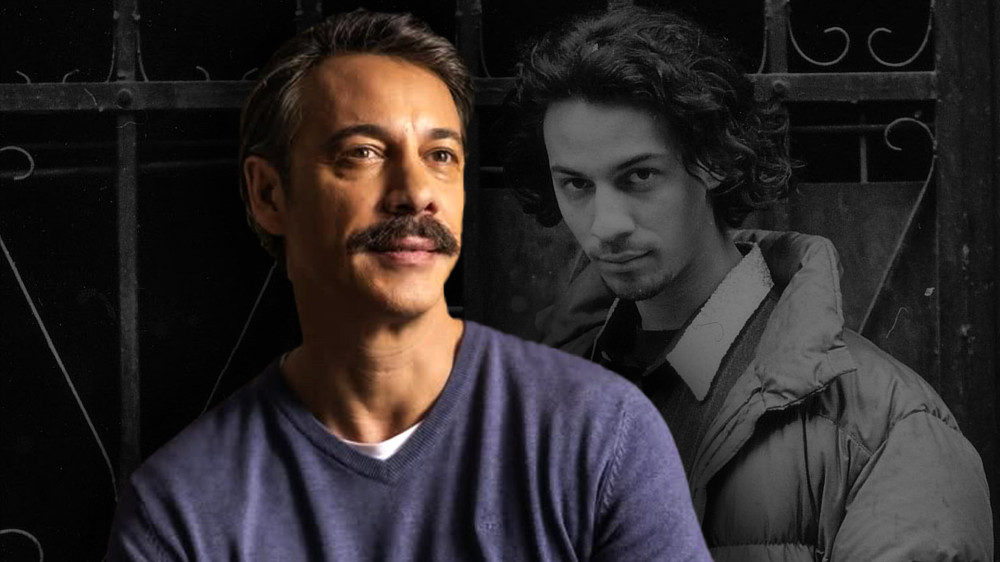
© FAMA Collection - Visual Archives 1992-1996 (Milomir Kovačević) / Riad Ljutović, personal archives
What today's fashion industry calls "upcycling" (repurposing old clothing and other items) has already become normal and a form of creation during the siege of Sarajevo. Sarajevo created amidst the destruction. Fashion shows were also held. Riad Ljutović recalls the creation of his fashion show "Trash", and speaks about the citizens' need for work and creativity.
"The war had already begun, the clothes were created in the period 1992-1993. I had just graduated from the Secondary School of Art, Department for Textile Design and Sculpture. There was nothing, of course, but I managed by looking for materials in the garbage dumps that were all over the city at that time. I mostly worked quite intuitively, combining some things that might not go together, for example a potato sack with leather applications. (...) That was my resistance to the war and the aggression that befell us at that moment. I did not want to stop creating and working, and continued despite everything."
In moments of total destruction during the siege of Sarajevo, creation becomes an act of resistance. The FAMA Collection archive contains photographs showing the fashion collection “Trash” that you created during the siege. How did the idea for this collection come about?
Riad Ljutović: The idea is just a continuation of what I started in 1991 as a student at the Secondary School of Arts, Department for Textile Design. During the war, I continued to sew and make some new fashion items. The collection was created from trash or discarded items that I found near the dumpster. I also used my mother Senada's old dresses and made some new items following world trends. The war caught me with some dreams that I wanted to realize. This type of fashion that was not classic could compete with the world fashion scene. The items were sewn on an old Singer machine that did not require electricity, and my dad Hazim was the tailor. The girls in the photos are from my sister Selma's then newly established "JOY" modelling agency, and the photos were taken at the National Theatre. The photographer is Milomir Kovačević Strašni.
In what year of the siege and under what circumstances in the city was the collection created? How did you find the materials, because we know that the shops were closed? How long did the process of creating and executing the collection take?
Riad Ljutović: The war had already begun, the clothes were created in the period 1992-1993. I had just graduated from the Secondary School of Art, Department for Textile Design and Sculpture. There was nothing, of course, but I managed by looking for materials in the garbage dumps that were all over the city at that time. I mostly worked quite intuitively, combining some things that might not go together, for example a potato sack with leather applications. You get a modern combination of a blouse where the idea is most important. We sewed the items periodically. Since there was more free time at the very beginning of the war, I was involved in creations. That was my resistance to the war and the aggression that befell us at that moment. I did not want to stop creating and working, and continued despite everything.
Culture was one of the ways citizens could maintain their mental health and remind themselves that there was a normal life, and that it existed outside the besieged city. Was the collection presented as a fashion show and what were the reactions to it?
Riad Ljutović: Just before the war, I worked on the very popular TVSA3 show "Top Liste". I knew the crew of the then famous show "Sarajevo Rat Art" and it was with their agreement, in the middle of the war, that a fashion show and interview with me was broadcast on TV. At that moment, the show resembled an MTV fashion show, with Madonna's music "Erotica". Many thought it was bold and brave to do something like that, when we literally had nothing to eat, but my resistance during the war was to remain normal and creative and not let the war destroy my free artistic spirit. That was my contribution during the war - to be myself even in such circumstances. Whoever was lucky enough and able to watch it on TV, whoever had electricity at that moment, said that it was brave and daring to do something like that, because while we were here in Sarajevo during the war, people outside were creating some new music, fashion, films and I think that we were also making great artistic things here that were between life and death. To create something that even remotely resembles something worldly from nothing was a feat.
How do you perceive the need for work and creativity in impossible conditions from today's perspective? How do you explain your need for creative expression under the constant threat of terror and in impossible existential conditions?
Riad Ljutović: That's what kept me from going crazy, from giving in to aggression, and that’s what helped me to save myself mentally with what I knew how to do. Back then, no one worked for money, we worked to survive and remain normal in such inhumane living conditions. Since we had that momentum of mortality, that we could die at any moment, our desire to do something and leave a trace that we existed was even stronger. That desire for life kept us going and constantly diverted our thoughts from the fact that we were living in a war zone where we were living flesh where they were throwing shells at us to destroy us, to make us vanish. That makes our art, no matter how modest it may be, all the more valuable. It showed a spirit that is indestructible and it proved that during that period of aggression against Bosnia and Herzegovina we did not give in. Instead we created and preserved art so that it would not perish, and with it our identity.
Your career shows your versatility and many talents – acting, theatre direction, ballet, dance, sculpture, set design, costume design. In the summer of 1992, you were part of the art project Bosnian House 1992 in production of FAMA. Your acting career began during the siege of Sarajevo. You made your acting debut during the war in 1993 as Mirabel in “The Wall”, on the stage of the Chamber Theatre ’55, where you would later perform the plays “Pješice”, “Alifakovac” and others. What did theatre mean to you as an actor and citizen of the city under siege at that time?
Riad Ljutović: Before the war, I was a TV presenter on the popular "TV Top List" and the war started almost at the peak of my career as a presenter. The war was a shock for me, I was thinking that it would end very quickly. Staying in wartime Sarajevo the whole time, surviving with the bare minimum, art was everything to me at that moment. Theatre was kind of fortress where you play under candles and grenades and travel to other worlds, forgetting where you are. I remember that back then I really got into the characters I played. I relived every time, crying like a little child after each performance, that is how deeply I entered into the acting ecstasy, showing emotions until the end, especially in the play "The Wall" which dealt with the theme of war - prison. While I was acting, I was Riad showing the world how much the people in Bosnia and Herzegovina, in Sarajevo, where we lived imprisoned as in a ghetto, were suffering. And we just wanted to live normally and do everything that was denied to us in the besieged city of Sarajevo. I was 20 years old then, full of dreams and hopes for a better life. I survived the war. I worked during the war and studied, and at the same time I was a soldier in the Army of Bosnia and Herzegovina. When I look at the past from today's perspective, I don't know if I would have the strength again to do the same and as much like in that period of darkness and human madness. The war did not bring anyone good. It brought lost lives and ruined generations of people who lost not only years of life, but also their homeland, leaving far away as refugees.
Describe your day during the siege of Sarajevo?
Riad Ljutović: Mostly it was just survival, collecting water or thinking about how we could keep warm, looking for firewood, anything that could be used. I read a lot at that time, whatever I could get my hands on. At the beginning of the war, I enrolled in the Academy of Performing Arts. I was the first wartime generation of students. I went to the Academy while shells were falling outside and sniper bullets were whizzing by, avoiding the main roads. After I turned 20, I received a call to join the Army of Bosnia and Herzegovina. I was in the army and studying at the same time, begging each time to be let to go to a lecture at the Academy. In the end, it couldn't work out that way anymore and I joined the Army of Bosnia and Herzegovina, where they took me from the play "The Wall" to the front line. Trying to stay alive and normal in wartime Sarajevo, where people's lives were almost worthless, my mother Senada was with me the whole time, and I can only thank her for staying alive. I rarely remember that difficult period, somehow wanting to leave it behind and live in the present moment, thinking only of the bright side of life. The war and my work during that period are the greatest life lessons for me, from which I still draw some ideas when I work on stage today.
More on this topic in our Macro Story.