
| 1. | PROLOGUE |
| 2. | BACKGROUND |
| 3. | PERCEPTIONS - THEN & NOW |
| 3.1. | Enes Zlatar Bure |
| 3.2. | Nedžad Begović |
| 3.3. | Una Bejtović |
| 3.4. | Amina Begović |
| 3.5. | Adi Sarajlić |
| 3.6. | Sabrina Begović-Ćorić |
| 3.7. | Srđan Jevđević |
| 3.8. | Haris Pašović |
| 3.9. | Vesna Mišanović |
| 3.10. | Amra Zulfikarpašić |
| 3.11. | Amina Begović |
| 3.12. | Fuad Babić |
| 3.13. | Riad Ljutović |
| 3.14. | Prof. Rešad Arnautović |
| 3.15. | Arijana Saračević Helać |
| 3.16. | Selma Hodžić / Sanina Rizvanbegović |
| 3.17. | Prof. Ognjenka Finci |
| 3.18. | Ferida Duraković |
| 3.19. | Dr. Bakir Nakaš / Dr. Vesna Čengić |
| 3.20. | Mladen Jeličić Troko |
| 3.21. | Maja Tulić |
| 3.22. | Dragan Rokvić |
| 3.23. | Šemsa Mehmedović |
| 3.24. | Adnan Harambašić |
| 4. | INTERACTIVE SURVIVAL MAP |
| 5. | REFERENCES |
|
The Art of Survival #2
AHEAD OF FEAR |
|
The Art of Survival #1
MAPPING A BESIEGED CITY |
| 1. | PROLOGUE |
| 2. | BACKGROUND |
| 3. | PERCEPTIONS - THEN & NOW |
| 3.1. | Enes Zlatar Bure |
| 3.2. | Nedžad Begović |
| 3.3. | Una Bejtović |
| 3.4. | Amina Begović |
| 3.5. | Adi Sarajlić |
| 3.6. | Sabrina Begović-Ćorić |
| 3.7. | Srđan Jevđević |
| 3.8. | Haris Pašović |
| 3.9. | Vesna Mišanović |
| 3.10. | Amra Zulfikarpašić |
| 3.11. | Amina Begović |
| 3.12. | Fuad Babić |
| 3.13. | Riad Ljutović |
| 3.14. | Prof. Rešad Arnautović |
| 3.15. | Arijana Saračević Helać |
| 3.16. | Selma Hodžić / Sanina Rizvanbegović |
| 3.17. | Prof. Ognjenka Finci |
| 3.18. | Ferida Duraković |
| 3.19. | Dr. Bakir Nakaš / Dr. Vesna Čengić |
| 3.20. | Mladen Jeličić Troko |
| 3.21. | Maja Tulić |
| 3.22. | Dragan Rokvić |
| 3.23. | Šemsa Mehmedović |
| 3.24. | Adnan Harambašić |
| 4. | INTERACTIVE SURVIVAL MAP |
| 5. | REFERENCES |
|
The Art of Survival #2
AHEAD OF FEAR |
|
The Art of Survival #1
MAPPING A BESIEGED CITY |
3.19.
Dr. Bakir Nakaš / Dr. Vesna Čengić
"We did not know what kind of severe injuries to internal organs can be caused by a small shell shrapnel"
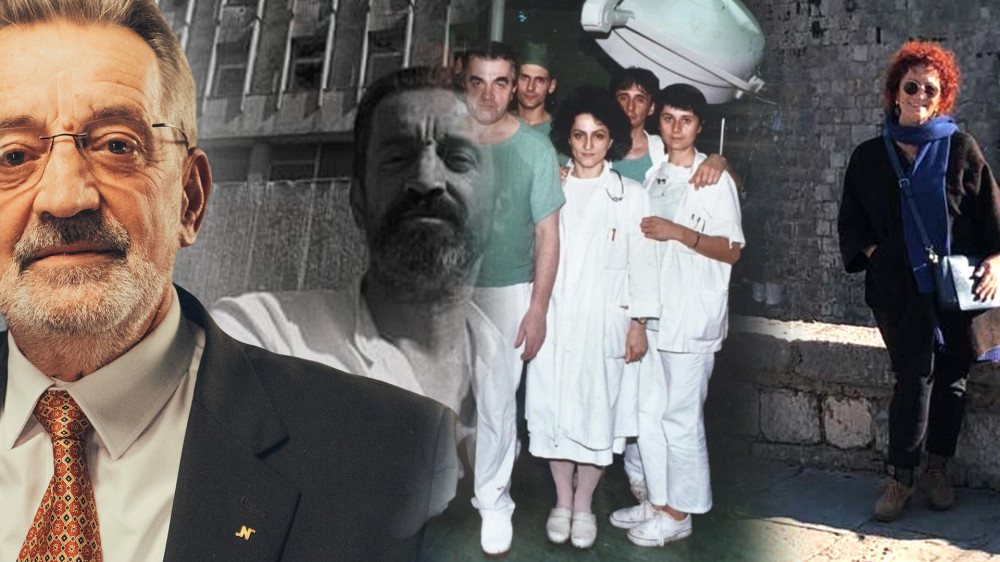
Bakir Nakaš - Then (The Siege of Sarajevo 1992-96, personal archives, Milomir Kovačević) and Now (© FAMA Collection - Visual Archives 1992-1996)
Vesna Čengić - Then (The Siege of Sarajevo 1992-96, personal archives) and Now (personal archives)
Doctors in besieged Sarajevo were faced with a situation that they have never experienced before. Working without electricity, water, medicines, medical aids and medical supplies meant only one thing - inventiveness, resourcefulness, fearlessness became their basic tools in the fight to save lives. Doctors are forced to repair previously unseen types of the most serious injuries in adults and children. Operations were performed under candles, sometimes in severe cold. Dr. Bakir Nakaš and dr. Vesna Čengić describe the work of doctors during the siege from two different time perspectives, then and now.
"If you ask me today how we coped with the lack of electricity, water, heating, adequate spaces and medical equipment, medicines, means for anaesthesia, sterilization, my answer would simply be "I don't know". The urge to survive, the belief that we are doing the right thing, the enthusiasm and willingness and determination of everyone to work together to ensure health care in besieged Sarajevo were decisive. New ideas and solutions were born in the hopeless situations in which we found ourselves."
- Dr. Bakir Nakaš
"There were no working hours, we stayed in the hospital as long as we needed, sometimes continuously for two or more days, but I must say that we never complained about being tired. There were only few of us, but we were a good team, we loved each other, shared everything, looked after each other, worried whether we would see each other again in the next shift, whether we would stay alive on the way home or to the hospital. We rejoiced at successes, saved lives and together we grieved for those we could not help, sharing the pain with their families. The hardest thing to experience was seeing one of your family members or a close friend among the wounded."
- Dr. Vesna Čengić
In various media sources about healthcare during the siege of Sarajevo, it is often mentioned that a large number of healthcare workers immediately left the hospitals and left the city at the beginning of the siege. In such a situation, a number of doctors and other hospital staff made the decision that they must continue their work, without thinking about the conditions under which they will perform their work. What did the first days of the siege look like for you, especially that turning point when you made the decision to stay in the hospital and, together with your associates and colleagues, bear the entire burden of treatment, operations, surgical procedures, rehabilitation of patients during the siege?
Bakir Nakaš: The first days of the siege of the city found me in the position of the head of the Department for Infectious Diseases in the former Military Hospital in Sarajevo. The situation was confusing, there was not enough valid information about what was happening in and around the city. We could not leave the hospital building. In addition to employees, patients and wounded, armed formations of the then JNA were also present in it. The reception of patients was suspended. Divisions also began among employees due to different views on current events.
When the artillery fire started in the city, I decided to leave the hospital together with several colleagues. When the JNA left the hospital on May 10, most of the employees, members of the former JNA, as well as civilians serving in the JNA, left with them. Out of more than 600 employees and soldiers of the former JNA, about thirty doctors, nurses, technicians and non-medical staff remained in the hospital at that time, taking care of about fifty sick and wounded. That was a turning point when I and my colleagues, about a hundred former employees of all profiles, who had previously either voluntarily left or were forced to leave the hospital, decided to return to their jobs and re-establish the system and put the hospital into operation.
How did the role of doctors change during the four years of the siege? What motivated you to work sometimes 24 hours a day, and even several days in a row, in one shift? How did the other fellow doctors perceive the new situation and the almost impossible working conditions?
Bakir Nakaš: After the initial shock and disbelief due to everything that was happening, doctors and everyone else who was involved in providing health care, decided to help sick and wounded patients and made enormous efforts. Those who remained in besieged Sarajevo accepted impossible working conditions with the awareness that there was no safe place and that they could be wounded or killed at any moment. There was incredible enthusiasm, dedication and sacrifice. Thanks to this, the health care system in besieged Sarajevo gave citizens and fighters a sense of security that they would receive the necessary help in case of need. In countless cases, the citizens themselves got involved in various ways in providing help through volunteer work or by donating food, firewood, etc. in order to ensure better conditions for the work of health institutions.
There is a video statement in the FAMA collection, in which you describe how medical instruments were sterilized. At one point you say that the doctors were no longer men in white, but men in red because of the amount of blood with which their coats were soaked. Can you describe what the doctors achieved in the impossible working conditions? How did you cope with the lack of electricity, water, medicines, anaesthesia, meant for sterilizing instruments, heating?
Bakir Nakaš: Due to the number of injured and the extent and severity of the injuries, it could truly be said that the doctors were no longer men in white, but men in red due to the amount of blood with which their coats were soaked. There was a huge disparity between the conditions, or rather the non-conditions, in which the work of medical and non-medical staff took place in health institutions and outside them, and the successful results of their work.
If you ask me today how we coped with the lack of electricity, water, heating, adequate spaces and medical equipment, medicines, means for anaesthesia, sterilization, my answer would simply be "I don't know". The urge to survive, the belief that we are doing the right thing, the enthusiasm and willingness and determination of everyone to work together to ensure health care in besieged Sarajevo were decisive. New ideas and solutions were born in the hopeless situations in which we found ourselves.
How would you describe the interpersonal relationships during the siege in the hospitals? Was there space, time and strength for doctors to provide psychological support to patients? Did the doctors give each other strength in difficult moments that happened every day?
Bakir Nakaš: Interpersonal relations during the siege in hospitals were much better than today. Teamwork, mutual trust, collegiality, inventiveness and the decision not to give up helped overcome the most difficult obstacles. The relationship between doctors and patients, citizens' trust in healthcare workers, care for people, mutual support were at a much higher level.
Which workday is particularly memorable to you?
Bakir Nakaš: The massacre in Ferhadija on May 27, 1992 remained in my memory in particular. During the first days of the siege of Sarajevo, the military hospital at that time was not able to provide first aid and treatment to sick and wounded citizens of Sarajevo. Until the military hospital was abandoned by members of the JNA on May 10, 1992, the citizens of Sarajevo were sent to the Koševo Clinical Centre.
After the members of the JNA left, the citizens of Sarajevo continued to avoid going to the former military hospital due to mistrust, until the first massacre on May 27 in Ferhadija Street. A large number of wounded were sent to the Koševo Clinical Centre, and not to our hospital, which prompted me to go by ambulance to the Clinic for Orthopaedics and Traumatology and pick up a number of wounded who were waiting for treatment and help. That moment was a sign for sick and wounded citizens that treatment is possible and safe to get treated in the former Military Hospital, which reduced the flow of patients to the Koševo Clinical Center.
From today's perspective, what are you especially proud of as a doctor?
Bakir Nakaš: From today's perspective, I am especially proud, both as a doctor and as a manager, of all colleagues and employees who, with their engagement, made it possible to provide all the necessary medical care to the wounded and sick, despite the terrible destruction and the lack of elementary conditions for hospital work, and to provide the conditions for the arrival of new Sarajevo residents into this world.
There have been many new methods and inventions in treatment and surgery, can you tell us more about that?
Bakir Nakaš: Due to the lack of standard equipment and inadequate conditions, we were forced to adapt and improvise, but also to create original aids. It is certain that the creation and production of Sarajevo war fixator "SARAFIKS" was one of the innovations that saved many wounded from amputations and preserved their limbs. Our doctors Dr. Šukrija Đozić and Dr. Raib Salihefendić, with the help of engineer Enes Baralić, created and produced several external fixators that were in great demand due to numerous limb injuries. Thanks to this invention, several thousand patients were saved not only in Sarajevo but also in other parts of BiH. No less significant was the production of infusion solutions, without which the number of deaths of wounded and ill patients would certainly have been much higher.
Is there anything from the period of the siege of Sarajevo that you would do differently today?
Bakir Nakaš: There is not much I would do differently today than I did during that period. Without false modesty, I think we did more than could have been expected under the circumstances.
How did you spend your time when you were not in the hospital, if there was any time at all?
Bakir Nakaš: The besieged Sarajevo during the aggression defended itself with various cultural events that made it possible to survive the war days more easily. Whenever I had the chance, I visited the National Theatre, Chamber Theatre, SARTR. I have a vivid memory of the ballet performances "Bolero", not only in the National Theatre, but also on the open stage in Skenderija. We tried to ensure that our patients were not deprived of cultural events, so shows and performances were held in the hospital in which numerous cultural workers participated. Some of them were at the hospital as patients at the time.
In various media sources about healthcare during the siege of Sarajevo, it is often mentioned that a large number of healthcare workers immediately left the hospitals and left the city at the beginning of the siege. In such a situation, a number of doctors and other hospital staff made the decision that they must continue their work, without thinking about the conditions under which they will perform their work. What did the first days of the siege look like for you, especially that turning point when you made the decision to stay in the hospital and, together with your associates and colleagues, bear the entire burden of treatment, operations, surgical procedures, rehabilitation of patients during the siege?
Vesna Čengić: Life in peace is interrupted suddenly, from today to tomorrow, a completely surreal state. There was no dilemma in my head, whether to stay or leave, there was no thought about it, until the moment of the offer of an organized and safe departure from the city for my family. Sitting at the table, thinking about that possibility, my younger brother said, I'm a man, I can't go. I said, I'm a doctor, I can't go, and my mother said, I'm your mom... I'll never forget that. And later, during the entire period of the siege, there was no thought of leaving the city.
How did the role of doctors change during the four years of the siege? What motivated you to work sometimes 24 hours a day, and even several days in a row, in one shift? How did the other fellow doctors perceive the new situation and the almost impossible working conditions?
Vesna Čengić: It's been a long four years, it was getting harder and harder to bear such terror, so much pain and blood. I often talked to journalists, especially at the beginning of the siege. I thought it was very important for the world to know what was happening in Sarajevo, precisely because it was hard to believe in that terrible truth, which was happening in the heart of Europe. I cried in front of the cameras of all the major world TV stations, testifying to the serious injuries of a huge number of people, but there was no reaction that I naively believed in and at that time I was angry with them, too. I must say that I did make a few friends among foreign journalists. In one situation, which I remember well, I called them and they helped with their story in the media, about the seriously wounded girl Irma, to make her evacuation to England happen.
The FAMA collection contains your video statement in which you talk about the enormous psychological pressure that doctors and medical workers were exposed to on a daily basis. Can you describe how doctors overcame emotional and psychological pressure and fear? Can you describe what the doctors achieved in the impossible working conditions? How did you cope with the lack of electricity, water, medicines, anaesthesia, means for sterilizing instruments, heating?
Vesna Čengić: I am an anaesthesiologist, fighting disease is my mission, and I could never have imagined that I would be fighting against the power and evil that comes from people, in order to save lives. Maybe that was my motivation and strength, and I believe that was the motivation of all my colleagues, we had to do everything to save them.
How would you describe the interpersonal relationships during the siege in the hospitals? Was there space, time and strength for doctors to provide psychological support to patients? Did the doctors give each other strength in difficult moments that happened every day?
Vesna Čengić: There were no working hours, we stayed in the hospital as long as we needed, sometimes continuously for two or more days, but I must say that we never complained about being tired. There were only few of us, but we were a good team, we loved each other, shared everything, looked after each other, worried whether we would see each other again in the next shift, whether we would stay alive on the way home or to the hospital. We rejoiced at successes, saved lives and together we grieved for those we could not help, sharing the pain with their families. The hardest thing to experience was seeing one of your family members or a close friend among the wounded.
Which workday is particularly memorable to you?
Vesna Čengić: I can't explain why I remember particular events so poorly, during such a difficult, surreal and painfully long period of the siege, spending most of that time in the hospital. I don't think it's conscious, the brain decided it on its own, there are only strong emotions and images, the least of which are stories.
One such event happened one summer day. At the entrance to the emergency room, on the ground floor of the hospital courtyard, somewhat protected, where we were always on duty, we heard the sound of a vehicle. We ran out and saw that it was an open truck with only human bodies covered in blood, one on top of the other, seriously wounded in the massacre in the city, alive and dead.
We brought in all the bodies, some on stretchers, some on the floor, we examined them, checked for signs of life, the type and severity of the injury, who we could and must help first. We had to react quickly, quickly decide on the priority of care, be calm and professional, and at the same time your heart breaks. I approached the girl who was lying on the floor, she was 3 or 4 years old, she was unconscious, she had a small wound in the chest area. I started external heart massage, I massaged her chest, I did not leave her, I was trying to bring her back to life and I did not give up. Dr. Nakaš, our chief of surgery, approached me, he recognized that I was not aware of the situation, nor of my actions, that I was not reasonable, that I did not accept that the girl had been brought in mortally wounded, with no signs of life, so he gently but firmly separated me from her. That I cannot forget.
From today's perspective, what are you especially proud of as a doctor?
Vesna Čengić: How did I endure living in such surreal circumstances? I watched the children in our yards between the buildings on Marindvor, they played and laughed and rejoiced, because this is their life it belongs to them, just like that, regardless of the circumstances, it belongs to their childhood and youth. I lived the same way, that was my life at that time, we don't always choose, but this was my choice, to stay and do what I love, what I know and what is my duty now, and to be happy that I can help, to save lives from violent destruction. There was so much joy in that, misfortune alternated with happiness and I never lost hope, the future must certainly be better...
I remember one patient who had to have his leg amputated, in the second act, because during the operation, after the injury, we tried to save the leg, and we always did that. I came to talk to him, to explain to him the necessity of such a decision and prepare him for it. While I was talking to him, tears welled up in my eyes, and he, his name was Mujo, hugged me and comforted me not to worry because he was strong! There were many such and similar situations, Zijo, Nermin, Dražen... Huso had a very serious injury to his stomach and chest, at the very beginning of the siege, he was in intensive care, but at one point, while I was next to him, he suffered a cardiac arrest, my hands saved him, with external heart massage the heart started beating again, and after a month Huso was walking and went home. My patients still pass through the city and greet me, that's what I'm proud of!
There have been many new methods and inventions in treatment and surgery, can you tell us more about that?
Vesna Čengić: The injuries we encountered and had to take care of, we have never seen before. We did not know what kind of severe injuries to internal organs can be caused by a small shell shrapnel or a sniper's rotating bullet. But how could we have known, on the exam in war surgery, we learned, of course, theoretically, what are the principles of caring for a war wound, but we were not ready for this experience. Thoraco-abdominal severe injuries from just one or more small shrapnel, we have never seen that. How to treat a patient who has bled due to multiple bone, soft tissue or large blood vessel injuries, and how to fight war wound infection, is a big demand and question for anaesthesiologists. The problem of how to start the anaesthesiology machine, without which we cannot introduce a patient into general anaesthesia, when there is no electricity or oxygen, we solved in our hospital with an innovation, adapting the domicile oxygen concentrator to a source of oxygen for the needs of anaesthesia. Our experience is valuable for the entire human society, that is, professional associations, and we have passed it on to our colleagues from other countries at international congresses. I must say that we regularly received compliments for the quality of the primary care of the most serious war-injured patients who were evacuated to other countries. Of course, our invention, Sarafix, an external fixator that treats open fractures of long bones, which is the primary war doctrine, and which was produced in Sarajevo during the siege, should be emphasized. We, as teams, adapted very quickly to inhumane, almost impossible working conditions, in taking care of severe war injuries, with our knowledge, will, combativeness, creativity and intelligence, which by definition is the ability to adapt to new circumstances, and that's where we were the strongest!
Is there anything from the period of the siege of Sarajevo that you would do differently today?
Vesna Čengić: No, I wouldn't do anything differently.
How did you spend your time when you were not in the hospital, if there was any time at all?
Vesna Čengić: When I wasn't in the hospital, I spent most of my time in the neighbourhood, that is, in my apartment building, that was our little world, and when I think about it, I remember it with nostalgia, because those were indelibly beautiful emotions between us.
Leaving the house was only to go to theatre plays. Haris Pašović came to the city, that was encouraging, as if he would save us! One day, in the fall of 1993, in the former Radnik cinema, the film festival began, the Sarajevo Film Festival, during the siege of the city, what joy! My brother and I went there, through the Red Cross courtyard we went out to the "open" Alipašina Street, and risking our lives we ran across it, like everyone else who went to the same place. I'm so glad that I survived that danger from a sniper bullet, entering a full cinema hall was more like a movie, because it was unreal, and I was elated.
More on this topic in our Macro Story.