
| 1. | PROLOGUE |
| 2. | BACKGROUND |
| 3. | PERCEPTIONS - THEN & NOW |
| 3.1. | Enes Zlatar Bure |
| 3.2. | Nedžad Begović |
| 3.3. | Una Bejtović |
| 3.4. | Amina Begović |
| 3.5. | Adi Sarajlić |
| 3.6. | Sabrina Begović-Ćorić |
| 3.7. | Srđan Jevđević |
| 3.8. | Haris Pašović |
| 3.9. | Vesna Mišanović |
| 3.10. | Amra Zulfikarpašić |
| 3.11. | Amina Begović |
| 3.12. | Fuad Babić |
| 3.13. | Riad Ljutović |
| 3.14. | Prof. Rešad Arnautović |
| 3.15. | Arijana Saračević Helać |
| 3.16. | Selma Hodžić / Sanina Rizvanbegović |
| 3.17. | Prof. Ognjenka Finci |
| 3.18. | Ferida Duraković |
| 3.19. | Dr. Bakir Nakaš / Dr. Vesna Čengić |
| 3.20. | Mladen Jeličić Troko |
| 3.21. | Maja Tulić |
| 3.22. | Dragan Rokvić |
| 3.23. | Šemsa Mehmedović |
| 3.24. | Adnan Harambašić |
| 4. | INTERACTIVE SURVIVAL MAP |
| 5. | REFERENCES |
|
The Art of Survival #2
AHEAD OF FEAR |
|
The Art of Survival #1
MAPPING A BESIEGED CITY |
| 1. | PROLOGUE |
| 2. | BACKGROUND |
| 3. | PERCEPTIONS - THEN & NOW |
| 3.1. | Enes Zlatar Bure |
| 3.2. | Nedžad Begović |
| 3.3. | Una Bejtović |
| 3.4. | Amina Begović |
| 3.5. | Adi Sarajlić |
| 3.6. | Sabrina Begović-Ćorić |
| 3.7. | Srđan Jevđević |
| 3.8. | Haris Pašović |
| 3.9. | Vesna Mišanović |
| 3.10. | Amra Zulfikarpašić |
| 3.11. | Amina Begović |
| 3.12. | Fuad Babić |
| 3.13. | Riad Ljutović |
| 3.14. | Prof. Rešad Arnautović |
| 3.15. | Arijana Saračević Helać |
| 3.16. | Selma Hodžić / Sanina Rizvanbegović |
| 3.17. | Prof. Ognjenka Finci |
| 3.18. | Ferida Duraković |
| 3.19. | Dr. Bakir Nakaš / Dr. Vesna Čengić |
| 3.20. | Mladen Jeličić Troko |
| 3.21. | Maja Tulić |
| 3.22. | Dragan Rokvić |
| 3.23. | Šemsa Mehmedović |
| 3.24. | Adnan Harambašić |
| 4. | INTERACTIVE SURVIVAL MAP |
| 5. | REFERENCES |
|
The Art of Survival #2
AHEAD OF FEAR |
|
The Art of Survival #1
MAPPING A BESIEGED CITY |

3.8.
Haris Pašović
"Why war during the film festival?"
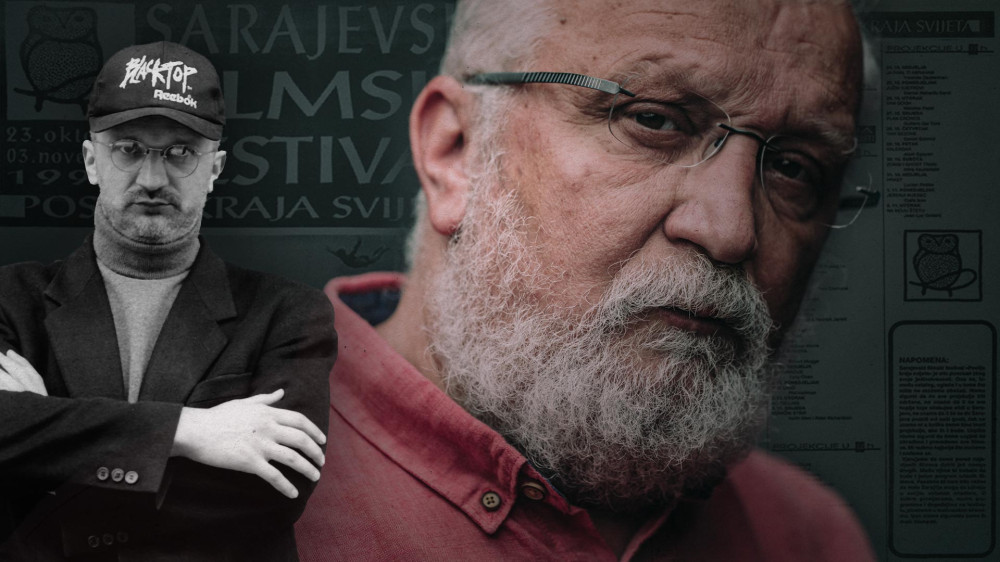
The slogan of the first film festival held in Sarajevo in 1993 was "We can't promise you anything". And really, the citizens of Sarajevo didn't need any promises - they just wanted to be part of the world and attend the screenings of then-current films by world-renowned authors. They wanted to forget for a moment the terror to which they were exposed day and night.
In two video statements - then and now - Haris Pašović describes what the organization of the first film festival in the city under siege looked like and what it meant for the citizens of Sarajevo to attend film screenings.
Then...
"In October ’93 we had a Film Festival with parallel projections in three cinemas. It lasted 10 days and there were 140 films from all over the world."
Now...
"There was no victory in sight, but somehow it was known that, even if we all died, we would die proudly like dignified people who have civilizational achievements that they want to maintain."
© FAMA Collection; Oral History: 'The Siege of Sarajevo 1992-1996'
Then...
“The first to reply was that wonderful old producer Lina Wertmüller who said she congratulated us. After that we heard from Wim Wenders who sent a letter saying he was sending us his films. Then things began to snowball. The result being that in October ’93 we had a Film Festival with parallel projections in three cinemas. It lasted 10 days and there were 140 films from all over the world. We calculated that there were about 20 thousand viewers in those 10 days. It really was a wonder. We were immediately joined by colleagues from Oslobođenje, Saga, Radio ‘Zid’, from the Academy of Scenic Arts. The atmosphere was fantastic. We hired some generators from our friends in the humanitarian organizations and some petrol. A team of volunteers joined us. It was an amazing atmosphere. And echoed round. People were eager to see the films; there were packed crowds. People literally chanced sniping to get there.” - Haris Pašović, Director of International Film and Theater Festival MES (November 1993)
© FAMA Collection; Macro Story: 'The Siege of Sarajevo - Then & Now'
Now...
It is very difficult to make an ordinary video with a statement, and you can think how difficult it is to make a film, and how it is still difficult to broadcast it in Sarajevo where there was no electricity and where there were no elementary possibilities, not only for projections, but also for life. And that was in October 1993 when we organized the Sarajevo Film Festival. The idea for the festival began with me sitting in the office and wondering what people were filming in the world now because we were already so far away from the rest of the world as if we were on another planet, that's what it looked like. What I wanted and what I thought was, come on, we have electricity sometimes, when we were a small priority, when the Presidency got a little electricity, then we also got some, because then the famous Irfan Nefić, who worked in the Electric Power Distribution, understood that culture should function in war, so he sometimes gave us some electricity.
We had one TV in the MES festival premises and one VCR, then there were VHS tapes. And then I said, well let's try to get a few of those VHS tapes through our connections that we had, through colleagues who worked in various humanitarian organizations. So we will show these films here in the office, there will be maybe 30 people who will come to watch this and we will call it the Sarajevo Film Festival. In just a month, we had about 150 films coming to us from all over the world, and we had to have three theatres by then. Late Anne Marie du Preez, who worked in the United Nations, and John Fawcett, who worked in the ICG, provided us with some fuel and some generator, so we edited it in the cinema led by Kasim Đajić, in 'Radnik', and then we showed those films that way. Also in the former cinema 'Romanija', today 'Imperial' and at the Academy of Performing Arts. The festival lasted, I think, 10 days. We had 20,000 visits, and we know this by giving out free tickets to simply limit the audience.
What is most fascinating about all this is that people responded so heartily to our festival. People came, literally risked their lives to go to the cinema to see a movie. This is captured in a documentary by Johan van der Keuken, a great, legendary Dutch film maker, director. And he made that movie. But I say, there were unbelievable things. Since some people came from the front line and had a gun, we had a rule that the gun should be left on the wardrobe so that they could get the number, just like today you leave your coat when you come to the theater. It was all really magnificent. It felt like the spirit of people who had not surrendered. That was the spirit of victory. There was no victory in sight, but somehow it was known that, even if we all died, we would die proudly like dignified people who have civilizational achievements that they want to maintain.
Today, after - how many years - from 1993 or after 30-31 years, the festival has grown into one big event. That part, post-war festival, is the responsibility of Miro Purivatra and today Jovan Marjanović. I had no desire to deal with it after the war, but they managed to create a festival that was highly appreciated. And what is most beautiful in all, it is a festival where sometimes, whenever possible, films by our directors, who graduated from our academy, are shown. Many of them enrolled it during the war. This year, too, there will be Danis, there will be Srđan, and for his film, for Srđan Vuletić's film, my student, Mirela Trepanić, wrote the script. Danis Tanović, my student, is opening the festival. I call them my students, but they are now international directors, famous around the world. Danis is the father of five children. They are all great people: Jasmila Žbanić, who enrolled in the Academy during the war together with Aida Begić, with Elmir Jukić, with Faruk Lončarević. Two years ago, Pjer Žalica, also a former student of mine, opened the festival with his film. From one situation where there was no film festival in Sarajevo before the war. There were three educated film directors and two or three educated, actually one educated theatre director, until I graduated, and then there were two of us. Both the opening of the Academy in 1989 and the fact that Raza Lagumdžija invited me to start a directing department, all this somehow came together and brought results that are huge when you look at where we started and where we could have ended up.
Therefore, what I was saying to all the journalists in the world at the time, because when we started, all the journalists of all the biggest television companies, all the biggest newspapers that were in Sarajevo, who were reporting in the siege, came to me and they all literally asked the same question, why a film festival during the war? And I replied to everyone: „Why war during the film festival?"
- Haris Pašović, Theater Director (August 2024)
„I got the idea for the Sarajevo Film Festival one day sitting in my office at the MES Festival and listening to the shelling in the distance. I asked myself: 'What kind of films are being made in the world now?' and thought that I would ask through my friends, foreigners who worked in besieged Sarajevo, for several European directors to send us their new films on VHS, the video format of that time. I thought, 'Okay, we'll get maybe a dozen movies; we will show them here at the MES Festival office on a video player; maybe 30 or so people will come to see these films and it will be the Sarajevo Film Festival.
In the fall of 1993, during the war, I initiated the creation of the first Sarajevo Film Festival. The theme of the festival was 'After the end of the world'. The young people in the MES Festival team prepared the festival, translated and subtitled films, and made screening schedules. The interest exceeded my wildest expectations. Our colleagues from around the world sent us about 150 films, which we showed in three cinemas, and there were more than 20,000 viewers. The legendary Dutch documentary filmmaker Johan van der Keuken recorded part of that atmosphere in his documentary film about the first Sarajevo Film Festival.
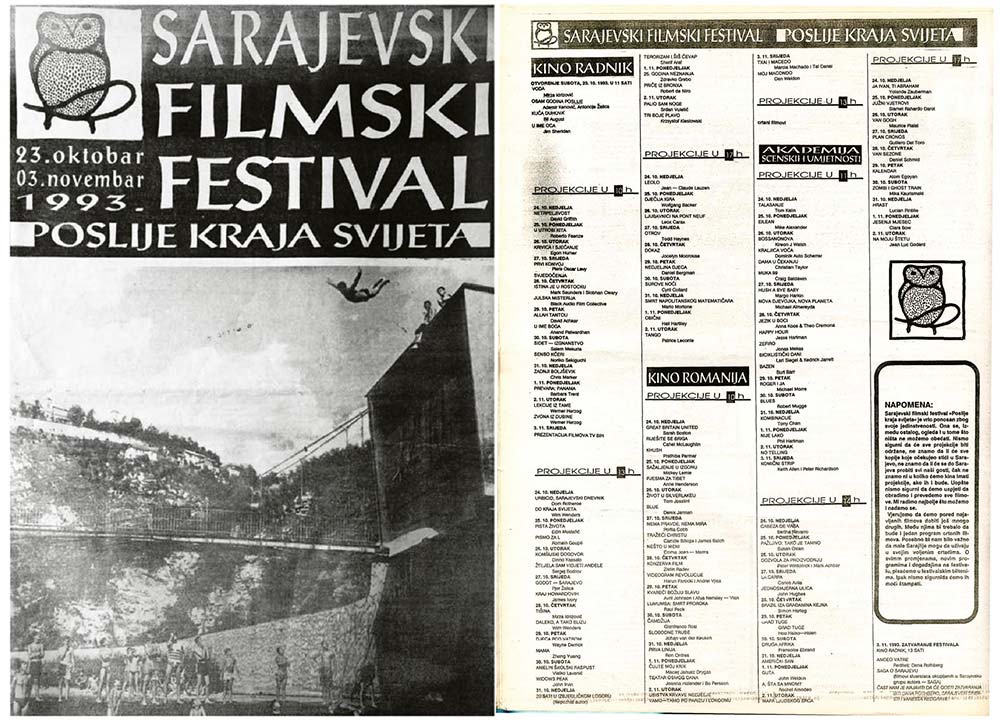
At one point, I met with Salko Hasanefendić, the then director of 'Oslobođenje'. I asked him to publish a special in 'Oslobođenje' which would be the catalog of the first Sarajevo Film Festival; free of charge, of course. He listened to me carefully, and then there was silence. I knew that he understood the importance of my request, but also that it was not easy to decide that in the terrible wartime paper shortage, they would give extra pages for the film festival! During the siege of Sarajevo, the daily newspaper 'Oslobođenje' was published on eight pages. There were reports from the battlefield on four pages. On the next four pages were the obituaries. One day I saw that a father quoted in the obituary of his murdered son: 'My generation is marching, my generation in pounding in the sky/one by one, we will all meet.' That moment is etched in my heart forever. It was a quote from Omar Mjesečar's song. Salko Hasanefendić said: 'We will give eight pages.' I listened in disbelief – 'Oslobođenje' will print an additional eight pages! A whole issue. So, he will give one whole day of his life to the Sarajevo Film Festival. I was overjoyed.
I invited Nada Salom, culture editor in 'Oslobođenje', to make a catalogue. She immediately came to the premises of the MES Festival and with Lejla Pašović, Lejla Hasanbegović, Mirsada Bjelak and other members of the team hurriedly wrote descriptions of the films. Nada called Marina Rodić, the technical editor of 'Oslobođenje', and Marina immediately started preparing photos and editing the catalogue. We finished the preparation that evening and Marina and I took the materials and jumped into the van that occasionally drove from the city centre to the 'Oslobođenje' building - relatively speaking. Near the 'Oslobođenje' building itself, it was the front line and it was not possible to approach the car completely without great risk. Heavy shooting was heard that evening. The driver drove us to about 300 meters from the building and said: 'I can't go any further.' Marina knew the way through some tall grass and some bushes; we crawled, she crawled forward and I followed her; both clutching papers and photos to themselves as something most precious. We finally somehow reached the building and I followed Marina into the basements where the editorial offices, printing office and some improvised bedrooms were located. People came out of the dark corridors, we greeted each other, everything was like in some post-apocalyptic movie, except for the mood - because everyone we met was smiling. Marina and I went to Ibrahim Cuco Horić, my friend from high school, who was the graphic editor on duty that night. We both rejoiced, happy that the other was alive, and immediately got down to work together with Marina.
We put together a catalogue; corrected the mistakes and Cuco sent the catalogue to be printed. We went to see the first print, were satisfied, and they sent me to get some sleep until the morning, when they will transfer me to the city centre. They woke me up around 7 o'clock and then everything happened incredibly fast. They took me outside, where they loaded the new issue of 'Oslobođenje' at high speed into the white Golf II, in the space where the last seat used to be. They threw me in together with the newspaper; in front were the driver and one distributor. I was sitting buried in hundreds of issues of the new 'Oslobođenje', managed to open one issue and saw a beautifully printed catalogue of the festival, and then the driver took off and drove over 100 km/h (standard speed in besieged Sarajevo to avoid snipers). On Otoka, next to the bridge, people were standing and waiting for the new 'Oslobođenje' with prepared BiH coupons in their hands (the "money" of that time), the Golf stopped briefly, the distributor opened the window, people gave coupons, he quickly gave them newspapers, everything was happening like in some action movie. We moved on, again over 100 km/h; they stopped, everything repeated at several more intersections.
There was some incredible secret between 'Oslobođenje' and the readers in that morning ritual in which both, those who distributed 'Oslobođenje' and the readers, risked their lives. I got out of the white Golf of the two distributors of 'Oslobođenje' at Šipad's building in Tito's Street. People passed by me and read the new issue of 'Oslobođenje' as they walked. I saw that they were curiously looking at the front page of the special, which had a photo: From the old power station, a guy was jumping swallow-flight-style into the river Miljacka, while other swimmers were standing in the water watching him. Annie Leibovitz, the world's best photographer, took this photo in July 1993 at the swimming pool in Bentbaša. Above the photo it was written 'SARAJEVO FILM FESTIVAL – AFTER THE END OF THE WORLD'.
I was very proud - of Sarajevo, of my team from the MES Festival, of 'Oslobođenje'. I never met Salko Hasanefendić, Marina Rodić, or Ibrahim Cuco Horić after that. But they were always and remained big in my eyes and in my heart! Sometimes, rarely, I meet or hear briefly from Nada Salom. They are my heroes of Sarajevo, but also of the film festival! The people of Sarajevo risked their lives to watch the plays of the MES Festival and the films of the first Sarajevo Film Festival. This is not a metaphor - they literally risked their lives for culture. Plays, films, concerts and exhibitions in Sarajevo under siege were an expression of civilization and human dignity. Festivals are made up of audiences – 'ordinary' spectators who in the dark immerse themselves in the work of art. They are the real reason for every festival - these unknown accomplices of the artist in creating meaning."
- Haris Pašović, Theater Director (August 2024)
More on this topic in our Macro Story.