
| 1. | PROLOGUE |
| 2. | BACKGROUND |
| 3. | PERCEPTIONS - THEN & NOW |
| 3.1. | Enes Zlatar Bure |
| 3.2. | Nedžad Begović |
| 3.3. | Una Bejtović |
| 3.4. | Amina Begović |
| 3.5. | Adi Sarajlić |
| 3.6. | Sabrina Begović-Ćorić |
| 3.7. | Srđan Jevđević |
| 3.8. | Haris Pašović |
| 3.9. | Vesna Mišanović |
| 3.10. | Amra Zulfikarpašić |
| 3.11. | Amina Begović |
| 3.12. | Fuad Babić |
| 3.13. | Riad Ljutović |
| 3.14. | Prof. Rešad Arnautović |
| 3.15. | Arijana Saračević Helać |
| 3.16. | Selma Hodžić / Sanina Rizvanbegović |
| 3.17. | Prof. Ognjenka Finci |
| 3.18. | Ferida Duraković |
| 3.19. | Dr. Bakir Nakaš / Dr. Vesna Čengić |
| 3.20. | Mladen Jeličić Troko |
| 3.21. | Maja Tulić |
| 3.22. | Dragan Rokvić |
| 3.23. | Šemsa Mehmedović |
| 3.24. | Adnan Harambašić |
| 4. | INTERACTIVE SURVIVAL MAP |
| 5. | REFERENCES |
|
The Art of Survival #2
AHEAD OF FEAR |
|
The Art of Survival #1
MAPPING A BESIEGED CITY |
| 1. | PROLOGUE |
| 2. | BACKGROUND |
| 3. | PERCEPTIONS - THEN & NOW |
| 3.1. | Enes Zlatar Bure |
| 3.2. | Nedžad Begović |
| 3.3. | Una Bejtović |
| 3.4. | Amina Begović |
| 3.5. | Adi Sarajlić |
| 3.6. | Sabrina Begović-Ćorić |
| 3.7. | Srđan Jevđević |
| 3.8. | Haris Pašović |
| 3.9. | Vesna Mišanović |
| 3.10. | Amra Zulfikarpašić |
| 3.11. | Amina Begović |
| 3.12. | Fuad Babić |
| 3.13. | Riad Ljutović |
| 3.14. | Prof. Rešad Arnautović |
| 3.15. | Arijana Saračević Helać |
| 3.16. | Selma Hodžić / Sanina Rizvanbegović |
| 3.17. | Prof. Ognjenka Finci |
| 3.18. | Ferida Duraković |
| 3.19. | Dr. Bakir Nakaš / Dr. Vesna Čengić |
| 3.20. | Mladen Jeličić Troko |
| 3.21. | Maja Tulić |
| 3.22. | Dragan Rokvić |
| 3.23. | Šemsa Mehmedović |
| 3.24. | Adnan Harambašić |
| 4. | INTERACTIVE SURVIVAL MAP |
| 5. | REFERENCES |
|
The Art of Survival #2
AHEAD OF FEAR |
|
The Art of Survival #1
MAPPING A BESIEGED CITY |
3.23.
Šemsa Mehmedović
"I was absorbed in my work and had no time to feel bad"
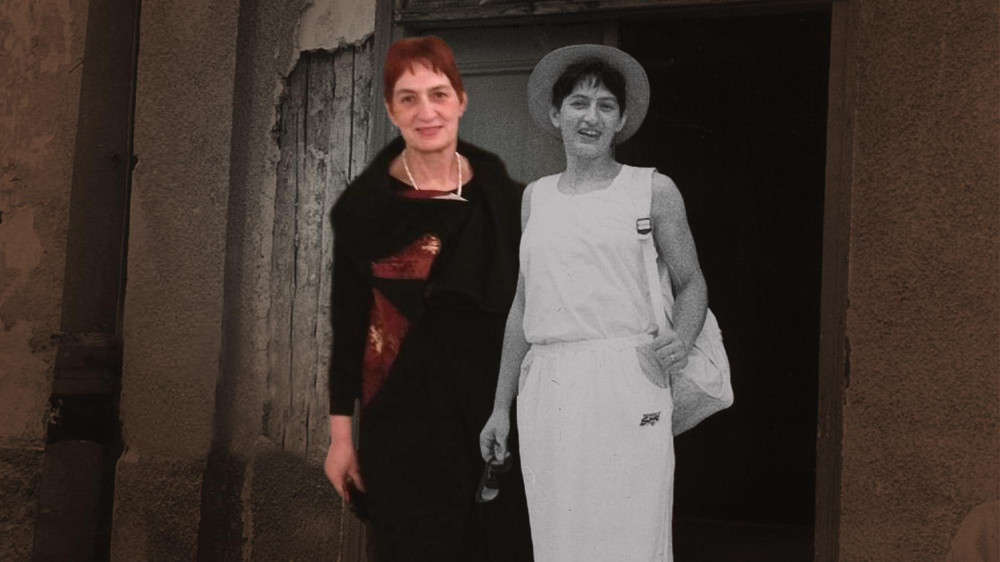
Šemsa Mehmedović - Sada (personal archives) i nekada (© FAMA Collection - Visual Archives 1992-1996)
During the siege of Sarajevo, citizens found ways to keep warm, to bring home water in canisters or in baby carriages in the simplest and safest way possible, to prepare meals from the scarce resources they had, or to make candles and improvised lamps to illuminate the living space. Over time, a whole collection of recipes and tips for survival was created, which were collected and exchanged. Šemsa Mehmedović talks about inventiveness during the siege.
"Sometimes we would get a can of 'ICAR' that we didn't know whether it was wise to eat or not, because the taste was bad, and probably the quality too. One of the favourite dishes (a wartime recipe) was rice pie. Rice is mixed with a little yeast and water and left to ferment, so it tastes like cheese, and from that, 'sirnica' pie was made. From boiled beans and any spices we could find, we made an excellent pâté. It was both delicious and nutritious. We made soup from the lentil and rice, a lentil pie, and somehow I managed to make the same meal look a little different every time. And I think those ideas for a 'diverse' diet were also a form of resistance."
The FAMA collection, more precisely the Oral History 1992-1996, contains, among other things, your video statement about how the citizens of Sarajevo kept warm during the siege, more specifically how you and your family came up with innovative ways to heat the house during the icy Sarajevo winters. Can you remember those moments when it was necessary to find firewood in impossible conditions during the siege of Sarajevo? How did you handle it?
Šemsa Mehmedović: In the absence of “real” wood, we had to think up/identify objects that could burn, to heat our house, to make lunch. It was incredible how many possibilities there were: plastic and rubber objects, pieces of clothing and shoes, pieces of carpet, books that we could part with. The books were the last thing on the list and with a heavy heart, but with the conviction that, when the war ended, books would be bought again. In order to provide firewood, and the aforementioned items for burning had already run out, the only thing left was to saw the trunk of an ash tree that grew in our garden. My husband was in the Bosnian Army, and I was alone with my five-year-old son. My feeling at that time, and throughout the war, was that I wanted to do, could do, and knew everything that needed to be done. I found an old saw in the shed, sawed and split my first tree that, with rational consumption, provided us with warmth for days.
Today, the house is full of books again! And new ones are constantly arriving, being bought.
How would you, from today's perspective, explain the resourcefulness of the citizens of Sarajevo during the four-year siege?
Šemsa Mehmedović: The aggression against our country was terrible. It was not only an attack on lives and property, but also an attack on our human dignity. To surround, kill, demolish everything, completely destroy the spirit of a people - that was the goal of the aggressor. The citizens of Sarajevo stayed and survived, offering resistance in all possible forms and levels. Everyone did what they knew and could. Resistance was primarily reflected in the strength of the spirit, and resourcefulness and ideas for survival are the result of precisely this truly indomitable strength. It was important to me that we all always be neat and clean, that the house sparkles, and all with a minimum of water that I had to bring myself. It was important to me that my son had a sense of security, the warmth of the home atmosphere, that we talked a lot and that we figured out together how to keep warm, what to eat, and all without panic and stress but always through socializing and playing. It was a recipe for staying sane.
In addition to firewood, the citizens of Sarajevo were constantly looking for food and new recipes. The challenge was how to make an edible meal out of nothing. Do you remember any recipes? How did you use basic humanitarian aid? What was in the humanitarian packages and do you remember what the meals prepared from the ingredients in the packages looked like?
Šemsa Mehmedović: Humanitarian aid was indeed an important basis for survival. We had, albeit in quite limited quantities - flour, oil, rice, beans, lentils. And to make the food tasty, everything was missing: spices, sugar, vegetables, not to mention eggs and meat. Sometimes we would get a can of "ICAR" that we didn't know whether it was wise to eat or not, because the taste was bad, and probably the quality too. One of the favourite dishes (a wartime recipe) was rice pie. Rice is mixed with a little yeast and water and left to ferment, so it tastes like cheese, and from that, "sirnica" pie was made. From boiled beans and any spices we could find, we made an excellent pâté. It was both delicious and nutritious. We made soup from the lentil and rice, a lentil pie, and somehow I managed to make the same meal look a little different every time. And I think those ideas for a "diverse" diet were also a form of resistance.
Considering that we found your video in our archive under the "Survival Tips" section, can you give us a comment on your video statement regarding keeping a diary during the siege? What did the act of writing down your thoughts and fears during the siege mean for your mental health and survival?
Šemsa Mehmedović: Part of my daily wartime ritual was writing. I recorded everything: events, thoughts, and of course the hope that one day this war would end and that we would see it through alive and well. Fear was a luxury I could not allow myself. When Dayton was signed, when my husband was demobilized from the Army of Bosnia and Herzegovina, our daughter was born. My son got the sister he had long wanted. We had nothing, not even a crib for the baby, she slept on the table in a borrowed carrier at first. But we were alive, healthy, and with that little baby a new life began. In peace. That's when I decided to destroy my war diary and I didn't regret it. Everything that was important to preserve was there!
In the FAMA collection we also have a photo of you from the time of the siege. You are standing at the entrance of the house, smiling, in white clothes. The photo radiates incredible optimism. Can you remember the moment when this photo was taken? How did you move around the city at that time, knowing that there was a risk of injury and death? How do you explain your great strength and indomitable spirit?
Šemsa Mehmedović: That day, armed with optimism, with the desire to get some food, I set off for the Markale market. In my backpack I carried some items that I intended to exchange for food. Everything was there: a toiletry bag, decorative hairpins, some jewellery (costume jewellery), some personal clothing that I did not need. I managed to exchange everything for some powdered milk and sugar. It was a magical feeling to take those groceries home. Happy that my child would eat something delicious and high-quality, I really did not even think about fear.
What was your day like during the siege?
Šemsa Mehmedović: You would get up early. The first thing you did was fetch water. I would fetch water from the city brewery. Washing dishes, bathing, doing laundry – everything required water. The broom replaced the vacuum cleaner, and there was also a device called an aspirator for manual vacuuming. Dusting and polishing furniture seemed to be of vital importance. It was actually a therapy called work – doing something useful from morning to night. I was absorbed in my work and had no time to feel bad. Then I would play with my son and do housework, and also, inventing games and stories that we still remember today. We would spend hours fantasizing about hiking and what to take in a backpack when going to the mountains. I would make candles from the remains of used candles. While doing housework, I would often sing as loud as I could. I had a collection of the magazine "Politikin zabavnik" and read to my son every day, but a little at a time so that it would last as long as possible. My favourite moments were when my husband could spend the night at home. We would make tea from something or coffee if we had it. And the three of us would talk long into the night, each of us anxiously waiting to part ways again.
More on this topic in our Macro Story.