

| 1. | PROLOGUE |
| 2. | MAPPED AND LEARNED |
| 3. | DAYTON@30 IN NUMBERS |
| 3.1. | Political Corruption |
| 3.2. | Judicial Corruption |
| 3.3. | Political Rights |
| 3.4. | Electoral Democracy |
| 3.5. | Political Polarization |
| 3.6. | Women's Political Empowerment |
| 3.7. | Civil Liberties |
| 3.8. | Human Rights |
| 3.9. | Media Freedom |
| 3.10. | Freedom of Expression |
| 3.11. | Engaged Society |
| 3.12. | Female Labor Force Participation |
| 3.13. | Unemployment Rate |
| 3.14. | Share of Industry Jobs |
| 3.15. | GDP from Manufacturing |
| 3.16. | GDP from Agriculture |
| 3.17. | GDP from Trade |
| 3.18. | GDP per Capita |
| 3.19. | Money Sent Back by Migrants |
| 3.20. | Foreign Aid Received |
| 3.21. | Number of Emigrants |
| 3.22. | Population Born Abroad |
| 3.23. | Old-Age Dependency Ratio |
| 3.24. | Median Age |
| 3.25. | Vaccination Coverage |
| 3.26. | Primary Energy Consumption |
| 3.27. | Annual CO₂ Emissions |
| 3.28. | Greenhouse Gas Emissions |
| 3.29. | Mobile Phone Usage |
| 3.30. | Internet Usage |
| 4. | DAYTON@30 IN PERCEPTIONS |
| 5. | REFERENCES |
The Art of Negotiations #1 HOW TO END A WAR |
The Art of Negotiations #2 LESSONS LEARNED |
| 1. | PROLOGUE |
| 2. | MAPPED AND LEARNED |
| 3. | DAYTON@30 IN NUMBERS |
| 3.1. | Political Corruption |
| 3.2. | Judicial Corruption |
| 3.3. | Political Rights |
| 3.4. | Electoral Democracy |
| 3.5. | Political Polarization |
| 3.6. | Women's Political Empowerment |
| 3.7. | Civil Liberties |
| 3.8. | Human Rights |
| 3.9. | Media Freedom |
| 3.10. | Freedom of Expression |
| 3.11. | Engaged Society |
| 3.12. | Female Labor Force Participation |
| 3.13. | Unemployment Rate |
| 3.14. | Share of Industry Jobs |
| 3.15. | GDP from Manufacturing |
| 3.16. | GDP from Agriculture |
| 3.17. | GDP from Trade |
| 3.18. | GDP per Capita |
| 3.19. | Money Sent Back by Migrants |
| 3.20. | Foreign Aid Received |
| 3.21. | Number of Emigrants |
| 3.22. | Population Born Abroad |
| 3.23. | Old-Age Dependency Ratio |
| 3.24. | Median Age |
| 3.25. | Vaccination Coverage |
| 3.26. | Primary Energy Consumption |
| 3.27. | Annual CO₂ Emissions |
| 3.28. | Greenhouse Gas Emissions |
| 3.29. | Mobile Phone Usage |
| 3.30. | Internet Usage |
| 4. | DAYTON@30 IN PERCEPTIONS |
| 5. | REFERENCES |
The Art of Negotiations #1 HOW TO END A WAR |
The Art of Negotiations #2 LESSONS LEARNED |

3.8.
Human Rights
The index captures the extent to which people are free from government violence and coercion, protected by property rights, and able to exercise freedoms of movement, religion, expression, and association.
Scale: 0 to 1 (higher = stronger human rights protections).

Direction of Change
HUMAN RIGHTS HAVE SIGNIFICANTLY IMPROVED BUT NOT CONSOLIDATED
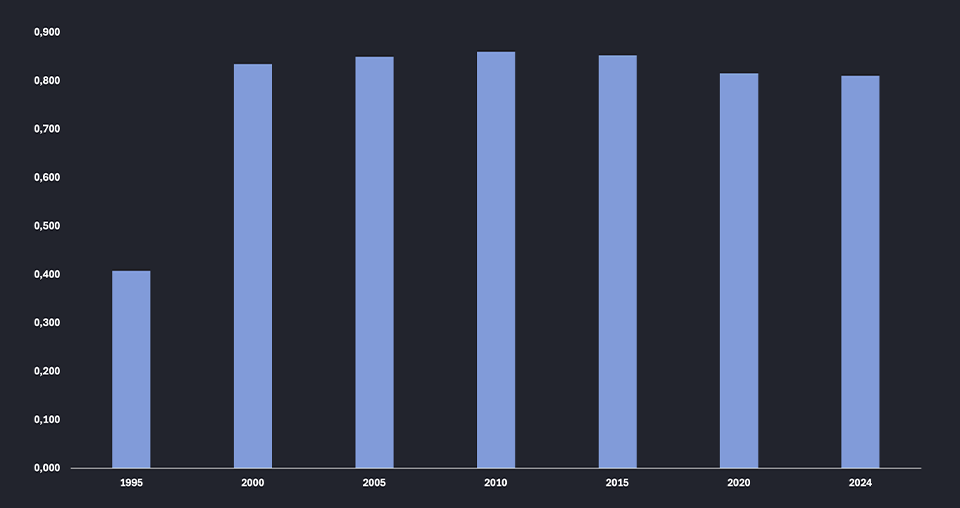
The index shows that human rights protections in Bosnia and Herzegovina improved significantly from the 1995 baseline but did not strengthen consistently or durably. The most dramatic rise occurs between 1995 and the early 2000s, when scores increase sharply and reach their highest levels. From the mid-2000s through the early 2010s, values remain relatively stable at this elevated range, marking the most favourable period in the series. After 2015, however, the index began to decline gradually, with noticeable dips in the early 2020s. Although the 2024 level remains well above the immediate post-war starting point, it is clearly below the peak achieved during the 2000s. Overall, the trajectory reflects substantial early gains followed by a long period of stagnation and mild deterioration rather than continuous improvement.
Global Rank
Compared with all geographic entities listed in the Index
| 1995 | 2024 | ||
| 0.408 | 0.811 | ||
| #137 out of 176 | #71 out of 179 |
| Europe | World | ||
| 1995 | 2024 | 1995 | 2024 |
| 0.865 | 0.758 | 0.581 | 0.538 |
Note: Population-weighted averages for Europe and the world.
Regional Rank
Compared with six former Yugoslav countries and Albania
| Country | 1995 | 2024 |
|
Albania Bosnia and Herzegovina Croatia Kosovo Montenegro North Macedonia Serbia Slovenia |
0,755 0,408 0,625 /// /// 0,730 0,542 0,939 |
0,876 0,811 0,899 0,811 0,896 0,803 0,770 0,899 |
Note: In 1995, Montenegro, Serbia, and Kosovo were part of the Federal Republic of Yugoslavia.
1995 (highest → lowest): Slovenia, Albania, North Macedonia, Croatia, Serbia, Bosnia and Herzegovina.
2024 (highest → lowest): Slovenia/Croatia, Montenegro, Albania, Bosnia and Herzegovina/Kosovo, North Macedonia, Serbia.
Conclusion
Human rights in Bosnia and Herzegovina rose sharply after the war, stabilised for more than a decade, and have since weakened slightly, leaving 2024 levels above the baseline but below the mid-2000s peak.
Source: V-Dem (2025) – processed by Our World in Data.