

| 1. | PROLOGUE |
| 2. | MAPPED AND LEARNED |
| 3. | DAYTON@30 IN NUMBERS |
| 3.1. | Political Corruption |
| 3.2. | Judicial Corruption |
| 3.3. | Political Rights |
| 3.4. | Electoral Democracy |
| 3.5. | Political Polarization |
| 3.6. | Women's Political Empowerment |
| 3.7. | Civil Liberties |
| 3.8. | Human Rights |
| 3.9. | Media Freedom |
| 3.10. | Freedom of Expression |
| 3.11. | Engaged Society |
| 3.12. | Female Labor Force Participation |
| 3.13. | Unemployment Rate |
| 3.14. | Share of Industry Jobs |
| 3.15. | GDP from Manufacturing |
| 3.16. | GDP from Agriculture |
| 3.17. | GDP from Trade |
| 3.18. | GDP per Capita |
| 3.19. | Money Sent Back by Migrants |
| 3.20. | Foreign Aid Received |
| 3.21. | Number of Emigrants |
| 3.22. | Population Born Abroad |
| 3.23. | Old-Age Dependency Ratio |
| 3.24. | Median Age |
| 3.25. | Vaccination Coverage |
| 3.26. | Primary Energy Consumption |
| 3.27. | Annual CO₂ Emissions |
| 3.28. | Greenhouse Gas Emissions |
| 3.29. | Mobile Phone Usage |
| 3.30. | Internet Usage |
| 4. | DAYTON@30 IN PERCEPTIONS |
| 5. | REFERENCES |
The Art of Negotiations #1 HOW TO END A WAR |
The Art of Negotiations #2 LESSONS LEARNED |
| 1. | PROLOGUE |
| 2. | MAPPED AND LEARNED |
| 3. | DAYTON@30 IN NUMBERS |
| 3.1. | Political Corruption |
| 3.2. | Judicial Corruption |
| 3.3. | Political Rights |
| 3.4. | Electoral Democracy |
| 3.5. | Political Polarization |
| 3.6. | Women's Political Empowerment |
| 3.7. | Civil Liberties |
| 3.8. | Human Rights |
| 3.9. | Media Freedom |
| 3.10. | Freedom of Expression |
| 3.11. | Engaged Society |
| 3.12. | Female Labor Force Participation |
| 3.13. | Unemployment Rate |
| 3.14. | Share of Industry Jobs |
| 3.15. | GDP from Manufacturing |
| 3.16. | GDP from Agriculture |
| 3.17. | GDP from Trade |
| 3.18. | GDP per Capita |
| 3.19. | Money Sent Back by Migrants |
| 3.20. | Foreign Aid Received |
| 3.21. | Number of Emigrants |
| 3.22. | Population Born Abroad |
| 3.23. | Old-Age Dependency Ratio |
| 3.24. | Median Age |
| 3.25. | Vaccination Coverage |
| 3.26. | Primary Energy Consumption |
| 3.27. | Annual CO₂ Emissions |
| 3.28. | Greenhouse Gas Emissions |
| 3.29. | Mobile Phone Usage |
| 3.30. | Internet Usage |
| 4. | DAYTON@30 IN PERCEPTIONS |
| 5. | REFERENCES |
The Art of Negotiations #1 HOW TO END A WAR |
The Art of Negotiations #2 LESSONS LEARNED |

3.4.
Electoral Democracy
Expert estimates of the extent to which political leaders are elected under comprehensive voting rights in free and fair elections, and freedoms of association and expression are guaranteed.
Scale: 0 to 1 (higher = more democratic).

Direction of Change
ELECTORAL DEMOCRACY ADVANCED EARLY, THEN GRADUALLY WEAKENED
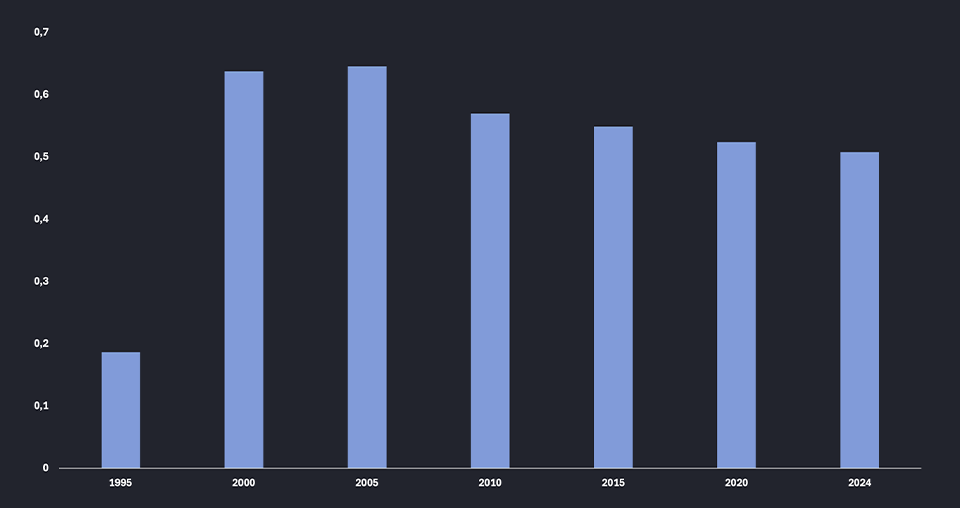
The index shows that Bosnia and Herzegovina experienced a sharp rise in electoral democracy in the late 1990s, followed by a long period of stagnation and gradual decline. From a very low baseline in 1995, the index increased rapidly by 2000, reaching its highest levels in the early 2000s. This period marks the peak of electoral institutional development, after which scores begin to level off and then slowly weaken. From around 2005 onward, values follow an incremental downward trajectory, with minor fluctuations but no return to earlier highs. The decline becomes more consistent after 2010, and by the early 2020s, the index settles at its lowest point since the early post-war years. By 2024, electoral democracy will remain significantly below its peak, indicating long-term decline rather than sustained improvement.
Global Rank
Compared with all geographic entities listed in the Index
| 1995 | 2024 | ||
| 0.187 | 0.508 | ||
| #139 out of 176 | #85 out of 179 |
| Europe | World | ||
| 1995 | 2024 | 1995 | 2024 |
| 0.727 | 0.649 | 0.464 | 0.390 |
Note: Population-weighted averages for Europe and the world.
Regional Rank
Compared with six former Yugoslav countries and Albania
| Country | 1995 | 2024 |
|
Albania Bosnia and Herzegovina Croatia Kosovo Montenegro North Macedonia Serbia Slovenia |
0,427 0,187 0,390 /// /// 0,451 0,293 0,848 |
0,507 0,508 0,723 0,651 0,615 0,563 0,315 0,716 |
Note: In 1995, Montenegro, Serbia, and Kosovo were part of the Federal Republic of Yugoslavia.
1995 (highest → lowest): Slovenia, North Macedonia, Albania, Croatia, Serbia, Bosnia and Herzegovina.
2024 (highest → lowest): Croatia, Slovenia, Kosovo, Montenegro, North Macedonia, Bosnia and Herzegovina, Albania, Serbia.
Conclusion
Electoral democracy in Bosnia and Herzegovina improved rapidly after 1995, reached its strongest point in the early 2000s, and then steadily weakened, with 2024 levels notably below those of the earlier period of progress.
Source: V-Dem (2025) – processed by Our World in Data.