

| 1. | PROLOGUE |
| 2. | MAPPED AND LEARNED |
| 3. | DAYTON@30 IN NUMBERS |
| 3.1. | Political Corruption |
| 3.2. | Judicial Corruption |
| 3.3. | Political Rights |
| 3.4. | Electoral Democracy |
| 3.5. | Political Polarization |
| 3.6. | Women's Political Empowerment |
| 3.7. | Civil Liberties |
| 3.8. | Human Rights |
| 3.9. | Media Freedom |
| 3.10. | Freedom of Expression |
| 3.11. | Engaged Society |
| 3.12. | Female Labor Force Participation |
| 3.13. | Unemployment Rate |
| 3.14. | Share of Industry Jobs |
| 3.15. | GDP from Manufacturing |
| 3.16. | GDP from Agriculture |
| 3.17. | GDP from Trade |
| 3.18. | GDP per Capita |
| 3.19. | Money Sent Back by Migrants |
| 3.20. | Foreign Aid Received |
| 3.21. | Number of Emigrants |
| 3.22. | Population Born Abroad |
| 3.23. | Old-Age Dependency Ratio |
| 3.24. | Median Age |
| 3.25. | Vaccination Coverage |
| 3.26. | Primary Energy Consumption |
| 3.27. | Annual CO₂ Emissions |
| 3.28. | Greenhouse Gas Emissions |
| 3.29. | Mobile Phone Usage |
| 3.30. | Internet Usage |
| 4. | DAYTON@30 IN PERCEPTIONS |
| 5. | REFERENCES |
The Art of Negotiations #1 HOW TO END A WAR |
The Art of Negotiations #2 LESSONS LEARNED |
| 1. | PROLOGUE |
| 2. | MAPPED AND LEARNED |
| 3. | DAYTON@30 IN NUMBERS |
| 3.1. | Political Corruption |
| 3.2. | Judicial Corruption |
| 3.3. | Political Rights |
| 3.4. | Electoral Democracy |
| 3.5. | Political Polarization |
| 3.6. | Women's Political Empowerment |
| 3.7. | Civil Liberties |
| 3.8. | Human Rights |
| 3.9. | Media Freedom |
| 3.10. | Freedom of Expression |
| 3.11. | Engaged Society |
| 3.12. | Female Labor Force Participation |
| 3.13. | Unemployment Rate |
| 3.14. | Share of Industry Jobs |
| 3.15. | GDP from Manufacturing |
| 3.16. | GDP from Agriculture |
| 3.17. | GDP from Trade |
| 3.18. | GDP per Capita |
| 3.19. | Money Sent Back by Migrants |
| 3.20. | Foreign Aid Received |
| 3.21. | Number of Emigrants |
| 3.22. | Population Born Abroad |
| 3.23. | Old-Age Dependency Ratio |
| 3.24. | Median Age |
| 3.25. | Vaccination Coverage |
| 3.26. | Primary Energy Consumption |
| 3.27. | Annual CO₂ Emissions |
| 3.28. | Greenhouse Gas Emissions |
| 3.29. | Mobile Phone Usage |
| 3.30. | Internet Usage |
| 4. | DAYTON@30 IN PERCEPTIONS |
| 5. | REFERENCES |
The Art of Negotiations #1 HOW TO END A WAR |
The Art of Negotiations #2 LESSONS LEARNED |

3.13.
Unemployment Rate
The unemployment rate measures the share of the labor force that is without a job but actively looking for work and available to start soon.
Scale: The indicator shows the share of the labor force without work.
Direction of Change
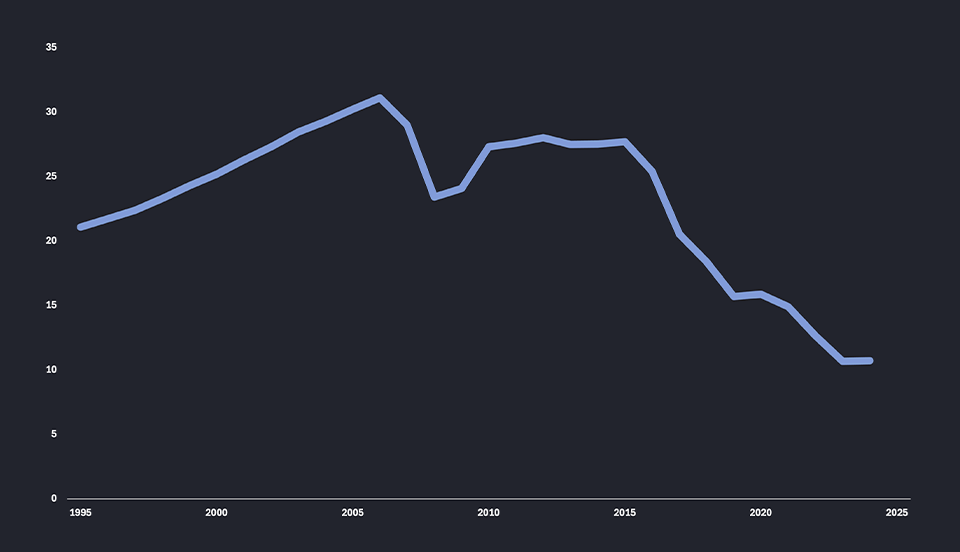
UNEMPLOYMENT HAS DECLINED SIGNIFICANTLY BUT REMAINS STRUCTURALLY HIGH
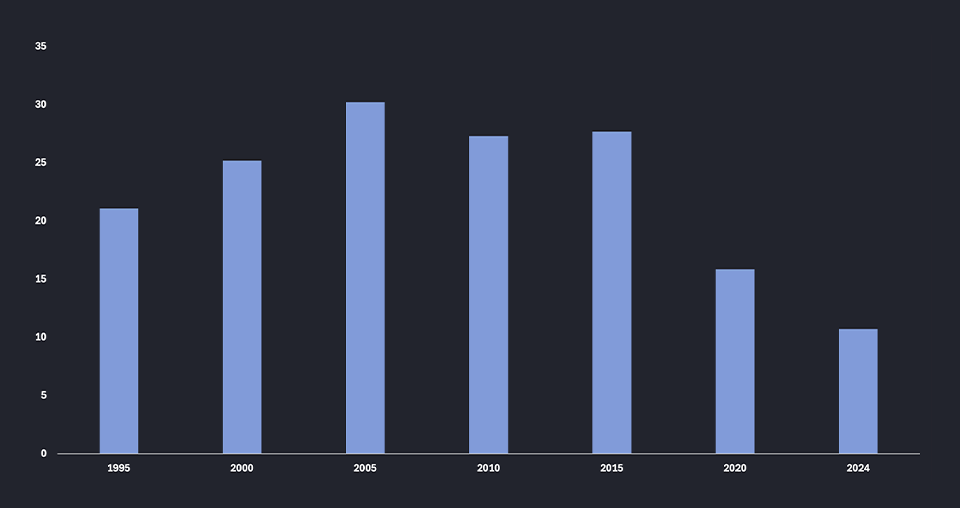
Unemployment in Bosnia and Herzegovina has followed a long arc of decline since the late 1990s but remains structurally high. Rates rose steadily from the mid-1990s into the early 2000s, peaking around 2005 before beginning a gradual downward shift. The trend becomes sharper after 2015, with unemployment decreasing in almost every subsequent year and reaching its lowest level in the final period of the dataset. Viewed across key Dayton anniversaries, the pattern shows slow improvement early on, followed by a more substantial reduction over the past decade. Taken together, the data indicate a meaningful long-term decline, yet unemployment levels today still reflect a labour market that has not fully stabilised since 1995.
Global Rank
Compared with all geographic entities listed in the Index
| 1995 | 2024 | ||
| 21.07 | 10.72 | ||
| #10 out of 188 | #33 out of 182 |
| Europe | World | ||
| 1995 | 2024 | 1995 | 2024 |
| 9.93 | 5.36 | 11.10 | 4.89 |
Note: Population-weighted averages for Europe and the world.
Regional Rank
Compared with six former Yugoslav countries and Albania
| Country | 1995 | 2024 |
|
Albania Bosnia and Herzegovina Croatia Kosovo Montenegro North Macedonia Serbia Slovenia |
14,60 21,07 10,10 /// 30,29 35,60 13,40 7,15 |
10,25 10,72 5,23 /// 14,10 13,41 7,39 3,35 |
Note: In 1995, Montenegro, Serbia, and Kosovo were part of the Federal Republic of Yugoslavia.
1995 (highest → lowest): North Macedonia, Montenegro, Bosnia and Herzegovina, Albania, Croatia, Serbia.
2024 (highest → lowest): Montenegro, North Macedonia, Bosnia and Herzegovina, Albania, Croatia, Slovenia
Conclusion
Despite clear improvement, Bosnia and Herzegovina still ends the period with one of the highest unemployment rates in the region, underscoring a labour market struggling to fully recover three decades after Dayton.
Source: ILO Modelled Estimates and Projections database (ILOEST) – ILOSTAT, via World Bank (2025) – processed by Our World in Data.