

| 1. | PROLOGUE |
| 2. | MAPPED AND LEARNED |
| 3. | DAYTON@30 IN NUMBERS |
| 3.1. | Political Corruption |
| 3.2. | Judicial Corruption |
| 3.3. | Political Rights |
| 3.4. | Electoral Democracy |
| 3.5. | Political Polarization |
| 3.6. | Women's Political Empowerment |
| 3.7. | Civil Liberties |
| 3.8. | Human Rights |
| 3.9. | Media Freedom |
| 3.10. | Freedom of Expression |
| 3.11. | Engaged Society |
| 3.12. | Female Labor Force Participation |
| 3.13. | Unemployment Rate |
| 3.14. | Share of Industry Jobs |
| 3.15. | GDP from Manufacturing |
| 3.16. | GDP from Agriculture |
| 3.17. | GDP from Trade |
| 3.18. | GDP per Capita |
| 3.19. | Money Sent Back by Migrants |
| 3.20. | Foreign Aid Received |
| 3.21. | Number of Emigrants |
| 3.22. | Population Born Abroad |
| 3.23. | Old-Age Dependency Ratio |
| 3.24. | Median Age |
| 3.25. | Vaccination Coverage |
| 3.26. | Primary Energy Consumption |
| 3.27. | Annual CO₂ Emissions |
| 3.28. | Greenhouse Gas Emissions |
| 3.29. | Mobile Phone Usage |
| 3.30. | Internet Usage |
| 4. | DAYTON@30 IN PERCEPTIONS |
| 5. | REFERENCES |
The Art of Negotiations #1 HOW TO END A WAR |
The Art of Negotiations #2 LESSONS LEARNED |
| 1. | PROLOGUE |
| 2. | MAPPED AND LEARNED |
| 3. | DAYTON@30 IN NUMBERS |
| 3.1. | Political Corruption |
| 3.2. | Judicial Corruption |
| 3.3. | Political Rights |
| 3.4. | Electoral Democracy |
| 3.5. | Political Polarization |
| 3.6. | Women's Political Empowerment |
| 3.7. | Civil Liberties |
| 3.8. | Human Rights |
| 3.9. | Media Freedom |
| 3.10. | Freedom of Expression |
| 3.11. | Engaged Society |
| 3.12. | Female Labor Force Participation |
| 3.13. | Unemployment Rate |
| 3.14. | Share of Industry Jobs |
| 3.15. | GDP from Manufacturing |
| 3.16. | GDP from Agriculture |
| 3.17. | GDP from Trade |
| 3.18. | GDP per Capita |
| 3.19. | Money Sent Back by Migrants |
| 3.20. | Foreign Aid Received |
| 3.21. | Number of Emigrants |
| 3.22. | Population Born Abroad |
| 3.23. | Old-Age Dependency Ratio |
| 3.24. | Median Age |
| 3.25. | Vaccination Coverage |
| 3.26. | Primary Energy Consumption |
| 3.27. | Annual CO₂ Emissions |
| 3.28. | Greenhouse Gas Emissions |
| 3.29. | Mobile Phone Usage |
| 3.30. | Internet Usage |
| 4. | DAYTON@30 IN PERCEPTIONS |
| 5. | REFERENCES |
The Art of Negotiations #1 HOW TO END A WAR |
The Art of Negotiations #2 LESSONS LEARNED |

3.21.
Number of Emigrants
Based on the data source – United Nations Population Division – an international migrant is someone who has been living for one year or longer in a country other than the one in which he or she was born. This means that many foreign workers and international students are counted as migrants. Additionally, the UN considers refugees and, in some cases, their descendants to be international migrants.
Scale: The number of people who were born in a country but now live in another country.
Direction of Change
EMIGRATION HAS MARKED THE COUNTRY’S TRAJECTORY
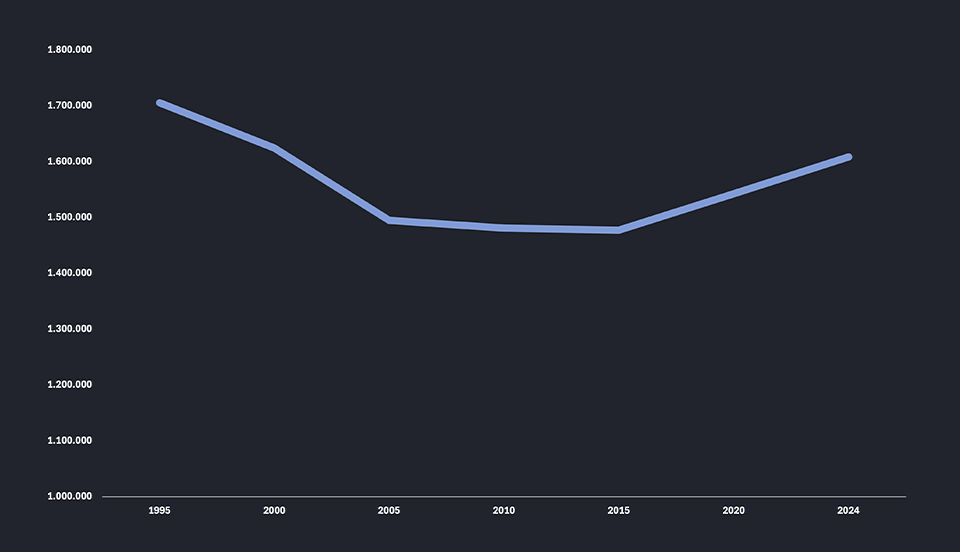
The number of people born in Bosnia and Herzegovina but living abroad shows a clear pattern of a country with a large diaspora. Since its 1995 peak, we have seen a gradual decline as some of the refugees have returned home. Those patterns plateaued around 2005 and have remained unchanged for a decade. However, after 2015, we see a persistent rise in emigration, with each subsequent year adding to the cumulative total. There are no significant declines across the period; rather, the data reflect continuous outward movement shaped by political uncertainty, economic factors, labour mobility, and long-term demographic pressures. If this rate of emigration continues, the country will surpass its 1995 peak.

Global Rank
Compared with all geographic entities listed in the Index
| 1995 | 2024 | ||
| 1,705,561 | 1,608,324 | ||
| #22 out of 238 | #51 out of 237 |
| Europe | World | ||
| 1995 | 2024 | 1995 | 2024 |
| 49,850,200 | 61,061,575 | 149,554,994 | 281,955,848 |
Note: Population-weighted averages for Europe and the world.
Regional Rank
Compared with six former Yugoslav countries and Albania
| Country | 1995 | 2024 |
|
Albania Bosnia and Herzegovina Croatia Kosovo Montenegro North Macedonia Serbia Slovenia |
394.084 1.705.561 1.056.934 /// 106.877 411.470 428.537 124.463 |
1.216.628 1.608.324 826.166 /// 90.678 534.616 963.307 78.808 |
Note: In 1995, Montenegro, Serbia, and Kosovo were part of the Federal Republic of Yugoslavia.
1995 (highest → lowest): Bosnia and Herzegovina, Croatia, Serbia, North Macedonia, Albania, Slovenia, Montenegro.
2024 (highest → lowest): >Bosnia and Herzegovina, Albania, Serbia, Croatia, North Macedonia, Montenegro, Slovenia.
Conclusion
Taken together, the data show that emigration from Bosnia and Herzegovina has not only persisted but accumulated over time, leaving the country with a steadily expanding diaspora and no indication of a structural reversal in the overall outward flow.
Source: United Nations Department of Economic and Social Affairs (2024).