

| 1. | PROLOGUE |
| 2. | MAPPED AND LEARNED |
| 3. | DAYTON@30 IN NUMBERS |
| 3.1. | Political Corruption |
| 3.2. | Judicial Corruption |
| 3.3. | Political Rights |
| 3.4. | Electoral Democracy |
| 3.5. | Political Polarization |
| 3.6. | Women's Political Empowerment |
| 3.7. | Civil Liberties |
| 3.8. | Human Rights |
| 3.9. | Media Freedom |
| 3.10. | Freedom of Expression |
| 3.11. | Engaged Society |
| 3.12. | Female Labor Force Participation |
| 3.13. | Unemployment Rate |
| 3.14. | Share of Industry Jobs |
| 3.15. | GDP from Manufacturing |
| 3.16. | GDP from Agriculture |
| 3.17. | GDP from Trade |
| 3.18. | GDP per Capita |
| 3.19. | Money Sent Back by Migrants |
| 3.20. | Foreign Aid Received |
| 3.21. | Number of Emigrants |
| 3.22. | Population Born Abroad |
| 3.23. | Old-Age Dependency Ratio |
| 3.24. | Median Age |
| 3.25. | Vaccination Coverage |
| 3.26. | Primary Energy Consumption |
| 3.27. | Annual CO₂ Emissions |
| 3.28. | Greenhouse Gas Emissions |
| 3.29. | Mobile Phone Usage |
| 3.30. | Internet Usage |
| 4. | DAYTON@30 IN PERCEPTIONS |
| 5. | REFERENCES |
The Art of Negotiations #1 HOW TO END A WAR |
The Art of Negotiations #2 LESSONS LEARNED |
| 1. | PROLOGUE |
| 2. | MAPPED AND LEARNED |
| 3. | DAYTON@30 IN NUMBERS |
| 3.1. | Political Corruption |
| 3.2. | Judicial Corruption |
| 3.3. | Political Rights |
| 3.4. | Electoral Democracy |
| 3.5. | Political Polarization |
| 3.6. | Women's Political Empowerment |
| 3.7. | Civil Liberties |
| 3.8. | Human Rights |
| 3.9. | Media Freedom |
| 3.10. | Freedom of Expression |
| 3.11. | Engaged Society |
| 3.12. | Female Labor Force Participation |
| 3.13. | Unemployment Rate |
| 3.14. | Share of Industry Jobs |
| 3.15. | GDP from Manufacturing |
| 3.16. | GDP from Agriculture |
| 3.17. | GDP from Trade |
| 3.18. | GDP per Capita |
| 3.19. | Money Sent Back by Migrants |
| 3.20. | Foreign Aid Received |
| 3.21. | Number of Emigrants |
| 3.22. | Population Born Abroad |
| 3.23. | Old-Age Dependency Ratio |
| 3.24. | Median Age |
| 3.25. | Vaccination Coverage |
| 3.26. | Primary Energy Consumption |
| 3.27. | Annual CO₂ Emissions |
| 3.28. | Greenhouse Gas Emissions |
| 3.29. | Mobile Phone Usage |
| 3.30. | Internet Usage |
| 4. | DAYTON@30 IN PERCEPTIONS |
| 5. | REFERENCES |
The Art of Negotiations #1 HOW TO END A WAR |
The Art of Negotiations #2 LESSONS LEARNED |

3.28.
Greenhouse Gas Emissions
Greenhouse gas emissions include carbon dioxide, methane and nitrous oxide from all sources, including land-use change. Measured as a percentage of the world's greenhouse gas emissions.
Scale: Measured in tonnes of carbon dioxide-equivalents over a 100-year timescale.

Direction of Change
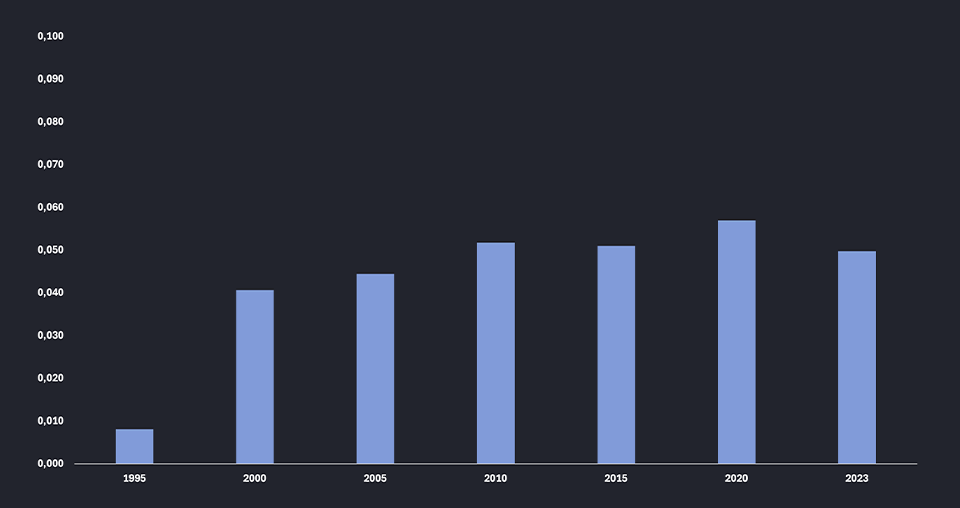
BIH’S SHARE OF GLOBAL EMISSIONS ROSE TO A MID-2000S PEAK, THEN GRADUALLY DECLINED
Bosnia and Herzegovina’s share of global greenhouse gas emissions increased steadily from 1995 into the early 2000s, moving from a very low baseline to a more visible contribution during the mid-2000s. This early rise reflects post-war economic recovery, rising energy use, and a gradual return of industrial activity. After reaching a peak around the late 2000s to early 2010s, the trend stabilised before entering a slow, uneven decline. From the 2015 peak, Bosnia and Herzegovina’s global emissions share has gradually decreased, reflecting both modest domestic efficiency improvements and the fact that global emissions grew faster elsewhere. By the early 2020s, the country’s share fell back toward earlier levels, signalling a long-term pattern of early growth followed by gradual reduction rather than continued expansion.
Global Rank
Compared with all geographic entities listed in the Index
| 1995 | 2023 | ||
| 0.008 | 0.050 | ||
| #164 out of 199 | #122 out of 197 |
| Europe | World | ||
| 1995 | 2023 | 1995 | 2023 |
| 8.551 | 6.378 | 100 | 100 |
Note: Population-weighted averages for Europe and the world.
Regional Rank
Compared with six former Yugoslav countries and Albania
| Country | 1995 | 2023 |
|
Albania Bosnia and Herzegovina Croatia Kosovo Montenegro North Macedonia Serbia Slovenia |
0,017 0,008 0,054 /// 0,004 0,035 0,127 0,047 |
0,014 0,050 0,039 /// 0,002 0,016 0,085 0,030 |
Note: In 1995, Montenegro, Serbia, and Kosovo were part of the Federal Republic of Yugoslavia.
1995 (highest → lowest): Serbia, Croatia, Slovenia, North Macedonia, Albania, Bosnia and Herzegovina, Montenegro.
2023 (highest → lowest): Serbia, Bosnia and Herzegovina, Croatia, Slovenia, North Macedonia, Albania, Montenegro
Conclusion
Overall, Bosnia and Herzegovina’s global emissions footprint peaked early and has since diminished, leaving the country a small but steadily shrinking contributor to global greenhouse gas emissions.
Source: Jones et al. (2024) – with major processing by Our World in Data.