

| 1. | PROLOGUE |
| 2. | MAPPED AND LEARNED |
| 3. | DAYTON@30 IN NUMBERS |
| 3.1. | Political Corruption |
| 3.2. | Judicial Corruption |
| 3.3. | Political Rights |
| 3.4. | Electoral Democracy |
| 3.5. | Political Polarization |
| 3.6. | Women's Political Empowerment |
| 3.7. | Civil Liberties |
| 3.8. | Human Rights |
| 3.9. | Media Freedom |
| 3.10. | Freedom of Expression |
| 3.11. | Engaged Society |
| 3.12. | Female Labor Force Participation |
| 3.13. | Unemployment Rate |
| 3.14. | Share of Industry Jobs |
| 3.15. | GDP from Manufacturing |
| 3.16. | GDP from Agriculture |
| 3.17. | GDP from Trade |
| 3.18. | GDP per Capita |
| 3.19. | Money Sent Back by Migrants |
| 3.20. | Foreign Aid Received |
| 3.21. | Number of Emigrants |
| 3.22. | Population Born Abroad |
| 3.23. | Old-Age Dependency Ratio |
| 3.24. | Median Age |
| 3.25. | Vaccination Coverage |
| 3.26. | Primary Energy Consumption |
| 3.27. | Annual CO₂ Emissions |
| 3.28. | Greenhouse Gas Emissions |
| 3.29. | Mobile Phone Usage |
| 3.30. | Internet Usage |
| 4. | DAYTON@30 IN PERCEPTIONS |
| 5. | REFERENCES |
The Art of Negotiations #1 HOW TO END A WAR |
The Art of Negotiations #2 LESSONS LEARNED |
| 1. | PROLOGUE |
| 2. | MAPPED AND LEARNED |
| 3. | DAYTON@30 IN NUMBERS |
| 3.1. | Political Corruption |
| 3.2. | Judicial Corruption |
| 3.3. | Political Rights |
| 3.4. | Electoral Democracy |
| 3.5. | Political Polarization |
| 3.6. | Women's Political Empowerment |
| 3.7. | Civil Liberties |
| 3.8. | Human Rights |
| 3.9. | Media Freedom |
| 3.10. | Freedom of Expression |
| 3.11. | Engaged Society |
| 3.12. | Female Labor Force Participation |
| 3.13. | Unemployment Rate |
| 3.14. | Share of Industry Jobs |
| 3.15. | GDP from Manufacturing |
| 3.16. | GDP from Agriculture |
| 3.17. | GDP from Trade |
| 3.18. | GDP per Capita |
| 3.19. | Money Sent Back by Migrants |
| 3.20. | Foreign Aid Received |
| 3.21. | Number of Emigrants |
| 3.22. | Population Born Abroad |
| 3.23. | Old-Age Dependency Ratio |
| 3.24. | Median Age |
| 3.25. | Vaccination Coverage |
| 3.26. | Primary Energy Consumption |
| 3.27. | Annual CO₂ Emissions |
| 3.28. | Greenhouse Gas Emissions |
| 3.29. | Mobile Phone Usage |
| 3.30. | Internet Usage |
| 4. | DAYTON@30 IN PERCEPTIONS |
| 5. | REFERENCES |
The Art of Negotiations #1 HOW TO END A WAR |
The Art of Negotiations #2 LESSONS LEARNED |

3.10.
Freedom of Expression
Central estimate of the extent to which people can discuss political matters at home and in the public sphere, the press, and media are free and can present different political perspectives, and the freedom of academic and cultural expression.
Scale: 0 to 1 (higher values = more freedom).
Direction of Change
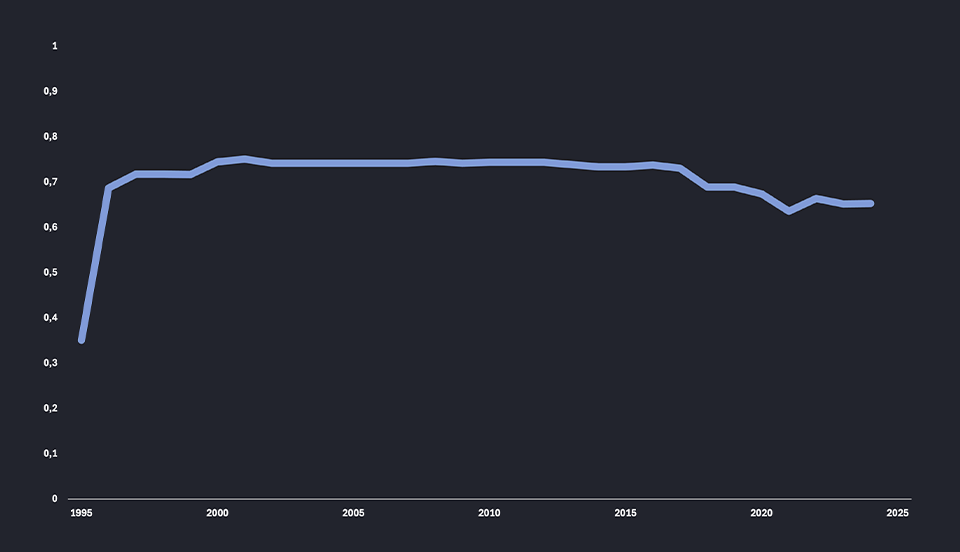
FREEDOM OF EXPRESSION IMPROVED EARLY, MAINTAINED TRAJECTORY BEFORE EXPERIENCING A GRADUAL DECLINE
The index shows that freedom of expression in Bosnia and Herzegovina rose sharply between 1995 and the early 2000s. Starting from a low level in 1995, values increased rapidly through the late 1990s and stabilised at their highest point from roughly 2000 to the late 2000s. This period represents the strongest and most durable phase of expressive freedoms. For almost fifteen years, the trend maintained a nearly unchanged path. Although the index remains above the levels recorded in the immediate post-war years, it no longer reaches the early-2000s peak. By 2024, freedom of expression sits clearly below its strongest period, indicating early gains followed by long-term softening rather than sustained consolidation.

Global Rank
Compared with all geographic entities listed in the Index
| 1995 | 2024 | ||
| 0.351 | 0.653 | ||
| #136 out of 176 | #104 out of 178 |
| Europe | World | ||
| 1995 | 2024 | 1995 | 2024 |
| 0.884 | 0.693 | 0.614 | 0.488 |
Note: Population-weighted averages for Europe and the world.
Regional Rank
Compared with six former Yugoslav countries and Albania
| Country | 1995 | 2024 |
|
Albania Bosnia and Herzegovina Croatia Kosovo Montenegro North Macedonia Serbia Slovenia |
0,766 0,351 0,496 /// /// 0,657 0,345 0,941 |
0,698 0,653 0,786 0,767 0,808 0,662 0,425 0,735 |
Note: In 1995, Montenegro, Serbia, and Kosovo were part of the Federal Republic of Yugoslavia.
1995 (highest → lowest): Slovenia, Albania, North Macedonia, Croatia, Bosnia and Herzegovina, Serbia.
2024 (highest → lowest): Montenegro, Croatia, Kosovo, Slovenia, Albania, North Macedonia, Bosnia and Herzegovina, Serbia.
Conclusion
Freedom of expression in Bosnia and Herzegovina improved strongly after 1995 but later weakened, leaving 2024 levels higher than the start year yet noticeably below the peak reached in the early 2000s.
Source: V-Dem (2025) – processed by Our World in Data.