

| 1. | PROLOGUE |
| 2. | MAPPED AND LEARNED |
| 3. | DAYTON@30 IN NUMBERS |
| 3.1. | Political Corruption |
| 3.2. | Judicial Corruption |
| 3.3. | Political Rights |
| 3.4. | Electoral Democracy |
| 3.5. | Political Polarization |
| 3.6. | Women's Political Empowerment |
| 3.7. | Civil Liberties |
| 3.8. | Human Rights |
| 3.9. | Media Freedom |
| 3.10. | Freedom of Expression |
| 3.11. | Engaged Society |
| 3.12. | Female Labor Force Participation |
| 3.13. | Unemployment Rate |
| 3.14. | Share of Industry Jobs |
| 3.15. | GDP from Manufacturing |
| 3.16. | GDP from Agriculture |
| 3.17. | GDP from Trade |
| 3.18. | GDP per Capita |
| 3.19. | Money Sent Back by Migrants |
| 3.20. | Foreign Aid Received |
| 3.21. | Number of Emigrants |
| 3.22. | Population Born Abroad |
| 3.23. | Old-Age Dependency Ratio |
| 3.24. | Median Age |
| 3.25. | Vaccination Coverage |
| 3.26. | Primary Energy Consumption |
| 3.27. | Annual CO₂ Emissions |
| 3.28. | Greenhouse Gas Emissions |
| 3.29. | Mobile Phone Usage |
| 3.30. | Internet Usage |
| 4. | DAYTON@30 IN PERCEPTIONS |
| 5. | REFERENCES |
The Art of Negotiations #1 HOW TO END A WAR |
The Art of Negotiations #2 LESSONS LEARNED |
| 1. | PROLOGUE |
| 2. | MAPPED AND LEARNED |
| 3. | DAYTON@30 IN NUMBERS |
| 3.1. | Political Corruption |
| 3.2. | Judicial Corruption |
| 3.3. | Political Rights |
| 3.4. | Electoral Democracy |
| 3.5. | Political Polarization |
| 3.6. | Women's Political Empowerment |
| 3.7. | Civil Liberties |
| 3.8. | Human Rights |
| 3.9. | Media Freedom |
| 3.10. | Freedom of Expression |
| 3.11. | Engaged Society |
| 3.12. | Female Labor Force Participation |
| 3.13. | Unemployment Rate |
| 3.14. | Share of Industry Jobs |
| 3.15. | GDP from Manufacturing |
| 3.16. | GDP from Agriculture |
| 3.17. | GDP from Trade |
| 3.18. | GDP per Capita |
| 3.19. | Money Sent Back by Migrants |
| 3.20. | Foreign Aid Received |
| 3.21. | Number of Emigrants |
| 3.22. | Population Born Abroad |
| 3.23. | Old-Age Dependency Ratio |
| 3.24. | Median Age |
| 3.25. | Vaccination Coverage |
| 3.26. | Primary Energy Consumption |
| 3.27. | Annual CO₂ Emissions |
| 3.28. | Greenhouse Gas Emissions |
| 3.29. | Mobile Phone Usage |
| 3.30. | Internet Usage |
| 4. | DAYTON@30 IN PERCEPTIONS |
| 5. | REFERENCES |
The Art of Negotiations #1 HOW TO END A WAR |
The Art of Negotiations #2 LESSONS LEARNED |

3.25.
Vaccination Coverage
This index tracks the proportion of 1-year-old children who received their first dose of the measles vaccine each year, reflecting trends in early childhood immunisation coverage.
Scale: Share of one-year-olds who have been immunized against a disease.
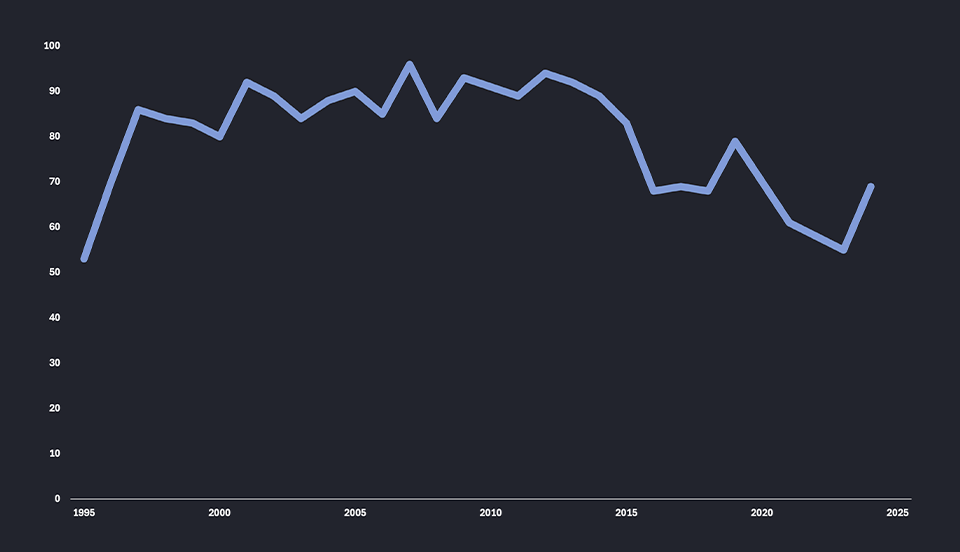
Direction of Change
VACCINATION COVERAGE HAS BEEN HIGH BUT INCREASINGLY IN THE PAST DECADE
Vaccination coverage for the first dose of the measles vaccine in Bosnia and Herzegovina shows a pattern of strong early growth as the country emerges from the war, followed by two decades of marked fluctuation. After relatively modest coverage in the mid-1990s, rates rose sharply by the early 2000s, reaching some of the highest levels recorded in the dataset. Throughout the mid-2000s and early 2010s, coverage remained generally high, yet irregular, with repeated dips interrupting periods of stability. From the mid-2010s onwards, the trend softened further, showing a gradual decline punctuated by sharp year-to-year variations. But in 2016, we noted a dramatic dip that has since disrupted vaccination uptake, especially since the COVID-19 pandemic. Partial recovery in 2024 sends out signals that are difficult to decode, as updated records may show a different trajectory.
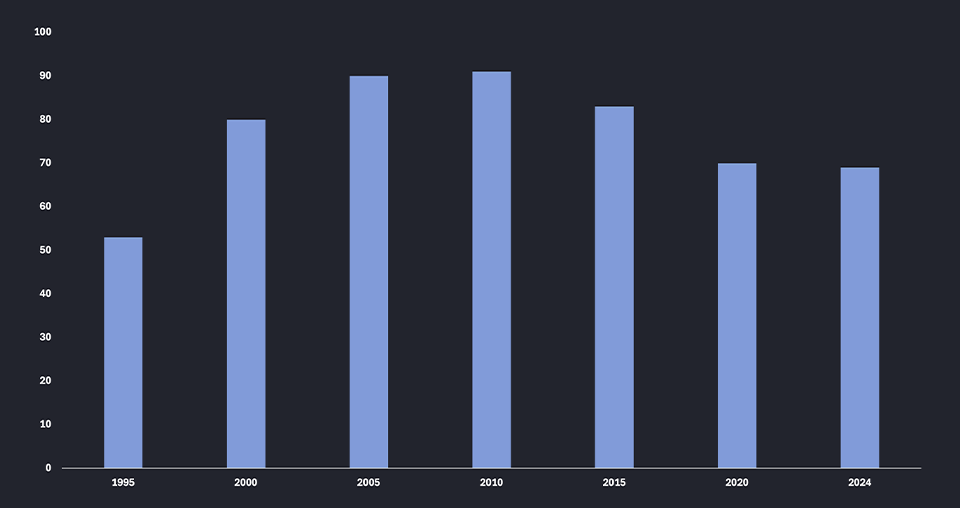
Global Rank
Compared with all geographic entities listed in the Index
| 1995 | 2024 | ||
| 53 | 69 | ||
| #161 out of 188 | #172 out of 194 |
| Europe | World | ||
| 1995 | 2024 | 1995 | 2024 |
| 86 | 94 | 73 | 84 |
Note: Population-weighted averages for Europe and the world.
Regional Rank
Compared with six former Yugoslav countries and Albania
| Country | 1995 | 2024 |
|
Albania Bosnia and Herzegovina Croatia Kosovo Montenegro North Macedonia Serbia Slovenia |
91 53 92 /// /// 97 86 93 |
81 69 90 /// 23 73 84 95 |
Note: In 1995, Montenegro, Serbia, and Kosovo were part of the Federal Republic of Yugoslavia.
1995 (highest → lowest): North Macedonia, Slovenia, Croatia, Albania, Serbia, Bosnia and Herzegovina.
2024 (highest → lowest): Slovenia, Croatia, Serbia, Albania, North Macedonia, Bosnia and Herzegovina, Montenegro.
Conclusion
Overall, vaccination patterns demonstrate that, despite historically strong coverage, long-term consistency has weakened, leaving Bosnia and Herzegovina more exposed to periodic declines in immunisation resilience.
Source: WHO & UNICEF (2025); UN, World Population Prospects (2024).