

| 1. | PROLOGUE |
| 2. | MAPPED AND LEARNED |
| 3. | DAYTON@30 IN NUMBERS |
| 3.1. | Political Corruption |
| 3.2. | Judicial Corruption |
| 3.3. | Political Rights |
| 3.4. | Electoral Democracy |
| 3.5. | Political Polarization |
| 3.6. | Women's Political Empowerment |
| 3.7. | Civil Liberties |
| 3.8. | Human Rights |
| 3.9. | Media Freedom |
| 3.10. | Freedom of Expression |
| 3.11. | Engaged Society |
| 3.12. | Female Labor Force Participation |
| 3.13. | Unemployment Rate |
| 3.14. | Share of Industry Jobs |
| 3.15. | GDP from Manufacturing |
| 3.16. | GDP from Agriculture |
| 3.17. | GDP from Trade |
| 3.18. | GDP per Capita |
| 3.19. | Money Sent Back by Migrants |
| 3.20. | Foreign Aid Received |
| 3.21. | Number of Emigrants |
| 3.22. | Population Born Abroad |
| 3.23. | Old-Age Dependency Ratio |
| 3.24. | Median Age |
| 3.25. | Vaccination Coverage |
| 3.26. | Primary Energy Consumption |
| 3.27. | Annual CO₂ Emissions |
| 3.28. | Greenhouse Gas Emissions |
| 3.29. | Mobile Phone Usage |
| 3.30. | Internet Usage |
| 4. | DAYTON@30 IN PERCEPTIONS |
| 5. | REFERENCES |
The Art of Negotiations #1 HOW TO END A WAR |
The Art of Negotiations #2 LESSONS LEARNED |
| 1. | PROLOGUE |
| 2. | MAPPED AND LEARNED |
| 3. | DAYTON@30 IN NUMBERS |
| 3.1. | Political Corruption |
| 3.2. | Judicial Corruption |
| 3.3. | Political Rights |
| 3.4. | Electoral Democracy |
| 3.5. | Political Polarization |
| 3.6. | Women's Political Empowerment |
| 3.7. | Civil Liberties |
| 3.8. | Human Rights |
| 3.9. | Media Freedom |
| 3.10. | Freedom of Expression |
| 3.11. | Engaged Society |
| 3.12. | Female Labor Force Participation |
| 3.13. | Unemployment Rate |
| 3.14. | Share of Industry Jobs |
| 3.15. | GDP from Manufacturing |
| 3.16. | GDP from Agriculture |
| 3.17. | GDP from Trade |
| 3.18. | GDP per Capita |
| 3.19. | Money Sent Back by Migrants |
| 3.20. | Foreign Aid Received |
| 3.21. | Number of Emigrants |
| 3.22. | Population Born Abroad |
| 3.23. | Old-Age Dependency Ratio |
| 3.24. | Median Age |
| 3.25. | Vaccination Coverage |
| 3.26. | Primary Energy Consumption |
| 3.27. | Annual CO₂ Emissions |
| 3.28. | Greenhouse Gas Emissions |
| 3.29. | Mobile Phone Usage |
| 3.30. | Internet Usage |
| 4. | DAYTON@30 IN PERCEPTIONS |
| 5. | REFERENCES |
The Art of Negotiations #1 HOW TO END A WAR |
The Art of Negotiations #2 LESSONS LEARNED |

3.14.
Share of Industry Jobs
The industry sector includes mining and quarrying, manufacturing, electricity, gas, steam and air conditioning supply, water supply, and construction activities, as defined by the International Standard Industrial Classification of All Economic Activities (ISIC) (categories B to F in ISIC revision 4).
Scale: Share of total employment working in the industry sector.

Direction of Change
INDUSTRIAL EMPLOYMENT HAS DECLINED SHARPLY OVER TIME
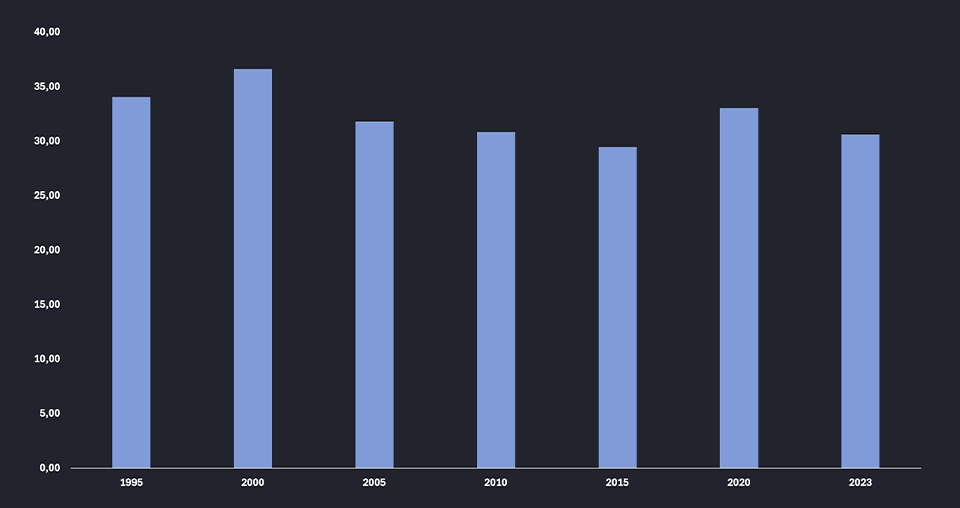
Industrial employment in Bosnia and Herzegovina has shown a clear long-term decline since the mid-1990s. After starting at a relatively high level in 1995, the share of total employment in industry gradually increased into the early 2000s, reaching its highest point. From the late 2000s onward, however, the trend reverses: the share begins a steady decline, briefly stabilising in the mid-2010s before entering two decades of fluctuating results. This downward trend persists through the most recent year, reflecting the gradual weakening of Bosnia and Herzegovina’s industrial base. Overall, the long-term direction points to a structural move away from industrial employment.
Global Rank
Compared with all geographic entities listed in the Index
| 1995 | 2023 | ||
| 34.07 | 30.62 | ||
| #11 out of 187 | #139 out of 184 |
| Europe | World | ||
| 1995 | 2023 | 1995 | 2023 |
| 29.14 | 24.24 | 21.19 | 23.68 |
Note: Population-weighted averages for Europe and the world.
Regional Rank
Compared with six former Yugoslav countries and Albania
| Country | 1995 | 2023 |
|
Albania Bosnia and Herzegovina Croatia Kosovo Montenegro North Macedonia Serbia Slovenia |
11,20 34,07 29,22 /// 24,40 35,71 26,67 43,13 |
21,18 30,62 27,47 /// 16,13 30,17 28,22 32,16 |
Note: In 1995, Montenegro, Serbia, and Kosovo were part of the Federal Republic of Yugoslavia.
1995 (highest → lowest): Slovenia, North Macedonia, Bosnia and Herzegovina, Croatia, Serbia, Montenegro, Albania.
2023 (highest → lowest): >Slovenia, Bosnia and Herzegovina, North Macedonia, Serbia, Croatia, Albania, Montenegro.
Conclusion
Bosnia and Herzegovina’s labour market has steadily de-industrialised since 1995, with industry now employing a far smaller share of workers than at the start of the century.
Source: ILO Modelled Estimates Database (ILOEST), ILOSTAT, via World Bank (2025) – processed by Our World in Data.