

| 1. | PROLOGUE |
| 2. | MAPPED AND LEARNED |
| 3. | DAYTON@30 IN NUMBERS |
| 3.1. | Political Corruption |
| 3.2. | Judicial Corruption |
| 3.3. | Political Rights |
| 3.4. | Electoral Democracy |
| 3.5. | Political Polarization |
| 3.6. | Women's Political Empowerment |
| 3.7. | Civil Liberties |
| 3.8. | Human Rights |
| 3.9. | Media Freedom |
| 3.10. | Freedom of Expression |
| 3.11. | Engaged Society |
| 3.12. | Female Labor Force Participation |
| 3.13. | Unemployment Rate |
| 3.14. | Share of Industry Jobs |
| 3.15. | GDP from Manufacturing |
| 3.16. | GDP from Agriculture |
| 3.17. | GDP from Trade |
| 3.18. | GDP per Capita |
| 3.19. | Money Sent Back by Migrants |
| 3.20. | Foreign Aid Received |
| 3.21. | Number of Emigrants |
| 3.22. | Population Born Abroad |
| 3.23. | Old-Age Dependency Ratio |
| 3.24. | Median Age |
| 3.25. | Vaccination Coverage |
| 3.26. | Primary Energy Consumption |
| 3.27. | Annual CO₂ Emissions |
| 3.28. | Greenhouse Gas Emissions |
| 3.29. | Mobile Phone Usage |
| 3.30. | Internet Usage |
| 4. | DAYTON@30 IN PERCEPTIONS |
| 5. | REFERENCES |
The Art of Negotiations #1 HOW TO END A WAR |
The Art of Negotiations #2 LESSONS LEARNED |
| 1. | PROLOGUE |
| 2. | MAPPED AND LEARNED |
| 3. | DAYTON@30 IN NUMBERS |
| 3.1. | Political Corruption |
| 3.2. | Judicial Corruption |
| 3.3. | Political Rights |
| 3.4. | Electoral Democracy |
| 3.5. | Political Polarization |
| 3.6. | Women's Political Empowerment |
| 3.7. | Civil Liberties |
| 3.8. | Human Rights |
| 3.9. | Media Freedom |
| 3.10. | Freedom of Expression |
| 3.11. | Engaged Society |
| 3.12. | Female Labor Force Participation |
| 3.13. | Unemployment Rate |
| 3.14. | Share of Industry Jobs |
| 3.15. | GDP from Manufacturing |
| 3.16. | GDP from Agriculture |
| 3.17. | GDP from Trade |
| 3.18. | GDP per Capita |
| 3.19. | Money Sent Back by Migrants |
| 3.20. | Foreign Aid Received |
| 3.21. | Number of Emigrants |
| 3.22. | Population Born Abroad |
| 3.23. | Old-Age Dependency Ratio |
| 3.24. | Median Age |
| 3.25. | Vaccination Coverage |
| 3.26. | Primary Energy Consumption |
| 3.27. | Annual CO₂ Emissions |
| 3.28. | Greenhouse Gas Emissions |
| 3.29. | Mobile Phone Usage |
| 3.30. | Internet Usage |
| 4. | DAYTON@30 IN PERCEPTIONS |
| 5. | REFERENCES |
The Art of Negotiations #1 HOW TO END A WAR |
The Art of Negotiations #2 LESSONS LEARNED |

3.17.
GDP from Trade
Sum of exports and imports of goods and services, divided by gross domestic product, expressed as a percentage. This is also known as the "trade openness index".
Scale: Trade in goods and services as a share of GDP, shown as a percentage.
Direction of Change
TRADE OPENNESS HAS EXPANDED AND CONTRACTED
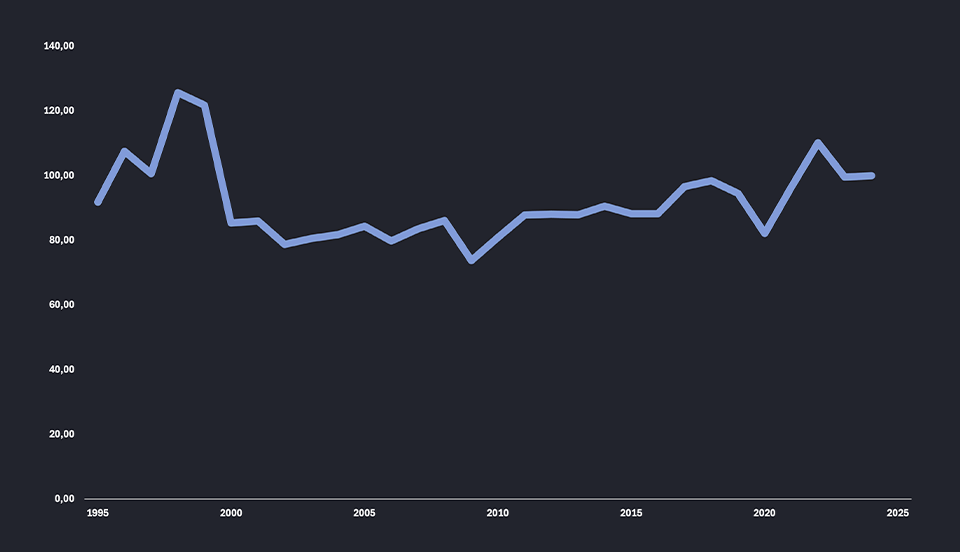
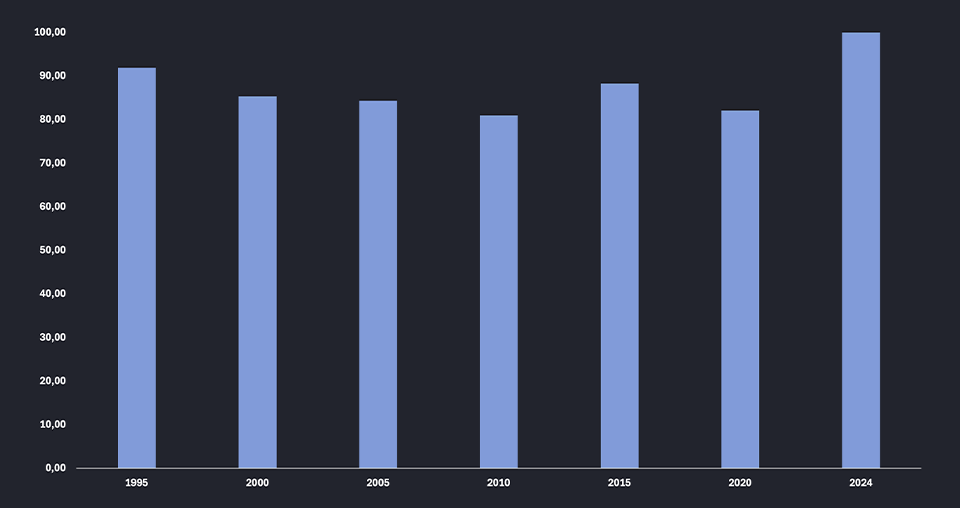
Trade as a share of GDP in Bosnia and Herzegovina shows a clear long-term expansion since 1995. The index begins at a moderate level in the mid-1990s, then rises quickly through the late 1990s and early 2000s as post-war reconstruction, market liberalisation, and regional reintegration accelerated cross-border flows. However, after 2000, we see a significant change as the share of GDP fluctuates. The steepest increases occur after 2010, when trade gradually becomes a larger component of economic activity, but it never reaches its peak shares of 1998. When viewed across key Dayton anniversary points, each milestone year shows a different level of intensity than the previous year, reflecting structural integration into regional and global markets. Taken together, the data indicate that Bosnia and Herzegovina remains more trade-exposed.
Global Rank
Compared with all geographic entities listed in the Index
| 1995 | 2024 | ||
| 91.88 | 99.97 | ||
| #43 out of 164 | #45 out of 136 |
| Europe | World | ||
| 1995 | 2024 | 1995 | 2024 |
| 57.27 | 83.68 | 43.07 | 56.55 |
Note: Population-weighted averages for Europe and the world.
Regional Rank
Compared with six former Yugoslav countries and Albania
| Country | 1995 | 2024 |
|
Albania Bosnia and Herzegovina Croatia Kosovo Montenegro North Macedonia Serbia Slovenia |
40,13 91,88 62,80 /// /// 72,04 12,57 93,05 |
79,07 99,97 102,71 114,26 112,42 138,47 111,46 156,48 |
Note: In 1995, Montenegro, Serbia, and Kosovo were part of the Federal Republic of Yugoslavia.
1995 (highest → lowest): Slovenia, Bosnia and Herzegovina, North Macedonia, Croatia, Albania, Serbia.
2024 (highest → lowest): Slovenia, North Macedonia, Kosovo, Montenegro, Serbia, Croatia, Bosnia and Herzegovina, Albania.
Conclusion
Trade openness in Bosnia and Herzegovina has expanded significantly since 1995, transforming the country into a far more externally connected, import-dependent economy.
Source: National statistical organizations and central banks, OECD national accounts, and World Bank staff estimates (2025) – processed by Our World in Data.