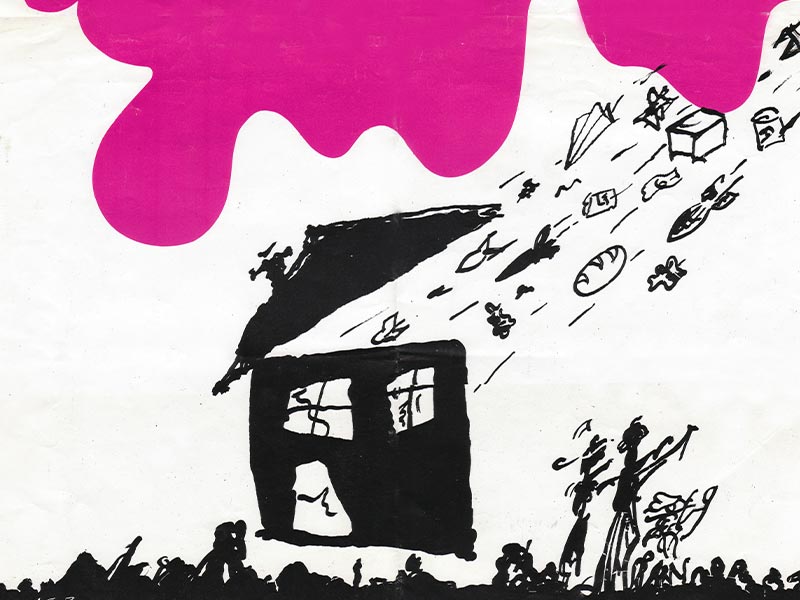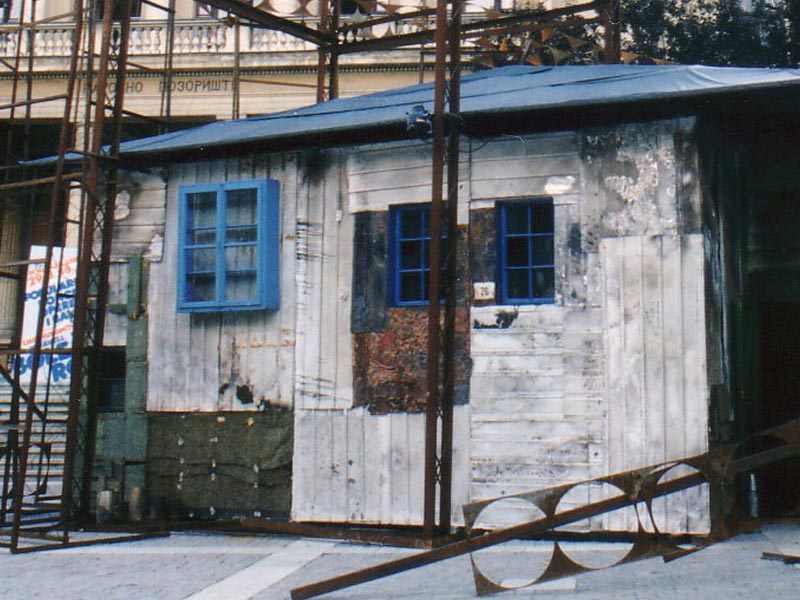

Produced during the siege, the four thematic editions document how Sarajevans used culture to resist terror. As institutions and buildings were being destroyed, artists and citizens organised events, staged performances, mounted exhibitions, and defended shared values through creativity, humour, and education. Each edition portrays cultural survival as a civic act of defiance, recording both individual contributions and collective resilience. The newsletter offers a vital insight into the efforts to sustain public and cultural life in the face of destruction.
The situation under siege was becoming increasingly demanding. Over time, the terror became more refined and sophisticated, and we could no longer rely solely on the routine of survival. Nothing could be predicted except that we had to expect the unexpected, and the only certainty was what was happening in the present moment. In order to maintain mental stability, we needed to strengthen the counterbalance. In our case, we began to follow an extraordinary current of unlimited creation within limited conditions. Nothing seemed possible when viewed through the logic of the outside world or our former lives. But we discovered that the citizens of Sarajevo were living by the logic of reality, and from that reality, they were drawing new possibilities. That is why we decided to call this state “Cultural Survival” and to follow that theme as a unique discovery about human nature.
Cultural Survival
Sarajevo is a unique city on the planet. It is a place where civilisation was deliberately destroyed through violence. Yet Sarajevo is also a symbol of civic resistance. In this city, violence was met with tolerance, fascism with art and culture, destruction with reconstruction, death with humour, the intrusion of rural culture with urban expression, and terror with the persistent maintenance of everyday life. Sarajevo was stripped of civil, existential, and social rights. It was denied the right to live. Everything that constitutes normal urban life was taken from Sarajevo and its citizens, except for the right to survive and preserve their culture.
Additional context
But amid all the destruction and death, children are being born, birthdays are celebrated, and weddings are held. In a city surrounded by a deadly circle of primitivism, exhibitions are opened, films are made, festivals are organised, and plays and musicals are performed. Sarajevo is living through a post-cataclysm. It has become an image of civilisation emerging from catastrophe, creating something out of nothing, sending messages to the future. Not because the future is inevitably one of wars and disasters, but because people are growing old and being born into a world that is becoming increasingly uncertain. The spirit of cultural survival is everything that endured beneath the rubble of Sarajevo, everything that survived the shelling of our civilisation. The reconstruction of that spirit, the spirit of Sarajevo, must begin now. Otherwise, Sarajevo will become a graveyard of the principles of multi-ethnicity and human rights.
Note:
All of these projects have since demonstrated that this methodology is key to documenting events if we aim for our effort to serve as a meaningful contribution to the interpretation and learning about the 1991-1999 period in the former Yugoslavia, both for local and global education. This project has already proven and continues to prove its value as a contribution to processes of truth and reconciliation, as well as to the democratisation of post-war society.
| Theme | The Siege of Sarajevo 1992-1996 |
|---|---|
| Research period | 1992-1994 |
| Original Format | Printed on both sides of a single A2 sheet (white glossy paper) in two colours (black and red). The newsletter was formatted within A3 dimensions, creating four content panels that feature text and photographs. |
| Language | English (B/C/S translation available) |
| Project content | As a chronicle of “Cultural Survival” in the besieged city, it documented and analysed cultural and intellectual life under siege as a form of resilience. It was issued in four editions: Winter 1993, Spring 1994, Summer 1994, and Autumn 1994. |
| Production | Sarajevo (1993-1994) |
| Note | Although the original printed edition of Newsletter #2 was lost during the siege, its content has been preserved through photocopies. |