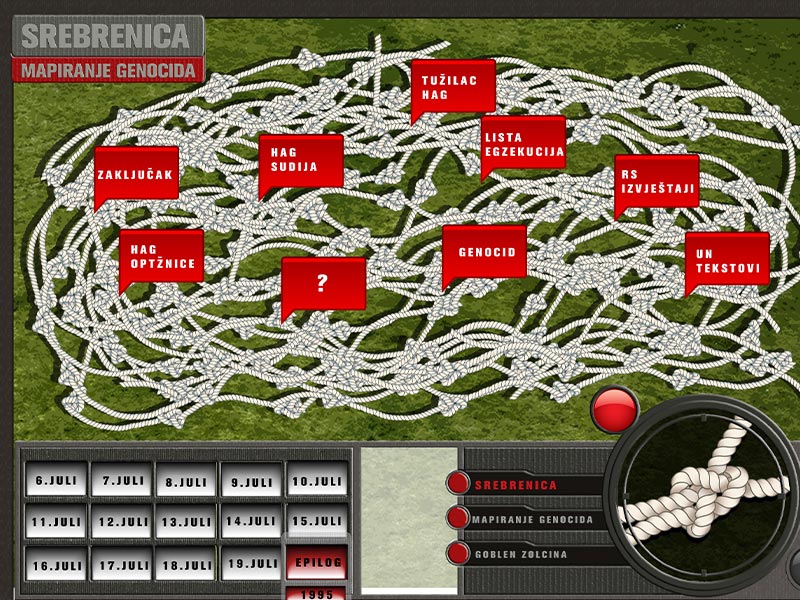

To mark the 20th anniversary, a new, expanded format of the documentary animation reconstructing the genocide was produced and presented alongside public lectures on post-genocide society. It was also broadcast on numerous TV channels. By linking memory with accountability, the project offers a universal model for understanding violence, transitional justice, and reconciliation in post-conflict contexts. Its primary goal was to transform knowledge into long-term civic engagement among students, educators, and the wider public.
FAMA projects seek to transform education on war, genocide, and urban/civic/cultural resistance into a universal educational model through a unique knowledge transfer platform. Using a methodology that identifies early warning signs within the information noise, the aim is to equip individuals and empower societies with tools to prevent the escalation of future or potential conflicts beyond the point of no return.
Bosnia and Herzegovina, as well as the wider region encompassing the former Yugoslav republics, continues to suffer the consequences of the 1992–1995 war, with everyday life shaped by unresolved issues of justice, memory, denial, and reconciliation.
For decades, a war of interpretations has been waged in this region, and what is too often overlooked due to the vested interests of many actors involved in the Bosnian case is the simplicity of truth when one considers only the facts.
As our contribution to establishing fact-based narratives in contrast to the ongoing political manipulation of history in Bosnia and Herzegovina and the region, we present the project: "School of Knowledge: Srebrenica, Mapping Genocide, Post-Genocide Society." The educational package is prepared in multiple formats to accommodate different methods of delivering lectures and presentations, with consideration for various target audiences (students, online users, institutes, educational institutions, libraries, and thematic conferences).
Additional context
REVISION OF HISTORY AND DENIAL
History lies in a two-sided paradox. On the one hand, we identify a conscious destruction of history’s great moral issues, resulting in an intellectual irrelevance of the historian himself, who becomes unable not only of thinking about society, but also of his own scholarship. On the other hand, new readings of history led by aggressive overzealous historians reduced history to a nihilistic category in which nothing of what happened actually happened, and everything we used to know we no longer do. The result is that generations of schoolchildren are being poisoned by a subject called history. Textbooks and different history books did whatever they could to legitimize irrational acts, hatred, revenge, violence, power and the sense of superiority in relation to the past.
- Dr Branka Prpa, Historian
DEFINING GENOCIDE
The term "genocide" did not exist before 1944. It is a very specific term, referring to violent crimes committed against groups with the intent to destroy the existence of the group.
The process of genocide consists of a series of events which unfold according to a specific pattern with identifiable phases, and features a characteristic internal logic. The process of genocide progresses from its beginning through a structured course to its end. First, it must define a target group (these victims are usually chosen solely on the basis that they belong to a specific group or category) and designate them for persecution or destruction. Second, the property of the members of that group must be expropriated. Third, the group must be concentrated in a single area. Fourth, the group must be deported. Finally, a significant number of the group must be killed. Although in reality these phases may unfold rapidly one after another, depending on the circumstances, it has been observed that the first phases of the process of persecution can occur in full view of the public, while later phases are shrouded in most cases secrecy.
- Ton Zwaan "On the Etiology and Genesis of Genocides and Mass Crimes Targeting Specific Groups"
Genocide Studies provide a resource for examining fundamental moral issues, and a structured inquiry into human behavior. Reflecting on these events can help learners develop an awareness of the value of pluralism and encourage acceptance of diversity in a pluralistic society.
Note:
All of these projects have since demonstrated that this method is key to documenting events if we want our efforts to serve as a meaningful contribution to the interpretation and understanding of the 1991–1999 period in the former Yugoslavia, for both local and global education. This project has already proven and continues to prove its value as a contribution to the process of truth and reconciliation, as well as to the democratisation of post-war society.
| Theme | Srebrenica Genocide (1995) |
|---|---|
| Research period | 1992 – 1995 (with focus on summer 1995) |
| Original Format | The project has a dedicated website featuring: • Video-documentary animation (38 minutes). • Video lecture (60 minutes). • 12 lectures – Public Lecture Sarajevo (28 May 2015). • Additional public lectures in Belgrade, Zagreb, Sarajevo and Oxford (February-March 2016). |
| Language | Bosnian / Croatian / Serbian and English |
| Project content | This educational project, through the presentation of evidence, testimonies, authentic statements, illustrations, thematic lectures, and a chronological overview of events leading to the genocide in Srebrenica, aims to present facts for the purpose of knowledge transfer and education. The project’s content spans a wide range of formats - from video-documentary animation mapping the genocide from early to mid-July 1995, to 12 thematic lectures by regional and international experts dedicated to key aspects of genocide and post-genocide society. |
| Production | Sarajevo (2014-2015) |
| Note | The project was carried out in partnership with Gallery 11/07/95. |