
To mark the 15th anniversary of the Srebrenica genocide, this video documentary animation presents 17 chronological animated maps that reconstruct the events of July 1995 using verified legal reports, UN sources, photographs, video footage, and survivor testimonies. Designed as a comprehensive digital learning tool, the project explains the mechanism of genocide by combining digital storytelling with fact-based visual reconstruction. It was widely distributed across Bosnia and Herzegovina, the region, and to international online audiences as a universal educational model.
The process of genocide consists of a series of events that unfold according to a specific pattern, marked by distinct phases and characterised by a certain ‘internal logic.’ Genocide has a beginning, a structured progression, and an end. First, a target group is identified (victims are typically selected based on their membership in a particular group or category) and subjected to persecution or destruction. Second, the group’s property is expropriated. Third, the identified group is concentrated in a specific location. Fourth, the group is deported. Finally, a significant number of its members are killed. While in practice, these phases can unfold rapidly, studies have observed that, depending on the circumstances, the early stages of persecution usually occur quite publicly. In contrast, the later stages are, in most cases, carried out in secrecy. (Ton Zwaan: “On the Etiology and Genesis of Genocide and Other Mass Crimes Against Specific Groups”)
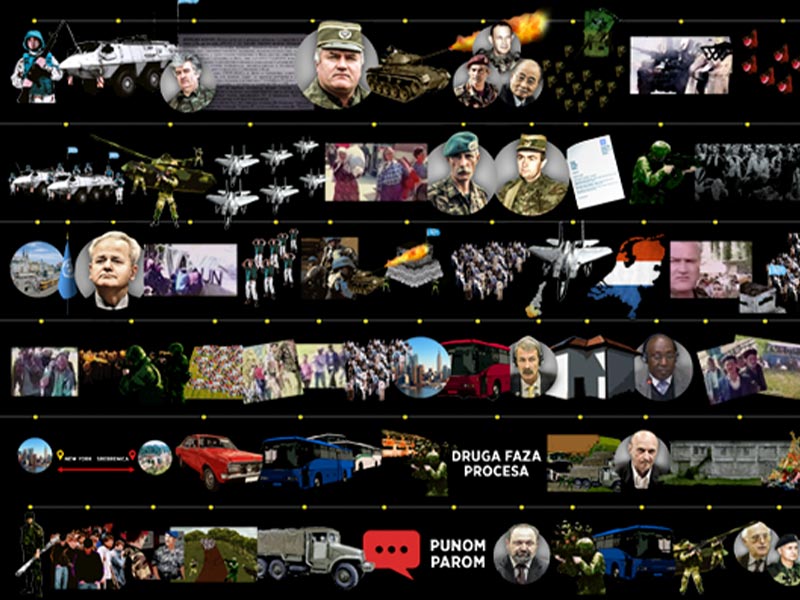
In search of a modern tool that is accessible to all users, especially young people, we chose the genre of documentary animation, which allows facts (established through extensive research) to be presented using contemporary technology. The project consists of 17 animated maps. Previous genocide studies have shown that every documented case of genocide has followed the same phases. This project comprises 17 animated maps, organised in chronological order and aligned with the methodologies employed by institutions that collect and archive documentation on the Srebrenica genocide and genocide in general, as established through numerous studies. Each map highlights key points supported by specific evidence, including text files, photographs, and video footage.
CONTENT
Additional context
To present this project as a universal educational model for interpreting and understanding the mechanism of genocide, its causes, and consequences. The model is based exclusively on the presentation of facts, without commentary or conclusions that could influence users or steer them toward a particular interpretation. The project is made available to the broader public through several phases. It was initially conceived as a tool for communication among young people in Bosnia and Herzegovina and Serbia, and later developed into a platform for dialogue among youth in the region and around the world through various communication channels, including the Internet, public screenings, presentations, lectures, and discussions.
The project was completed in one year. It was preceded by extensive research of all available documents, testimonies, studies, books, films, and photographs. The working methodology is presented on a dedicated website, which will also serve as the final stage of the project.
Sources and documents reviewed, selected, and used in the project include:
Note:
All of these projects have since demonstrated that this method is key to documenting events if we want our efforts to serve as a meaningful contribution to the interpretation and understanding of the 1991–1999 period in the former Yugoslavia, for both local and global education. This project has already proven and continues to prove its value as a contribution to the process of truth and reconciliation, as well as to the democratisation of post-war society.
| Theme | Srebrenica Genocide (1995) |
|---|---|
| Research period | 1992 – 1995 (with focus on summer 1995) |
| Original Format | A video-documentary animation (224 minutes, DVD format) and a specially designed interactive website featuring 17 animated maps and supporting content. |
| Language | Bosnian / Croatian / Serbian and English |
| Project content | The project comprises 17 animated maps, organised in chronological order and aligned with the methodologies employed by institutions that collect and archive documentation on the Srebrenica genocide and genocide in general, as established through numerous studies. Each map contains specific evidence at key points, including text files, photographs, and video recordings. |
| Production | Sarajevo (2009-2010) |
| Note | To mark the 15th anniversary (July 2010), a special edition of the project was released on DVD, with 20,000 copies distributed free of charge as a supplement in the daily newspaper Oslobođenje. Project Administrator: Youth Initiative for Human Rights / Inicijativa mladih za ljudska prava - YIHR BH |