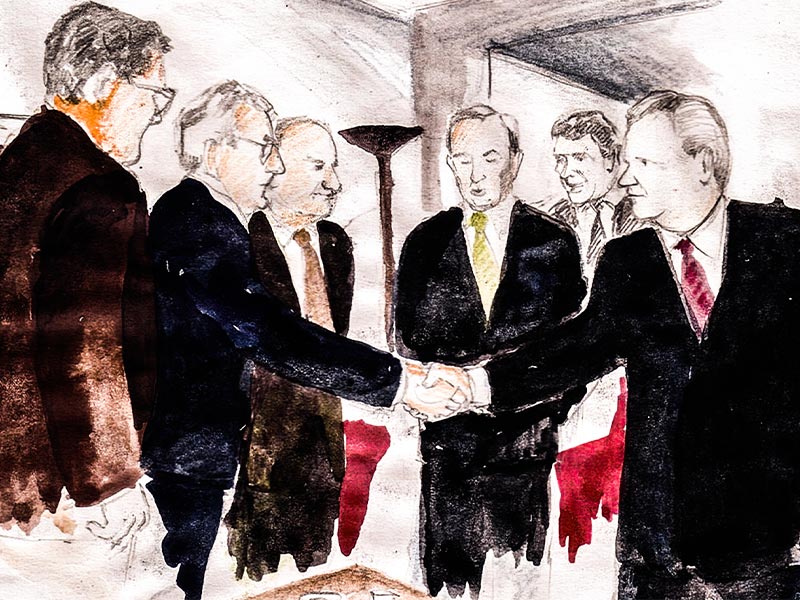

As the first political documentary produced after the war and broadcast in both BiH entities, this two-part series analysed the Dayton Peace Agreement. The first episode explores the negotiation process and the roles of key domestic and international actors, while the second addresses issues of borders, territorial organisation, and post-war governance. Each episode offers a politically neutral analysis designed to enhance public understanding of the agreement, its implementation challenges, and the long-term implications for peacebuilding in Bosnia and Herzegovina.
The Siege of Sarajevo and the war in Bosnia and Herzegovina ended with the signing of the Dayton Peace Accords. For us, it was important to address the end of the siege: how the war ended and how the siege was lifted. To that end, we chose to use the book written by the chief architect of the agreement. It was the only way to document and map the negotiations that led to the end of the siege. We also wanted to explore how the agreement would be implemented.
This dossier became the first domestically produced political TV documentary programme about the Dayton Peace Agreement to be broadcast in both entities of Bosnia and Herzegovina. It aimed to explain the complex issues of the agreement and investigate how they were being implemented. Through this work, FAMA helped fill a critical media gap, providing the people of Bosnia and Herzegovina with expert, highly objective, and politically neutral analysis of the Dayton Agreement and its impact on citizens and the country.
Additional context
In an effort to provide an overview of key aspects of both local and international plans for implementing the agreement, several media centres were established in Bosnia and Herzegovina and the United States. The studio in Sarajevo played a central role in conducting interviews with local politicians and representatives of the international community in BiH. It also prepared analytical documentation profiling the presidents who signed the peace agreement and were key political figures during the war in BiH: Slobodan Milošević (Serbia), Alija Izetbegović (BiH), and Franjo Tuđman (Croatia).
The Sarajevo studio coordinated field reports from both entities in BiH, providing a more comprehensive picture of the local political landscape, international policies, and everyday life. The studios in Dayton and Washington, D.C., were tasked with explaining the structure and significance of the agreement, as well as its prospects for implementation.
Note:
All of these projects have since demonstrated that this method is key to documenting events if we want our efforts to serve as a meaningful contribution to the interpretation and understanding of the 1991–1999 period in the former Yugoslavia, for both local and global education. This project has already proven and continues to prove its value as a contribution to the process of truth and reconciliation, as well as to the democratisation of post-war society.
| Theme | The Dayton Peace Accords |
|---|---|
| Research period | 1991-1997 |
| Original Format | A two-part political TV documentary (60–75 minutes per episode), combining studio interviews, presidential dossiers, and segments filmed on location. |
| Language | Bosnian / Croatian / Serbian and English |
| Project content | Episode #1 examines the implementation of the Dayton Peace Accords, situated within a historical context that is framed by the presidential profiles of Slobodan Milošević, Franjo Tuđman, and Alija Izetbegović. Episode #2 delves into the accords’ provisions on borders and territorial exchange between the Federation of BiH and Republika Srpska. |
| Production | Sarajevo, Dayton, OH and Washington D.C. (1997) |
| Note | Interviews with US experts and representatives were recorded in partner studios located in Dayton and Washington, D.C. |