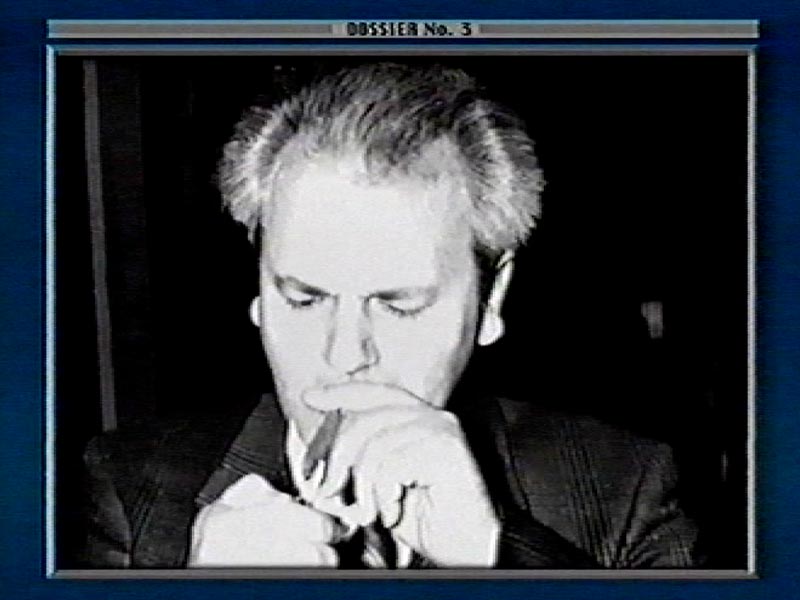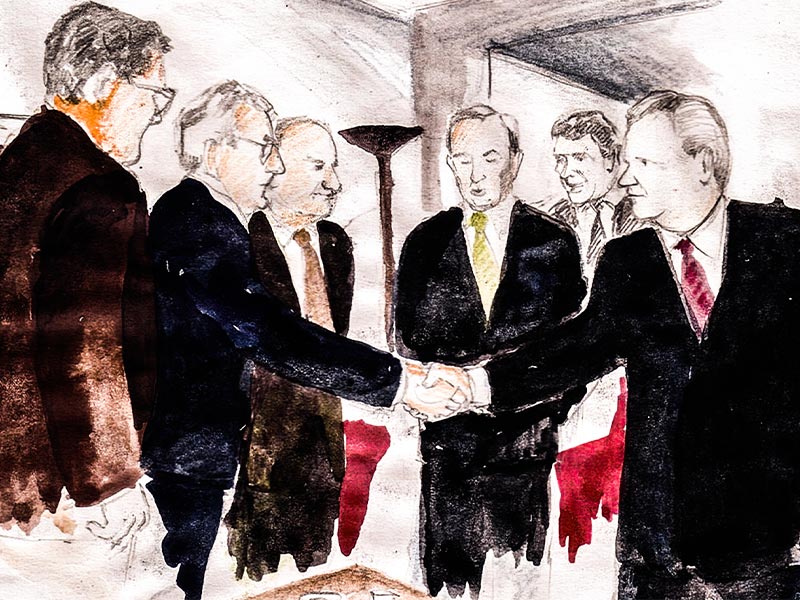

The project marked the 20th anniversary of the Dayton Peace Agreement through a video documentary animation and the “Study Table” installation. The exhibition was first displayed at the National Museum and later became a permanent feature at the BiH Historical Museum. Based on Richard Holbrooke’s book “To End a War,” the “Study Table” installation presents different phases of the negotiation process in multimedia formats, from shuttle diplomacy to the Dayton talks, making this complex process more accessible and engaging for a broader audience.
For decades, a war of interpretations has been waged in this region. What is too often overlooked due to the self-interest of many actors involved in the "Bosnia case" is the simplicity of truth when one considers only the facts.
As our contribution to establishing fact-based knowledge in contrast to the ongoing political manipulation of history in Bosnia and Herzegovina and the wider region, we present the project "School of Knowledge: Mapping the Dayton Peace Accords."
The educational package "Mapping the Dayton Peace Accords" is prepared in multiple formats to accommodate various ways of delivering lectures and their intended uses, with different target audiences in mind: students, online users, institutes, educational institutions, libraries, and thematic conferences.
The project "School of Knowledge: Mapping the Dayton Peace Accords" was initiated in 2000, when FAMA received permission from Ambassador Richard Holbrooke and his publisher, Random House, to use his book "To End a War" to create the FAMA album titled "The Dayton Peace Accords: Mapping the Negotiations." The goal of the project was to visualise and contextualise the path to Dayton by mapping the U.S.-led “shuttle diplomacy” and the peace negotiations in Dayton in a format accessible to the broader public.
The Bosnian War is considered “the greatest collective failure of the West (in Europe) since the 1930s.” This is the story of how the United States led efforts to end the war in Bosnia and shape the Dayton Peace Agreement in 1995.
Additional context
The Dayton Peace Agreement is not only a peace accord that preserved stability and peace in Bosnia and Herzegovina; it is also an opportunity to learn about the process by which such agreements are formed. We hope that this educational Study Table will help contextualise and visualise the events that marked the end of the 20th century and continue to shape the future of Bosnia and Herzegovina today.
Richard Holbrooke in his own words (from “To End A War” book):
Although the United States initially viewed the Balkan wars as a European problem, by mid-1995 Washington decided to launch a last, all-out negotiating effort. President Clinton decided on a strategy and assembled a U.S. Negotiations team headed by Ambassador Richard Holbrooke.
* * *
With a travel schedule that changed every few hours, we moved so unpredictably across Europe that Washington often did not know where we were, driven by the sense that it was now all or nothing.
* * *
It is a high-wire act without a safety net. Much work must precede the plunge into such an all-or-nothing environment. Therefore, the site for peace proximity talks had to be just right as the goals of the U.S. Negotiations were defined:
The consequences of failure are great. But when the conditions are right,[the] Dayton [model]can produce dramatic results. Dayton, therefore, has contemporary relevance because it succeeded; in short, it ended a war!
Note:
All of these projects have since demonstrated that this method is key to documenting events if we want our efforts to serve as a meaningful contribution to the interpretation and understanding of the 1991–1999 period in the former Yugoslavia, for both local and global education. This project has already proven and continues to prove its value as a contribution to the process of truth and reconciliation, as well as to the democratisation of post-war society.
| Theme | The Dayton Peace Accords |
|---|---|
| Research period | 1992-1995 (with focus on 1995) |
| Original Format | The project has a dedicated website featuring: • Video-documentary animation (16:51 minutes). • Educational “Study Table” visuals. The installation is permanently exhibited at the History Museum of Bosnia and Herzegovina in Sarajevo. |
| Language | Bosnian / Croatian / Serbian and English |
| Project content | The educational project has been prepared in several formats, ranging from a video-documentary animation to the multimedia “Study Table”, in line with different approaches to knowledge transfer for diverse target audiences. The project aims to visualise and contextualise the road to Dayton by mapping American "shuttle diplomacy" and the peace negotiations in Dayton, in a way that is accessible to the broader public. |
| Production | Sarajevo (2015) |
| Note | The project was carried out in partnership with Gallery 11/07/95. |