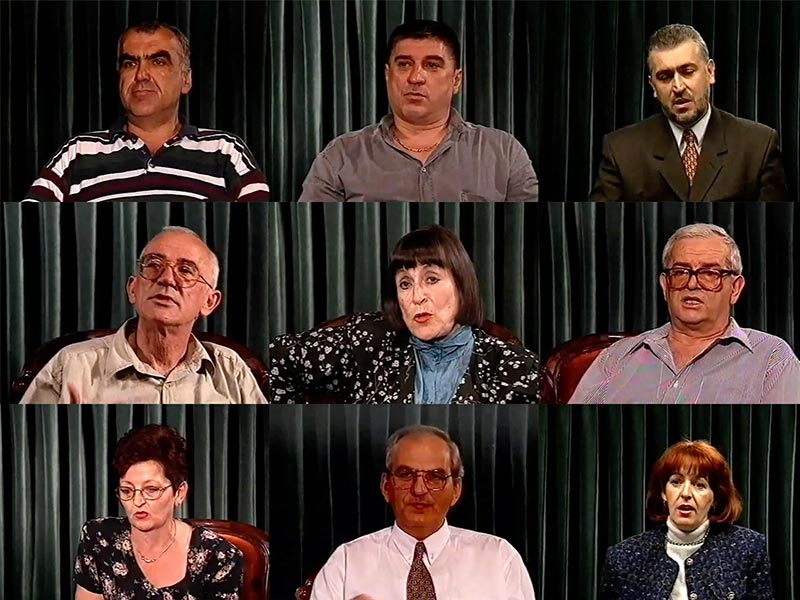

Produced shortly after the war, this was the first and only large-scale public opinion study documenting everyday life during the siege of Sarajevo. Testimonies from 4,637 citizens across all city municipalities revealed patterns of survival, ingenuity, and resilience. Covering 31 questions on daily routines, innovation, and mental endurance, the digitised surveys offer a rare insight into basic survival and resistance as a form of defiance. By correlating responses by age, gender, profession, and location, the study deepens our understanding of life under siege.
In different parts of the city, people survived under different conditions. They didn’t travel far to find out how others in a different neighbourhood were living. By 1996, we realised it was time to establish a methodological process by surveying ten different areas of the city. All the survey questions focused on experiences of the siege and all levels of survival. But that wasn’t enough to form a complete picture. So, we digitised around 4,637 questionnaires and obtained instant responses to each of the posed questions. This led to major revelations. A sample of 4,637 responses is statistically significant enough that frequent answers could be accepted as indicative patterns. For example: work is the law of survival; you must not think of anything except what’s happening at that moment; if it weren’t for cigarettes, Sarajevo would have fallen; recycling means giving new purpose to objects; people moved around just to avoid thinking about their condition – and that movement became a source of many innovations; many chronic illnesses (like migraines) receded because the body redirected all defence mechanisms toward survival… Today, our collection contains pearls of insight that serve as initial capsules for scientific advancement across various disciplines.
In 1996, immediately after the peaceful reintegration of Sarajevo, our team began preparing the archiving project. According to our plan, the first phase was the Survival Questionnaires, conducted from 1992 to 1996. We recognised that memories fade, that people change their views under various influences, that they die or relocate to other regions, which is why it was crucial to record their testimonies immediately after the war ended. We divided the surveys by districts, aware that life under siege varied significantly between the old and new parts of the city. Survival methods differed even within neighbourhoods, depending on whether there was access to a water source, how much land was available for gardens, whether a house was directly exposed to sniper fire, or whether the area was near frequently shelled strategic points.
We employed a random sampling method and surveyed individuals of diverse genders, professions, and ages, with a particular focus on those from different residential areas. Our goal was to ensure that the testimonies remained fully authentic, without any intention of influencing the outcome. In our effort to construct a comprehensive picture of the four-year siege on every level, from the first to the last day, the selection of questions proved to be a crucial element.
QUESTIONNAIRE FORMAT - LIST OF QUESTIONS
The Siege of Sarajevo 92-96: Survival Questionnaire
• YEAR OF BIRTH:
• PROFESSION:
• GENDER:
• CITY DISTRICT:
QUESTIONS / ANSWERS:
Note:
All of these projects have since demonstrated that this method is key to documenting events if we want our efforts to serve as a meaningful contribution to the interpretation and understanding of the 1991–1999 period in the former Yugoslavia, for both local and global education. This project has already proven and continues to prove its value as a contribution to the process of truth and reconciliation, as well as to the democratisation of post-war society.
| Theme | The Siege of Sarajevo 1992-1996 |
|---|---|
| Research period | 1992-1996 |
| Original Format | The questionnaires (public opinion survey) were collected in person, completed by hand on paper, and later transcribed into a digital Word format. |
| Language | Bosnian / Croatian / Serbian (English translation available) |
| Project content | 4,637 Sarajevans from all city districts shared their personal experiences of life under siege by answering 31 standardised questions and providing their gender, year of birth, profession, and city district. |
| Production | Sarajevo (1996-1997) |
| Note | Special thanks to all the participants – the citizens of Sarajevo. |