


The Siege of Sarajevo 1992-1996
“I read everything I missed before”
Macro Story #18: Reading and Writing

Sarajevo's nights during the siege were long, sleepless, and not conducive to rest. In such circumstances, the citizens of Sarajevo took books off their shelves and read. They read by candlelight, by oil lamps; they read in cold basements, in hallways and corridors. Always in semi-darkness. In books, they read about other worlds, other people's destinies, other wars. They were seeking answers, comfort, hope. They revisited books they have read many times, looking for something they may have skipped over, but now need to read. To remind them that there was life before the siege, and to keep them hopeful that there will be a tomorrow.
During the shelling of the city, many libraries in the city were burned and destroyed. The library collections were saved by employees, neighbours and passers-by. The shelling and burning of libraries during the siege of Sarajevo was one of the most severe forms of culturocide.
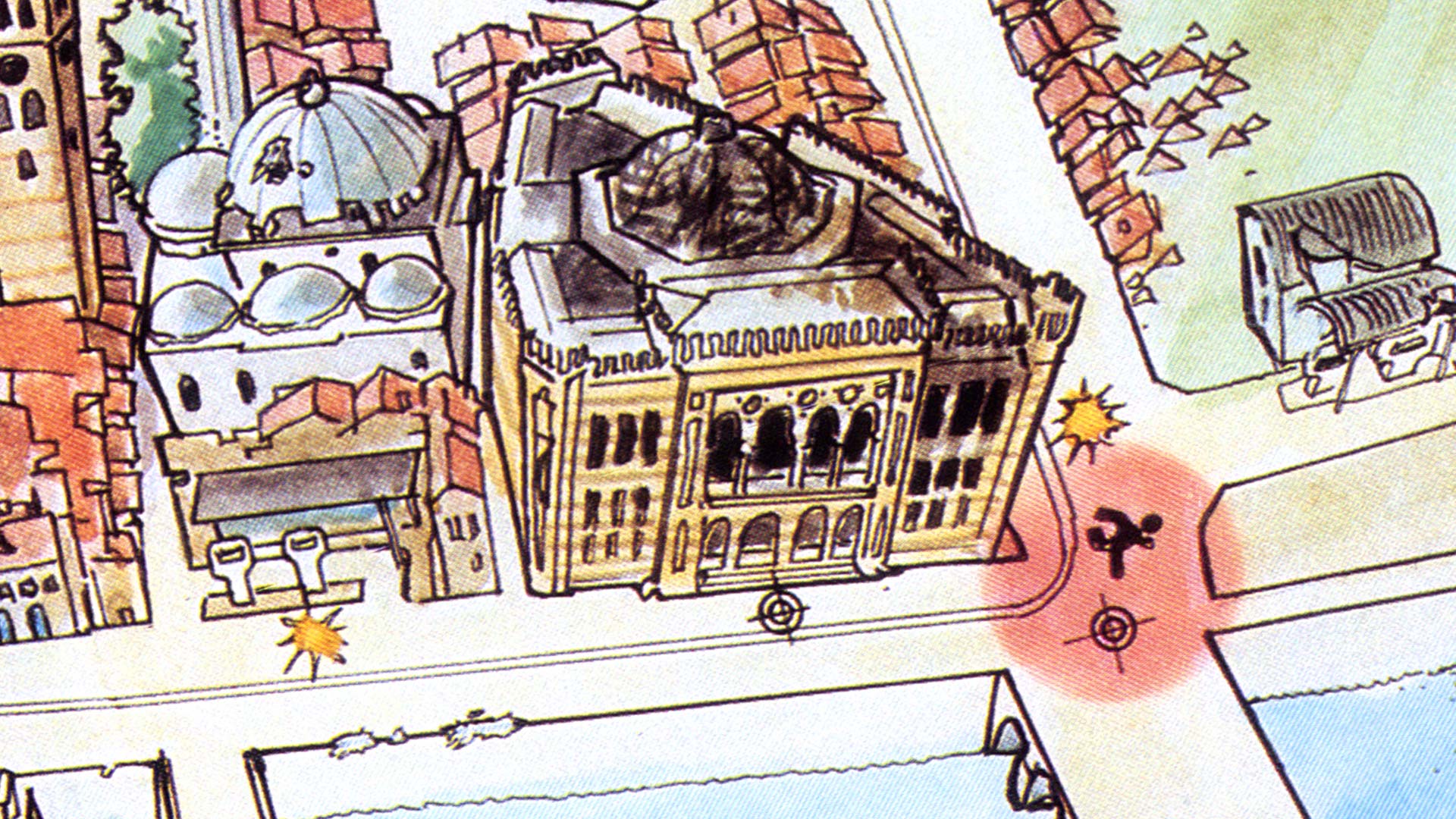
© FAMA Collection; 'Survival Map (The Siege of Sarajevo 1992-1996)'
The monumental City Hall was built during the period of the Austro-Hungarian rule in 1894. It was built in a pseudo-Moorish style with many decorative elements on its facade, in its central hall, on the staircase and in the ceremonial halls. In 1945 the building was turned into the National Library which contained more than 1 million books, a great number of domestic and foreign periodicals and a collection of rare books. On August 25, 1992, one hundred years after its building had begun, the shelling of the City Hall started from the Trebević and other mountains. It was hit by 50 shells and it started to burn a short time before midnight. The indomitable fire destroyed the entire building and two million books, a national monument of Bosnia and Herzegovina.
„I went out in the courtyard, which was partially paved in concrete, because there is a garage, and everything is kind of gray. Behind it there is some greenery, and then on the concrete I saw big black pieces of burned paper. And then it was awful. I realized at one moment that the National Library was on fire? These papers were big pieces of paper, and on these big burned pieces of paper you could make out some of the writing. There must have been really high temperatures. It was terrible. When I went into the house, I told everyone. We all were very attached to the National Library building, because it was located on one of main roads, and wherever you went in Sarajevo, you had to pass the National Library. That beautiful building which was truly a symbol of the city. I did feel sorry about that building, but I also thought we were finished. Because at that point we were afraid - we did feel sorry about our city - but we were more afraid for our lives. We were thinking, ‘this is it, this is the end, its coming closer, it’ll be here soon.’ And above my house, on the other side was a hill there is a clearing. And they were behind the hill. And I always imagined how they would swoop down from that hill like Indians, like in a Western. That was interesting to me. A crowd of people whom are coming towards us down the hills.“ - Zlata Huseinčehajić, Boutique Owner
© FAMA Collection; Oral History: 'The Siege of Sarajevo 1992-1996'
As the years of the siege passed, the citizens of Sarajevo felt the need to write down what they did each day, to write diaries, to record events in the city, and the personal or family war story. They felt the need to leave their war experience written down, so that they, their children, or someone else could later read about what life was like under siege. Often, the motive for writing a diary was the desire to leave a written word as a reminder of the days of the siege in the event of death. Writing was a form of therapy and mental exercise.
„A detail, which prompted me to write a diary, was when a girl told be how our entrance had a scent like our school. So as not to forget it, I started to write a diary. To have those memories and details five, ten, fifteen years from now, if I stay alive. So that either I or some of mine could read what I did with those children, what I went through.“ - Faiza Kapetanović, Teacher
© FAMA Collection; Oral History: 'The Siege of Sarajevo 1992-1996'
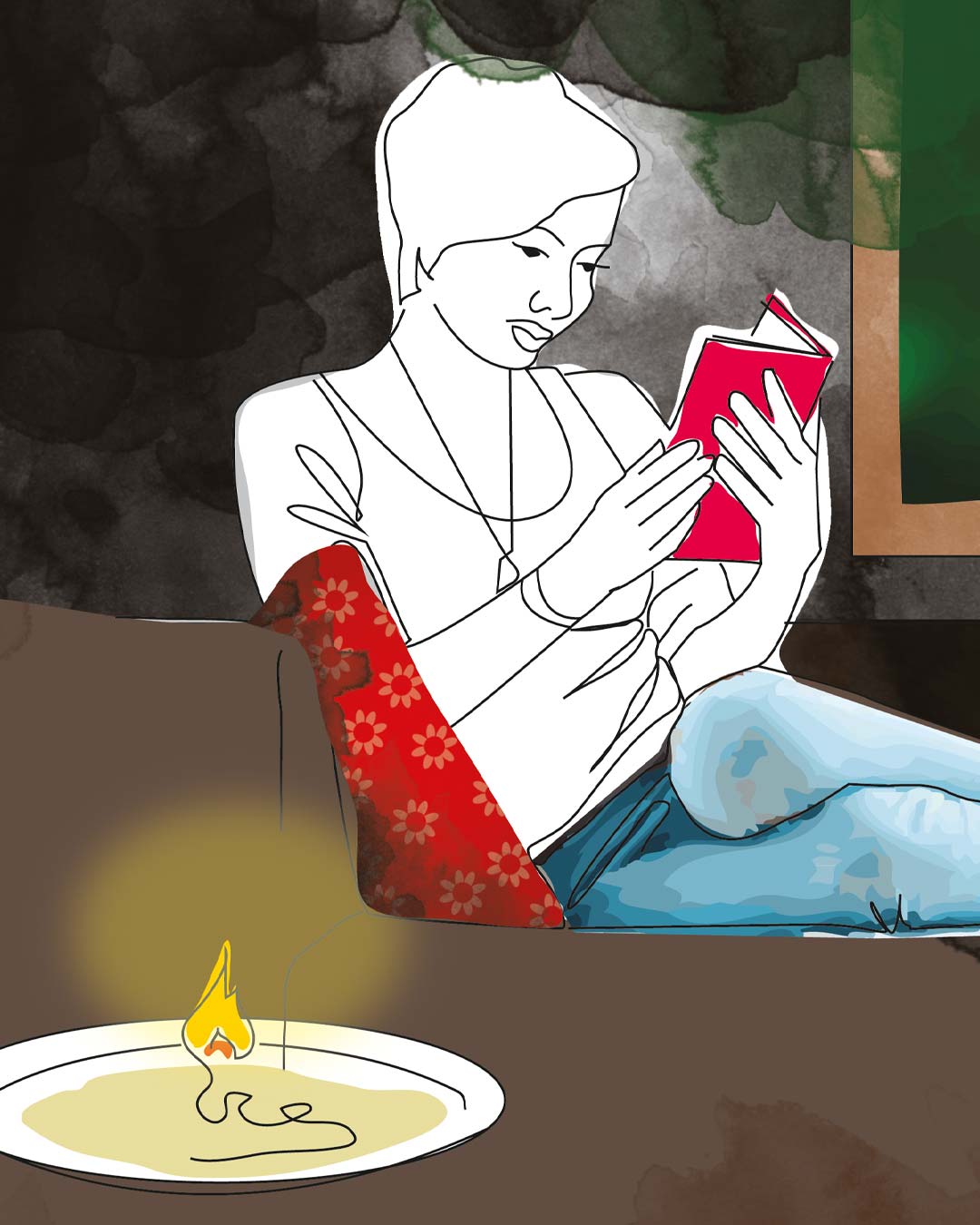
© FAMA Collection - Visual Archives 1992-1996 (Jelena Oksenfeld)
What did you do in your free time?
I wrote a war diary, read books, hoping that the war would finally end.
year of birth: 1974
profession: Nurse
gender: Female
city district: Buća Potok
© FAMA Collection; 'Survival Questionnaire' - The Siege of Sarajevo 92-96
„On the 9th of March I met - I remember as if it were yesterday - a French journalist in front of the Cathedral in Sarajevo. I know that he was a TV journalist and that they treated him like a big star. He stopped me on the street and gave me my book that had been published in France, which was called 'War Diary'. I had no idea that the book had been published in France. Somehow they had gotten their hands on texts that I had written during the first 150 days of the war, and sent daily from Sarajevo to 'Slobodna Dalmacija'. They collected and translated them, and made a book out of them. They told me that it was the first published book about Sarajevo that was written by someone in Sarajevo. That book was received very well throughout the world.“ - Zlatko Dizdarević, Journalist
© FAMA Collection; Oral History: 'The Siege of Sarajevo 1992-1996'
During the siege, books played a multiple role: they were a source of knowledge, a window into the world, they offered comfort, but they were also a means of barter in markets or, unfortunately, during periods of several days of freezing days and nights, a means of heating, which was difficult for most Sarajevans.
„It is well known that the National Library of Bosnia and Herzegovina was destroyed by artillery fire on August 25, 1992 and because of that we made even more effort to preserve what was left of this heritage. Namely, during the siege of Sarajevo, which was among the worst sieges in the history of mankind, the people had to burn everything they could lay their hands on, including books, in order to survive. In order to prevent it in some way we pointed out that books were the guardians of memory and that they should be saved and that they were friends who didn’t demand favours in return. Of course, we are not able to judge what response our appeal had, but it is certain that it was part of an effort to keep Sarajevo spiritually alive at a time when human life was in danger every day. Books meant support for all of us in Sarajevo. In the besieged Sarajevo, to our knowledge, people read much more than in peacetime because they could in some way separate from the cruel reality in which they lived. Reading some novel or poem or remembrances of other people of other wars or the past, we were looking for answers regarding the situation we had found ourselves in. I hope that at least a part of our appeal was effective and that it had a positive effect on the preservation of the Sarajevo literary treasure.“ - Enes Kujundžić, Director of the National and University Library
© FAMA Collection; Oral History: 'The Siege of Sarajevo 1992-1996'
„In 1994 everything came down to swapping. Everything you did was mainly swapping and I remember well there were many, many cases. But I remember well, when I gave my English dictionary for a kilo of beans, the black ones that was never cooked enough. The most vivid memory was New Year’s, 1993. That day an elderly lady brought me half a litre of cognac for the ‘Nostradamus Prophecies’. I was really happy about the swap. I thought it was a real bargain.“ - Mehmed-Meša Kerken, Antique shop owner
© FAMA Collection; Oral History: 'The Siege of Sarajevo 1992-1996'
In the abnormal conditions of siege, in a state of collective fear and confusion, literature was also created. Writers wrote and even published their novels, children's books, poetry collections. Some were lucky enough to have their written word, through various channels, reach the world where it was translated and published. Their works left a lasting personal mark, but also the mark of the inhabitants of a city under siege who are committed to civilization and culture and who, through writing, literature and poetry, resist terror and barbarity.
„My typewriter, which needs neither gas, nor water nor electricity, needs only my fingers. Whether they are frozen or not, and my desire, an ardent desire, used to protect me from those awful sounds, which will probably, at least it seems that way to me, remain the deepest and the most permanent trauma of war. I must admit that I did not really experience the war down in the basement. I mentioned the basement in one of my stories, but it was actually the only time I went down. My son was thirsty, so we left the basement looking for something to drink. I never went back. While other people who lived in the same area as myself, which was a very dangerous area near the Jewish cemetery, an area between two ex-sniper streets, would go down to the basement, I would read. I would read intensively. I must say, regardless of the fact that it sounds a little odd, bizarre, even perverse, I experienced the war as an another, long, long holiday, which gave me time to read everything I had failed to, read. And since I am at the age of re-reading books, I used the time to read. I was really able to concentrate.“ - Alma Lazarevska, Writer
© FAMA Collection; Oral History: 'The Siege of Sarajevo 1992-1996'
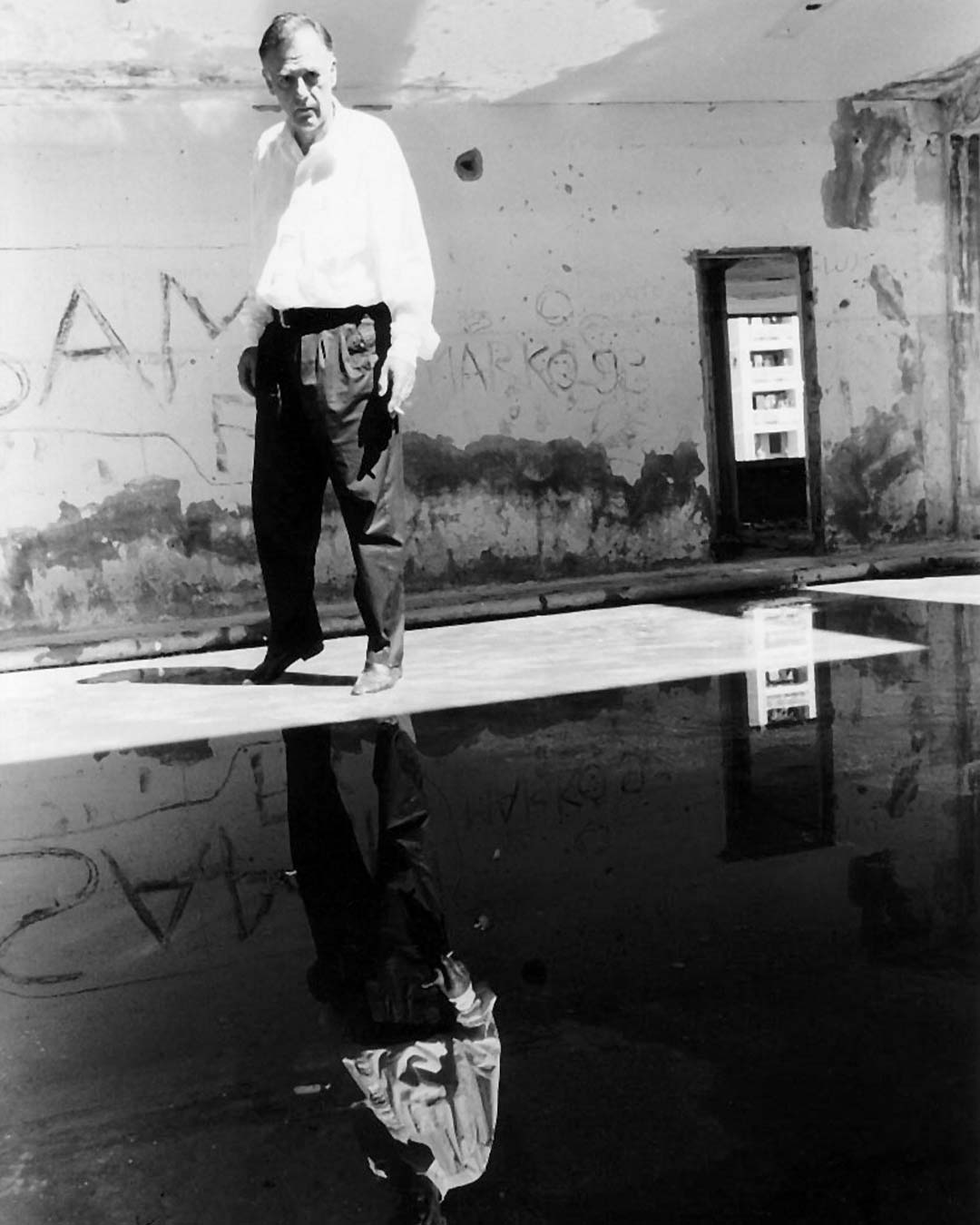
© FAMA Collection - Visual Archives 1992-1996 (Milomir Kovačević)
"Wake up, coffee, try to write, if I'm not painting, I read at night." - Nedžad Ibrišimović, Writer
„There was a terrace quite well sheltered from snipers and random shooting. Whenever it was sunny, and it seems to me that there was a lot of sun in September, I sat on a stone block facing a half-burnt house. Through its ruins, behind it, I could see the sky, and sometimes it seemed to me I could see a NATO plane, and below me, in the mist, I could see Sarajevo, part of Trebević, although I was never quite sure whether it was part of Trebević or something else. Here I had an unusual kind of peace and I could write. Most of my first book 'Konačari' was written on that terrace. And some letters that are very dear and important to me, although I still don’t know whether they all reached their addressees. Because I’ve forgotten how many I sent at that time. To this day I haven’t managed to recapture that unusual and strange peace and concentration that I found on that hill above Sarajevo on 21 September ’93.“ - Nenad Veličković, Writer
© FAMA Collection; Oral History: 'The Siege of Sarajevo 1992-1996'
During the siege, the citizens of Sarajevo read and wrote. They read to forget, at least for the moment, the circumstances in which they lived and to preserve their mental health, and they wrote so that neither they, nor their loved ones, nor anyone else, who would later read their writings, would forget. After surviving every day in abnormal conditions, under constant risk to their own lives, after a difficult daily struggle for survival, the citizens of Sarajevo read and wrote at night. Writers played a significant role in recording the experience of the siege. We talked to the writer Ferida Duraković about what motivated writers to continue writing. What did books mean to Sarajevans during the siege? What books did she read? How did the conditions of life under siege and everyday risk and fear influence her writing?
Writer
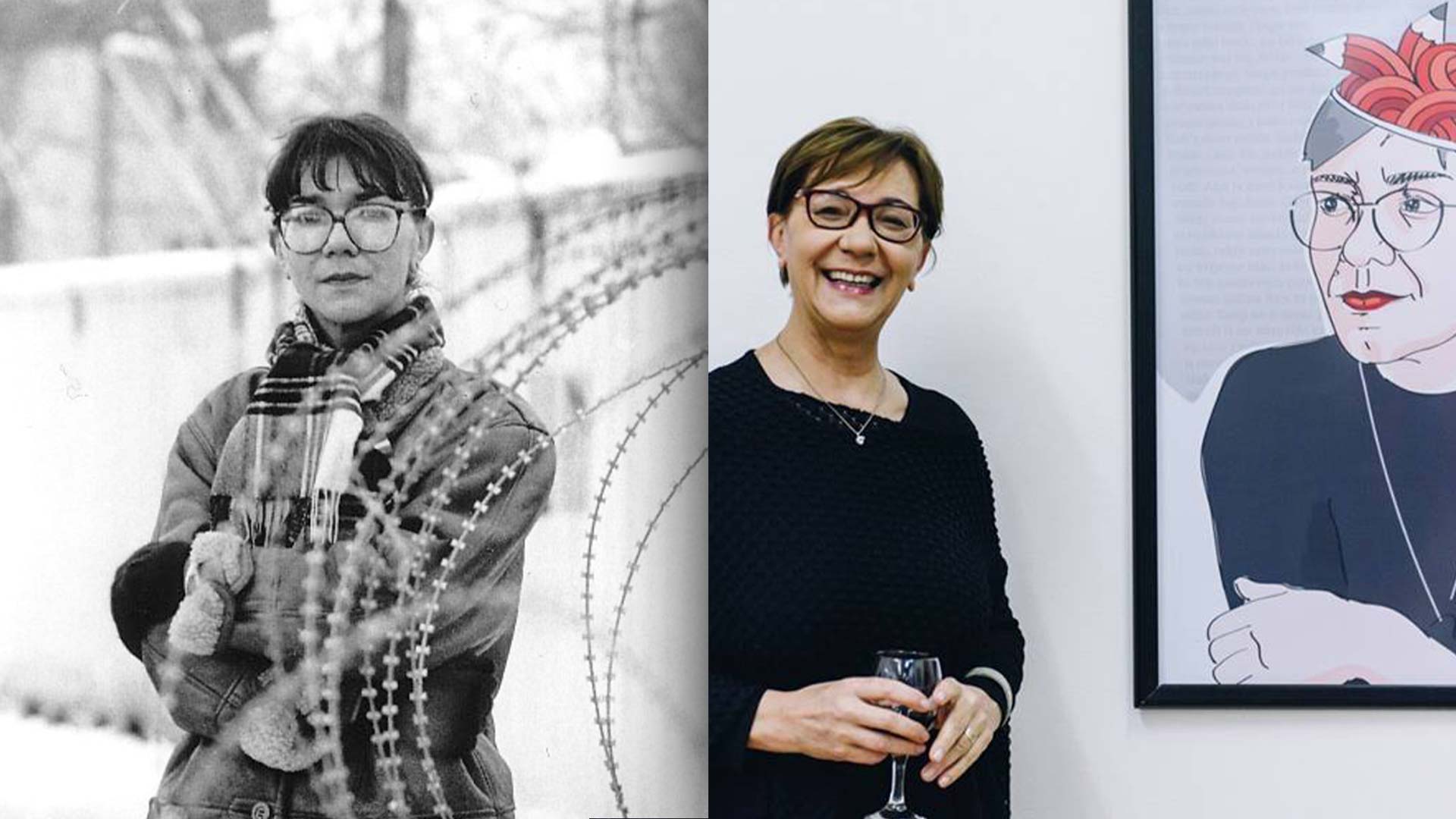
Photo: Ferida Duraković - Then (The Siege of Sarajevo 1992-96, © FAMA Collection - Visual Archives 1992-1996 (Milomir Kovačević)) and Now (personal archives, © Imrana Kapetanović)...
Many Sarajevans who survived the siege still remember the long nights they spent reading books by candlelight. They read to take their minds off the sound of shelling, at least for a short while. Many read some books more than once, because they were a comfort to them or because they had nothing else to buy. Books were sold and bought on the streets and in the markets. What did books mean to Sarajevans during the siege? What did you read then? Is there a book that “helped” you in some way during those difficult days and nights?
Ferida Duraković: These memories of the post-apocalyptic horror of the 1990s in besieged Sarajevo are incredible! After 30 years, I feel like I'm seeing someone else going through all of this and then I cry...
For the first few months, we walked around the city like zombies, waiting for "it" to end, so that we could continue our lives as before, to return to our individual everyday lives and ordinary human problems... Because all of us who stayed in the city believed that "it wouldn't last long", that the JNA (the Yugoslav People's Army, "proud, steely, compact" from school textbooks, the one that spread "freedom, brotherhood and peace", because it was "Tito's army!") knew where it was stepping, why and whom it was stepping on, so that by July we would all be on the Adriatic Sea, swimming. But the Poet, who senses what he himself does not know, but it writes itself for him (B. Miljković), says that "delusions sing most beautifully"...
Well, then we started to reset, to catch up... First the old people, especially those who experienced and survived World War II: my father started buying flour and salt with the little money we had in the house, my mother counted sugar, rice and macaroni packages in the pantry - because the old people knew: when the flood of war starts, it takes away people and bridges and houses, animals and life itself, along with the ideals of youth and the ridiculous communism of the former state. A mother, with four hearts in her chest for four children, that's a special story of courage and strength.
As the unimaginable horror heated up, we had to find meaning in the long, too-long nights under curfew, under grenades and snipers, in basements and on the front lines... And so we ALL started reading. Exchanging books: professors, teachers, tailors, workers, soldiers, neighbors, everyone! We all stood in line every day for water or bread and talked about books, as if that thread of civilization kept us hopeful and alive.
Those who had fled from the city called while the phones were working; they complained about how hard it was for them without us and how unhappy they were, even where they had arrived. Out of love for them, we were still silent about our suffering and frozen by thoughts of the future. That is why we sought confirmation of our fate in books, as some solid proof that - if we were gone - we would confirm our fate described in some novel or poem that resembled our life... For me, for example, books like „Death in Venice“ by Thomas Mann and everything else that suddenly resembled futile intellectualization and writing in leisure "fell" to the hundredth place forever, and books that spoke of our fears of death, hunger, disease, oblivion from the rest of the world and lack of dignity, rose up - then I "swallowed" „The Plague“ by Albert Camus on two occasions (for what is war but a plague?), which became the book of my life. And to understand the fate of my relatives and friends in exile, I read Miloš Crnjanski's „Novel of London“. I cried to the poetry of Gottfried Benn, and to the cries in the verses of the unfortunate Georg Trakl...
That is why we sought confirmation of our fate in books, as some solid proof that - if we were gone - we would confirm our fate described in some novel or poem that resembled our life...
In addition to reading books, citizens kept diaries or recorded daily sketches of events, wrote poems or short stories. During the siege, authors wrote and even published novels and poetry collections. The diaries of journalist Zlatko Dizdarević and the girl Zlata Filipović were published in France. Literature lives. The written word lives. What did writing mean to the citizens of Sarajevo at that time, and what to the writers?
Ferida Duraković: Every written text, especially one published somewhere outside of Bosnia and Herzegovina, related to our life and suffering in the besieged city, and to the violently murdered Yugoslavia, and especially Bosnia and Herzegovina, gave us hope that SOMEONE, sometime and somewhere after us, would come across a trace of our misfortune, that they would read who we were, what we experienced, how we lived and died, or rather how we were murdered, those without weapons, civilian collateral damage of all wars. Because the written word truly lives. Especially if it is true, since it is repeated by thousands of civilian companions. Our words, written and sent to the world together with journalistic reports and photographs, were undeniable witnesses to crimes against civilians. The International Peace Center Sarajevo played an important and great role in this, through which thousands of foreigners of all kinds who were interested in Bosnia in one way or another passed. There, the writers had the opportunity to bring and leave to a foreign journalist or humanitarian their text related to the war, or a letter for their loved ones somewhere in a faraway world, and many of them would do their best to deliver those private and public letters to the right place, and send the texts to where our appeals would resonate. In 1993, a school notebook was also published - the diary of the girl Zlata Filipović, the thoughts of a child captured under shells in Sarajevo. I was given the task of translating those twenty pages into English from Friday to Monday, it was a bad translation, but so necessary - and it immediately went out into the world. The diary was later published in many languages and in many editions, much thicker than the original, but I no longer had anything to do with it.
„The International Peace Center gave me a small copybook, an exercise book of some 20 pages to translate it in a day or two. Somehow I managed to do it. It was a bad translation, of course, I must say, because it had to be done in a hurry, because of the shelling, because there was no time for revisions, and so on. But as a writer I understood that it could be interesting to translate it into English and distribute it to the foreigners. This was I think published. First this little booklet, that little diary. In the form of an exercise book and with the support of the UNICEF.“ - Ferida Duraković, Secretary General of the BH P.E.N. Centre
© FAMA Collection; Oral History: 'The Siege of Sarajevo 1992-1996'
Because the written word truly lives. Especially if it is true, since it is repeated by thousands of civilian companions. Our words, written and sent to the world together with journalistic reports and photographs, were undeniable witnesses to crimes against civilians.
How would you describe your own writing process during the siege? How did the conditions of life under siege and the daily risk and fear influence your writing? How did your experience of the siege influence your creativity in the period after the siege and does it still influence you today?
Ferida Duraković: Almost all of us spent the first year of the war trying to find our bearings and understand what was happening to us, why in Sarajevo and Bosnia and Herzegovina, and how not to pay with our own lives for someone else's choice to go to war - especially if the president of your new-old homeland resolutely declares: "Sleep peacefully, there will be no war", while in the Parliament a criminal (a poet, imagine!) threatens "a highway of hell and suffering that will lead Bosnia and Herzegovina to hell, and the Muslim people perhaps to extinction". We did not sleep peacefully. There was a war. Bosnia and Herzegovina stepped into hell by someone else's decision. The president lied. Thousands of civilians (women, children, the elderly, the helpless, the wounded, the hungry) died, tens of thousands were wounded, hundreds and hundreds of children were killed in the city alone. I cannot even think about Bosnia and Herzegovina, not even today.
I did not write during the first months of the war: our family house burned to the ground in the shelling, along with everything I had, although that was not much. We had to provide food and water, "invent" money for the overpriced salt, sugar, flour, survive hungry until we got the first grams of humanitarian aid... I worked as a fixer and translator, we lived in other people's apartments in Sarajevo, suffered and loved each other much more than before and after the war... In September 1992, I published my first text about the war - a kind of diary, "Every mother is a wunderkind". And my mother, like all mothers in the war, was a miracle child.
I did not write during the first months of the war: our family house burned to the ground in the shelling, along with everything I had, although that was not much. We had to provide food and water, "invent" money for the overpriced salt, sugar, flour, survive hungry until we got the first grams of humanitarian aid... I worked as a fixer and translator, we lived in other people's apartments in Sarajevo, suffered and loved each other much more than before and after the war...
In the surveys and video interviews (Oral History) that we conducted with the citizens of Sarajevo during and immediately after the siege of the city, we very often came across statements from citizens that they found salvation in books. In our materials on education and childhood during the siege, the interviewees mention how children read a lot of books at that time, not only for school, but also in their free time. They developed their imagination, learned and grew into smart, literate and successful generations. How can we motivate children and young people to read today, in the age of modern media and social networks? Is enough being done today to create a new reading audience?
Ferida Duraković: I think we are worrying without reason that children do not read or will not read. The new generations, those children who were born during or after the war, are children of the new technological era. If they are deprived of a normal life by their own state, at least they are not deprived of progress in the world, on the contrary. These are already formed and sovereign individuals, they are more educated than their parents (as is only right) and they have their own ways of surprising us in every way. Books may change their appearance, children read them technically in a different way, but they read, and the content of great literature and ancient messages about good and evil will never disappear from them, nor will they disappear from the lives of children who carry the reading culture from home and school. After all, the world that our children and grandchildren inherit from us – may they forgive us for leaving such a world behind! – is not that good, so whatever those children do, let them fix it for themselves, not for us, logically – we, participants in the (geo)political fractures of the world or not, ruined that same world and unwillingly handed it over to predators and dementors before we became aware that wars are fought not for the betterment of all of us but for the power of the heartless. We know this, thirty years after “our” wars, and today before our eyes Palestinian children, women and the elderly are dying of hunger and wounds at the will of those same predators and dementors. It is terrible that we are leaving our children with nothing but the monster of capitalism, the lack of solidarity, neighbourly support and tenderness that we experienced so deeply during the war.
Today's children, I know for sure, read, in other formative ways, but we don't need to dictate to them what to read, how to educate themselves, they acquire knowledge either here or in the wider world... although nationalistic literary and cultural canons clip their wings so that they don't fly away from those who want to control their lives. Instead of giving them the wind at their backs so that our children, educated and eager for a well-ordered home, can return to us and forgive us for our inability to navigate the modern world that scares us.
Today's children, I know for sure, read, in other formative ways, but we don't need to dictate to them what to read, how to educate themselves, they acquire knowledge either here or in the wider world... although nationalistic literary and cultural canons clip their wings so that they don't fly away from those who want to control their lives.
The first non-governmental organization in Bosnia and Herzegovina registered in besieged Sarajevo was the P.E.N. Centre of Bosnia and Herzegovina, which was founded in 1992. You talk about it in a video statement in our Spoken History (FAMA Collection). What did the founding of the centre mean at the time and how did you communicate with the international P.E.N. organization? Was it possible to establish contact and cooperation with authors outside Bosnia and Herzegovina? What was the cooperation with them like, if any?
Ferida Duraković: The P.E.N. Centre of Bosnia and Herzegovina, which we founded on October 31, 1992, was created on the initiative of Prof. Zdenko Lešić and Prof. Muhamed Filipović, with the great help of the poet Goran Simić.
After the news of the formation of the "self-proclaimed multiethnic P.E.N. Centre", which foreign journalists present in Sarajevo sent to the world, in September 1993 at the congress in Santiago de Compostela (Spain) our centre was accepted with acclamation and applause as a full member of the world association. We were not at that congress because we could not leave the besieged city, but our colleagues from the Slovenian P.E.N. Centre, represented by the brilliant writer Boris A. Novak, who founded the Committee for Assistance to Sarajevo, did it for us in a friendly and brotherly way. And in 1994, with the help of UNESCO, we travelled to Prague for the P.E.N International Congress, when we officially became a member of the world family of writers, poets, editors, novelists and other intellectuals.
The P.E.N Centre became a meeting point throughout the war. Numerous artists, actors, writers, committed intellectuals and advocates for peace (as well as adventurers and swindlers of various orientations and intentions) came to visit us. I cannot remember them all, but I will always remember Susan Sontag, Juan Goytisolo, Vanessa Redgrave, Maruša Krese, Annie Leibovitz, Nedim Gürsel, Predrag Matvejević, Christopher Merrill, Drago Jančar, Joan Baez, Bruce Dickinson, the Laibach group, Boris A. Novak, Zubin Mehta, David Wilde, Phil Alden Robinson, Bibi Anderson, Bernard-Henry Lévy… Not to mention hundreds of journalists, war correspondents and politicians of various profiles. Ironically, I remember the wife of French President Mitterrand, who took a nap during a meeting with members of the Academy of Sciences and Arts of Bosnia and Herzegovina, and when I asked her if she would take any wounded children with her when she left Sarajevo, she replied: "I have not received such a request," and then disappeared into the fog of general dishonour together with her pretentious husband, whom the people of Sarajevo greeted with hope on the streets, thinking that he was on their side.
However, in the memory of not only us artists, but also the citizens of Sarajevo, Susan Sontag remained, who directed (how fitting!) the play "Waiting for Godot" by Samuel Beckett in the Youth Theatre with local forces and in poor technical conditions, in order to turn the rest of the world to the wonderful city that in the heart of Europe is dying before the eyes of the Western world, waiting for... Godot. The premiere was held on August 17, 1993. The strange respect she had for all of us, and besides all the gifts she collected and brought to Sarajevo and at the cost of her arrest in Pale, one fact knocked everyone in wartime Sarajevo off their feet: on the second day of her stay in Sarajevo, she took off her bulletproof vest with the words: "I can't wear a bulletproof vest next to all of you who walk with me without a bulletproof vest. May what befalls you be mine."
„The news that the BH P.E.N. was established reached London. The news also arrived at the Congress in Santiago de Compostela in Spain. We were supposed to be present as delegates, but there was no way we could get out of Sarajevo. It was extremely difficult to leave Sarajevo. So it was only later that we found out what had happened. The Slovenian P.E.N. with their president, Boris Novak, decided to represent the P.E.N. Centre of BH and ask that it be accepted into the world’s family of the writers’ organization. And a wonderful thing happened on September 21st. The BH P.E.N. Centre was included into the International P.E.N. by acclamation.“ - Ferida Duraković, Secretary General of the BH P.E.N. Centre
© FAMA Collection; Oral History: 'The Siege of Sarajevo 1992-1996'
Every written text, especially one published somewhere outside of Bosnia and Herzegovina, related to our life and suffering in the besieged city, and to the violently murdered Yugoslavia, and especially Bosnia and Herzegovina, gave us hope that SOMEONE, sometime and somewhere after us, would come across a trace of our misfortune, that they would read who we were, what we experienced, how we lived and died, or rather how we were murdered, those without weapons, civilian collateral damage of all wars.
What was your day like during the siege?
Ferida Duraković: Instead of a futile repeated story about how it was, which everyone talks about in their war records of various kinds, I offer readers a prose poem/poem prose, a kind of diary of the war events of 1992.
When we were leaving our home at the entrance of the town in a hurry, for good, I carried a few dear books, a vanity case, and under-garments. She carried two bags of food. I ask, What did you bring, Mom? What everybody needs, she said. Later, through the shelling and sniper fire, she went to our garden and brought lettuce, onions, and carrots to her grandchildren. Are you afraid, I ask. No, child, she says. I just think of my children and God opens the path for me immediately. THERE.
***
When my brother was sent to the front line, by our little house, she got dressed and went there too. Where are you going, Mom, for God's sake, I ask desperately. I'm going to help him, to make it easier for him. My brother barely survived getting her out of the encirclement. For God's sake, Mom, he says, don't help me anymore. Now she sits all day long on the balcony, watching and listening: Is he alive? Perhaps he's lying on the bare ground? Does he have anything to eat?... Do you remember crazy mothers from books? That's her. Just a little different. THERE.
***
When I helped them move, after living for a while on the fifteenth floor, onto the ninth floor, at our friends' apartment, she says to me, as if guilty of something: You know, child, I must make my own order in this kitchen. But I remember where everything should be, so when we return home (!), if God allows it, I'll put everything back where it was. THERE.
***
The other day, coming back from my "ramble" around the town, I grope up those stairs as if, God forbid, I'm passing through some long grave, and count: first, second, fifth, seventh, ninth floor, and suddenly on the railing I feel a rope. She opens the door, I ask, What's this, Mom? She says, I tied it so that you know when you have reached our door. Early in the afternoon she lights the oil lamp and leaves it in the stairway, so that people see what they are bumping into. She leaves the apartment door open, so the neighbors grope more easily in the skyscraper dark. She leaves matches by my bed, on shelves, on tables. She wakes up at night and lights the oil lamp again in the corridor. She knows I fear the dark, so I should have light on hand. She doesn't sleep at all, but all night listens attentively across the whole town, on four sides, with her crazy, motherly, hearty ear. Are we breathing? Are we warm? Do we have bad dreams? Is something hurting us? THERE.
***
All day long, nine floors up and nine floors down, she brings water.
Before the war she couldn't climb even nine stairs. Now, it's as if nothing hurts her. She is only two sizes smaller. Now, she says, nothing ought to hurt me, there's war. Later I will be sick as I please... The other day an acquaintance asked me: How do you manage to stay so clean and white when there is no water or electricity? It's all her fault, I say. She "fetches water," washes all my white shirts, sterilizes my pants and sneakers, and dries them. Then she prays to God for just a little electricity, and quickly-quickly irons everything and hangs it in the wardrobe. You mustn't look like a refugee, she says, out of spite to those up there who chased us out of our home. THERE.
***
When the shooting starts around the skyscraper, we quarrel. I don't want to go to the stairway or the cellar; I feel better when I read during the shelling. All right then, says she, I'm staying with you. And she sits by my side, and I know she's scared to death. She sits until I get so infuriated that I also go out to the stairway or the cellar. I have never seen anything more stubborn in my life. She'll move me to the safe place, or she won't exist. THERE.
***
Around the beginning of the war; I find her in front of the house, sitting on a bag of sand, and crying. What is it?, I ask. Nothing, she says.
What do you mean, nothing?, I ask. Well, she says, I'm ashamed that I gave birth to you. Why, mother, we aren't so bad, I joke. It's not that, she replies seriously. I'm ashamed of bringing you forth into such a world. If I knew, she says, that I must die for the war to end, I swear to God I would lie down and die. Just for my children and grandchildren to live. THERE.
***
With God, I have that godless, calculating relationship. She doesn't.
Of all the possible calculations, she prays to God only to gather us once again around her, safe and sound, in her little home at the entrance to the town (!), and to bring out that motherly cheese pie of hers, which we used to devour on Saturdays, leaving her to wash the
98 dishes and collect broken and scattered things which the grandchildren could break and scatter only in her house. THERE.
***
She scolds me every day, that I don't know how to find my way in life, that I don't know how to take advantage of a situation, that I am naive... I don't know how to respond, so I just say: Well, you know, Mom, I'm a poet, that's why. You are Mummy's little shit, that's what you are, she says, and kisses me again, smackingly, as Moms do, up to the sky. THERE.
***
And constantly, persistently, unerringly, she dreams the same dream: as if she is back home, and the house is intact, her flowers around it.
The tomcat sleeps in the old armchair on the porch; she comes out of the house, cheerful after having a bath. It's Saturday, and we are coming for lunch. Then in the evening we are having a barbecue, and she can't make everything ready. My God, anxiety clasps her, chokes her, and she wakes up-in a crazy August war day, sweating and terrified, in somebody else's house, on somebody else's bed. And there, over the skyscraper, shells roar, tearing her old heart apart, piece by piece.
***
May God give you long life, my old one. If you endure, I will too. This war, like some long and serious illness, will end through your effort alone. You'll apply that secret balm of yours to it, that blend of wisdom, healing herbs, and ancient folk tales in which, it should be said, the winner is always the one who neither harms nor wishes harm upon others.