


The Siege of Sarajevo 1992-1996
“In the midst of destruction, we decided to build”
Macro Story #17: Building and Innovation

During the four years of the siege of Sarajevo, the law of mental and physical survival in extreme circumstances was – work. Doing the work necessary for basic survival, people were also occupied with their minds. At the very beginning of the siege, the citizens of Sarajevo resolutely continued to cultivate civilizational values, realizing that in this way they could resist barbarism, shelling, demolition, fire and death. In the midst of destruction, Sarajevans decided to build and be inventive. They found creative solutions to everyday problems in abnormal living conditions.
At all levels of survival, it was of fundamental importance to create a new reality. In cramped circumstances, everything had to be created anew: cooking and heating stoves, water carts, school benches, gardens, theater performances... water. Everything had to start from scratch. The citizens of Sarajevo became innovators out of necessity, finding new solutions and creating new things from the old. Innovations became a means of survival.
© FAMA Collection - Visual Archives 1992-1996
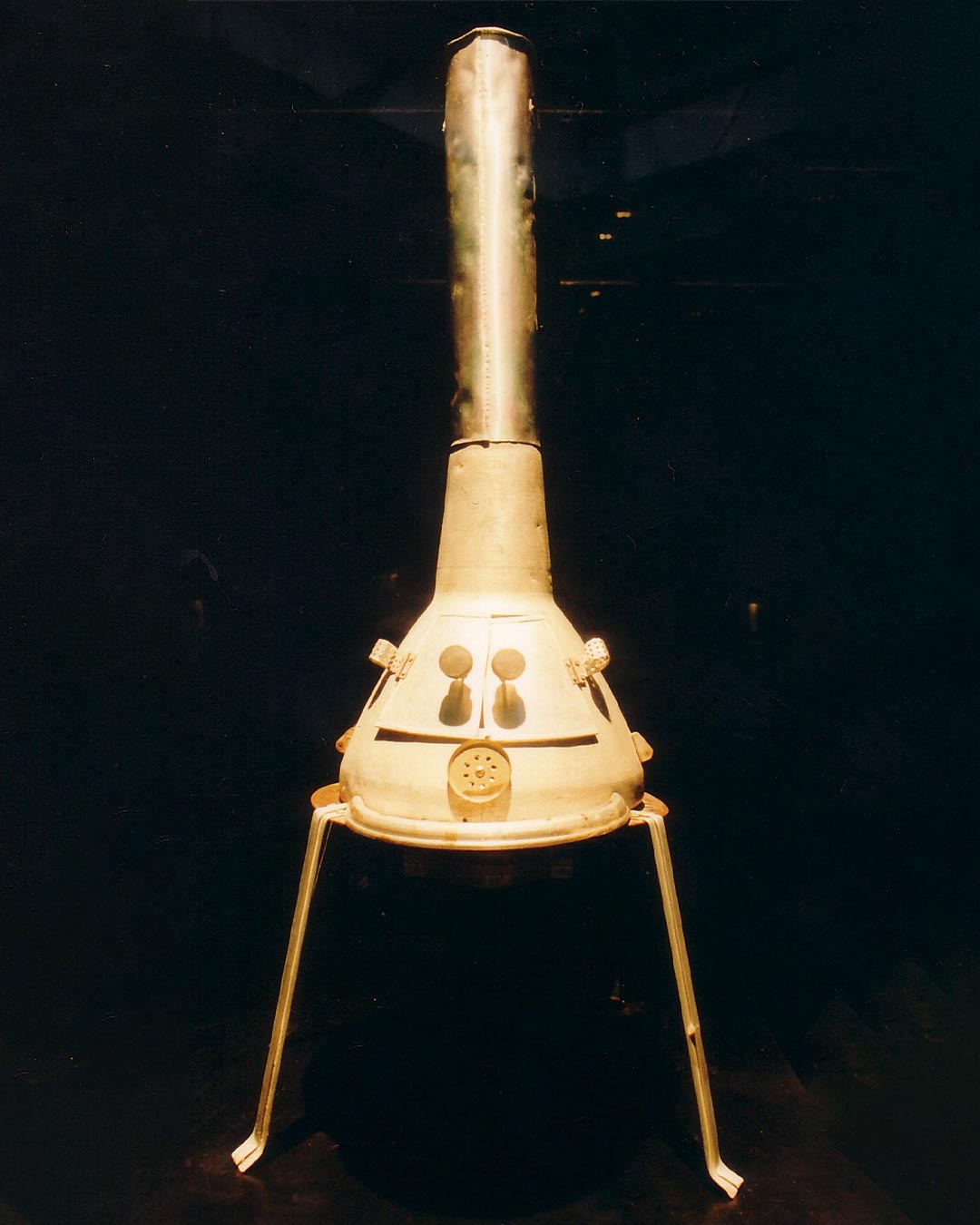
Milenko Simić, architect, made a stove out of a theater spotlight; it heated the apartment during the four years of the siege.
"When you remove a boiler, it has a coating around it and a cauldron inside. Between the coating and the cauldron there is glass wool. And then we removed the glass wool, and on the upper part of the boiler coating we drilled a hole to which we fitted a chimney. We couldn’t do it inside our home, but we made a joint one on the staircase, so that we can use it, not only me, but the neighbors, too. So to open up the cauldron, to get a place in which to put the things, the most important thing was to bake bread, because there was no bread to be found. We baked bread in high pressure cookers, in all sorts of improvised pots, etc. And then we took a saw and sawed off the front part of the cauldron and we got the inner part, which is round. And then we put a wire fixture inside, so that we can put the things that we cooked, that is the pan, inside. Well, then we had to make a sort of handle, when it gets hot, that we could open it. And underneath we cut out another part, where we put a can where you make fire. In that can, the hot air goes between the coating and the cauldron and out through the chimney. And then we got what we wanted. But then, there was a small problem, who was going to light the fire first, because the one who lights it first has to use up the largest amount of logs. So we did it in shifts, one day me, the next day Gavro, the third time Sadija, the fourth time Dragan, and so on. All in the entire neighborhood was getting along incredibly well. And that was then, when the fire was lit at 6 o’clock in the morning, the whole day till late at night and it burned. When we already started to get gas, we invented all sorts of burners. But those burners were made of a simple pipe with holes drilled through, so there was a lot of soot and in the morning we would wake up all black under the nose, because the soot was all over the place in fact. Then we started fitting little gas taps to that part, then a thermal element, then a small pilot-burner that kept the fire burning all the time, so that the gas doesn’t have to be on all the time, it was like saving gas, but it was also protection, because there were explosions all over town as you know." - Azem Mehmedović, Citizen
© FAMA Collection; Oral History: 'The Siege of Sarajevo 1992-1996'
© FAMA Collection - Visual Archives 1992-1996
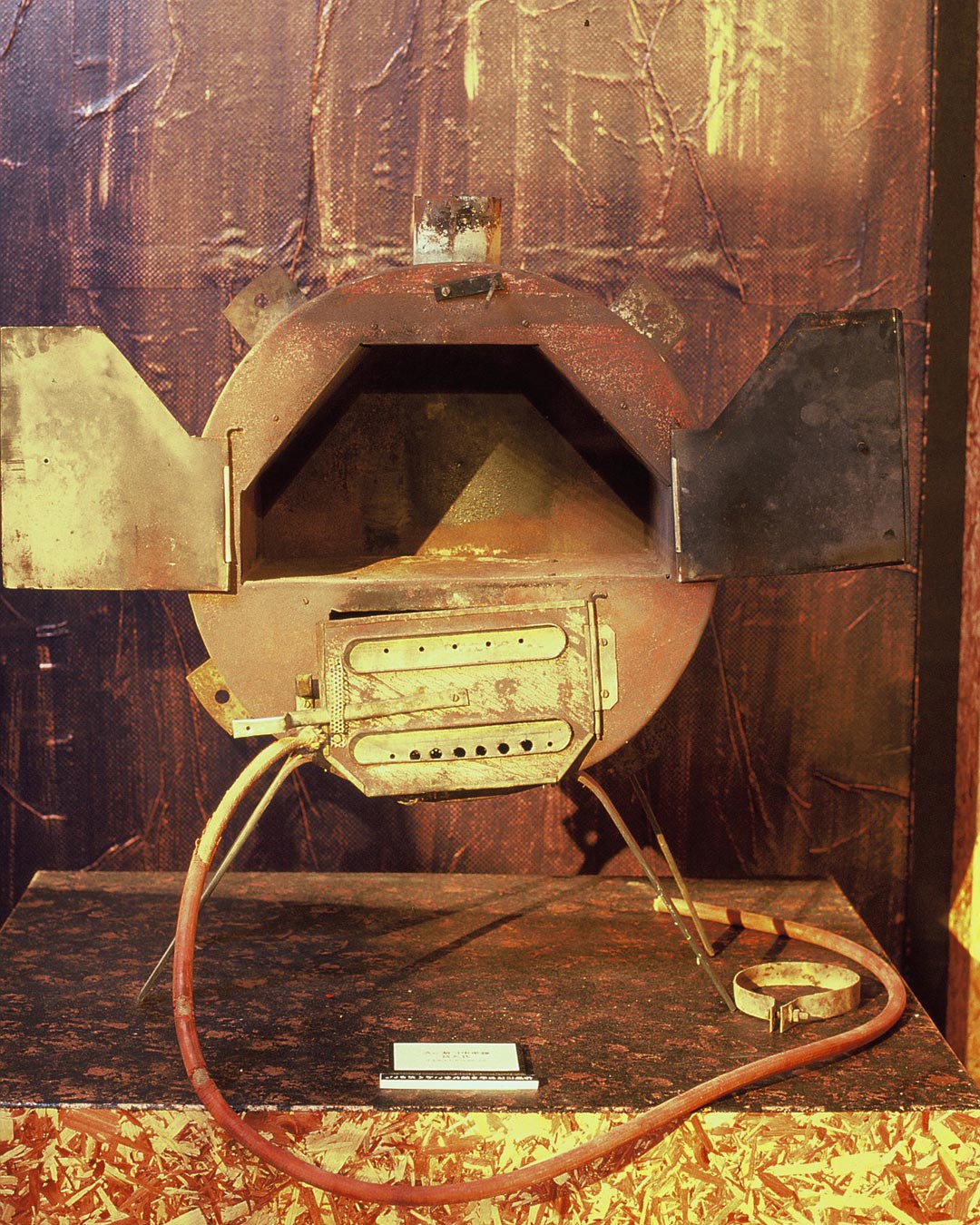
Stove made from a washing machine (recreating the life under siege) - Survival Art Museum '96. (Exhibition in Tokio)
© FAMA Collection - Visual Archives 1992-1996
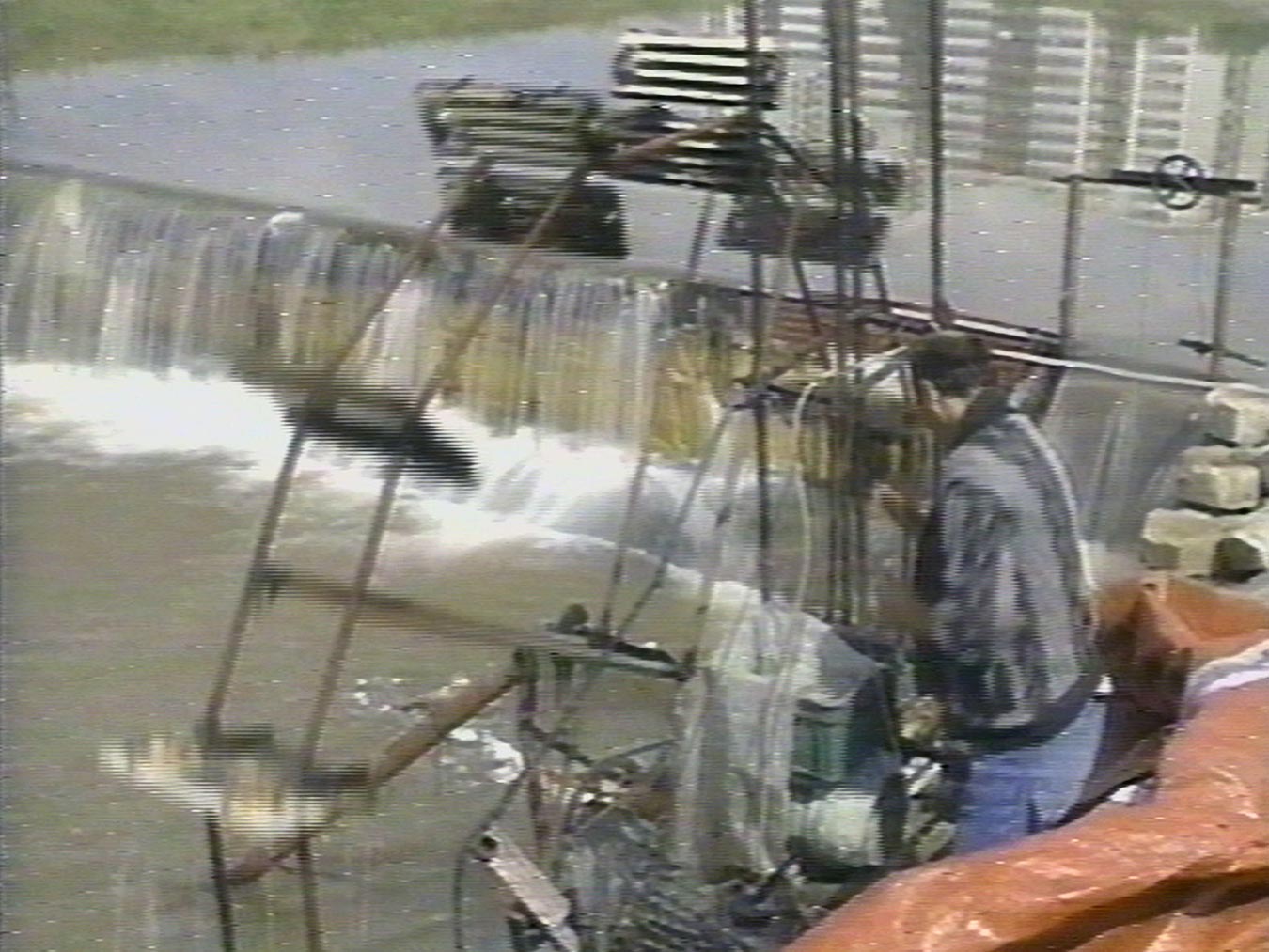
"I invented a turbine and built it on the river; it produced electricity for several buildings in the neighborhood."
"Since Sarajevo was blocked off nothing could be imported. And because of the lack of fuel, gas was the only resource. This prompted me to work constantly and finally produce a safe pressure regulator, which had all the characteristics of European regulators. It satisfied the performance norms of regulators by Singer, Rombach and so on. I installed 12 units in various buildings around Sarajevo. We wanted to produce them but we were not able because we lacked production materials. We couldn’t even move about and that was one of the problems." - Josip Nose, Constructor
© FAMA Collection; Oral History: 'The Siege of Sarajevo 1992-1996'
Building, creating, making something out of nothing, inventiveness, innovation - all this powered the city under siege and gave the citizens the strength to survive new and abnormal circumstances. In addition to innovation, the citizens of Sarajevo turned to manufacturing and crafts. Pieces of furniture were produced from the scarce resources available. Objects were made from wood, metal, wool, textiles. Knowledge of some kind of craft became important for survival - both personally and for the wider community.
"In 1993 a problem occurred and it was planks. I looked for planks mainly in the surrounding foothill areas of the city. I went there and bought, so to speak, plank by plank in various places. Let’s say that a bag of logs was some 30 to 40 German marks. I would buy a bag of logs for 30, 40 marks. I would give that for a bag, take it someplace near [pica, Trebević, Kromolj, some place I heard there could be planks or some building material. Then I would give the people the bag; I would take a plank or a piece of it, removed from a pigeon-house or hen house. Because I knew how to pick planks I needed for the furniture, so that a suite that went to the Sartre, War Theatre, was made of five, five types of walnut-wood from five different locations, I made a complete suite in the shape of leaves which is now in the possession of the Sartre, War Theatre." - Haris Haznadarević, Owner of the stylish furniture company “Haznadarević”
© FAMA Collection; Oral History: 'The Siege of Sarajevo 1992-1996'
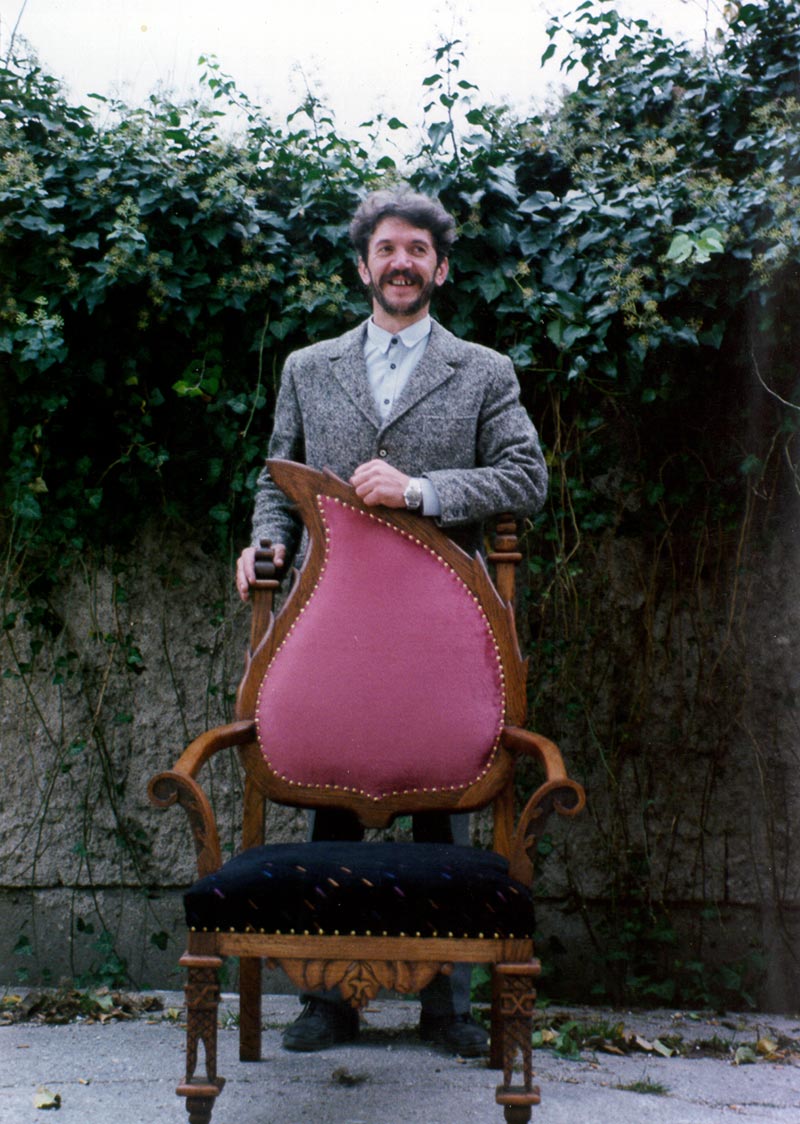
Haris Haznadarević with crafted stylish furniture
© FAMA Collection - Visual Archives 1992-1996
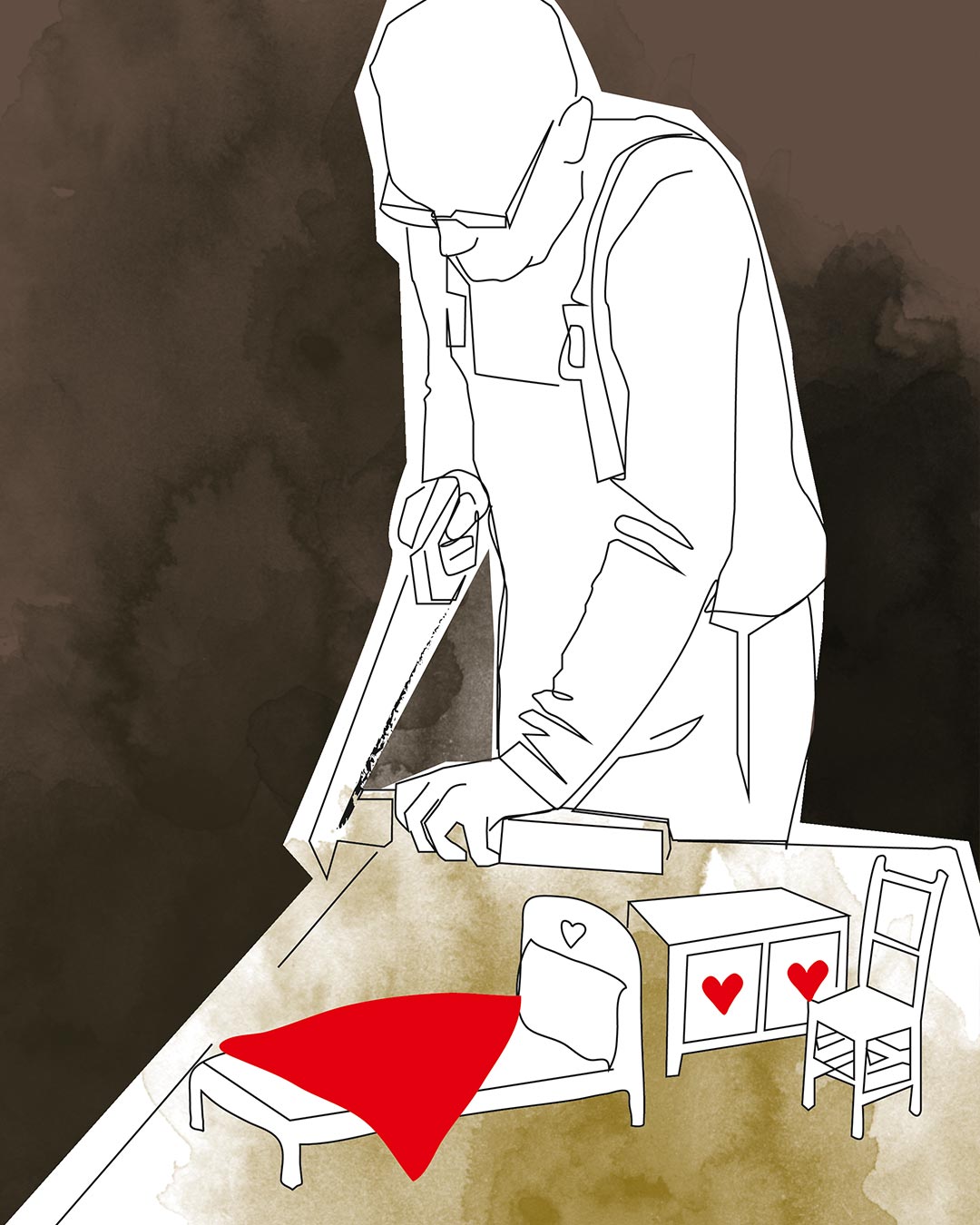
© FAMA Collection - Visual Archives 1992-1996 (Jelena Oksenfeld)
Milenko Simić, architect and designer, made furniture for doll houses. Creating such a small furniture was an achievement – a proof that meticulous creation of a small bed, a small desk, a small closet, small chairs reminded of the great Chinese master from the 18th century, who in an olive pit carved a boat with doors and windows, and with eight figures in it, of which two were playing chess. The doll house furniture is a precise, dedicated work, the art of creation.
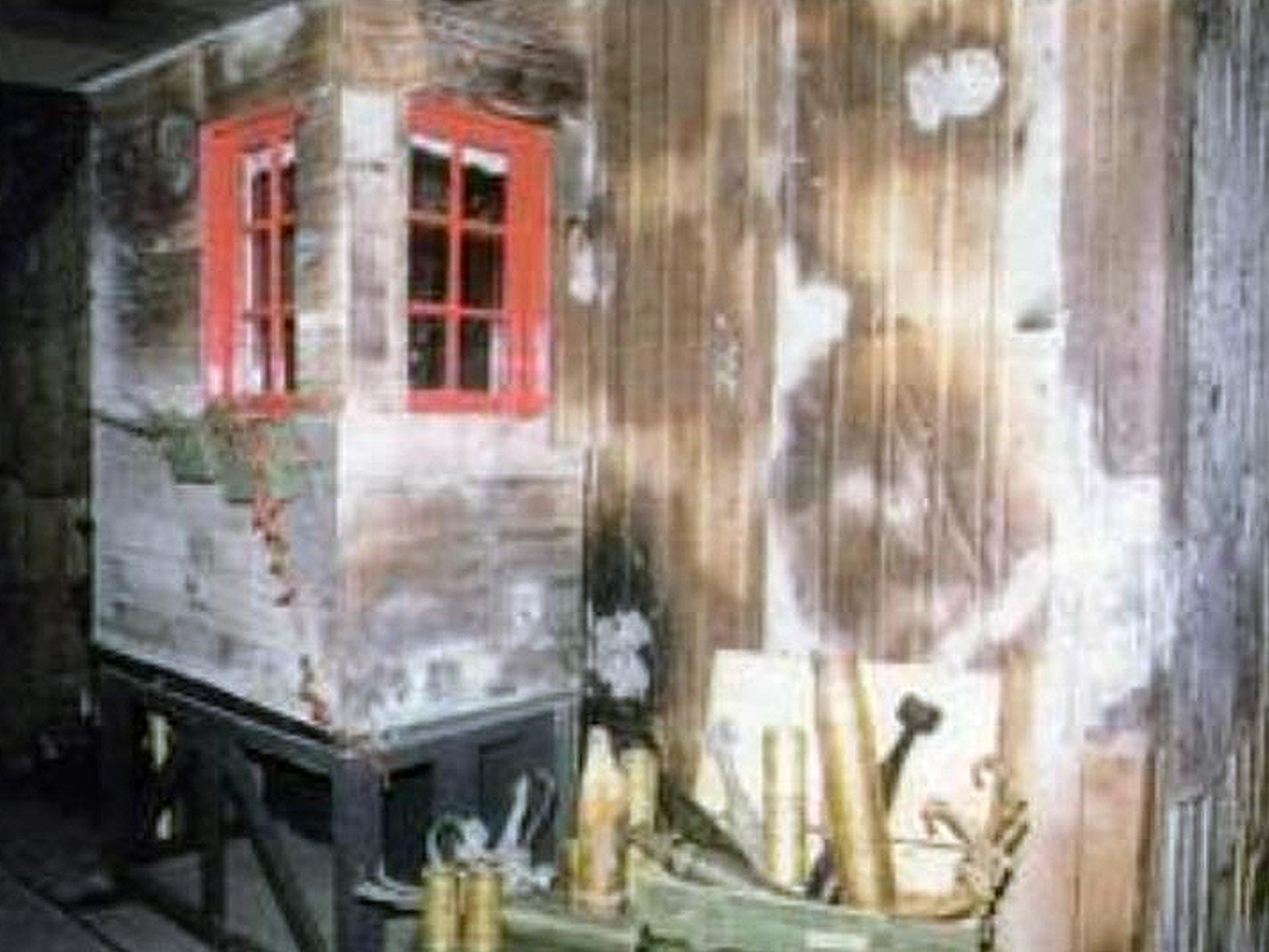
© FAMA Collection - Visual Archives 1992-1996
The only building built during the siege of Sarajevo was the Bosnian House (Survival Art Museum '92, architect: Ognjenka Finci). The Bosnian House is the centrepiece of the "Jelly Bomb" project produced by FAMA. This multimedia pavilion, which was installed in the Scout House, was a reconstruction of a traditional house in the city under siege, built in life-size from recycled materials. The contents included artifacts and innovations, an art exhibition, an exhibition of wartime "fashion", film screenings, concerts, and theatre performances.
During the siege, the citizens of Sarajevo created, built, became resourceful and innovative, they became innovators and constructors. The city fought against destruction with the power of creativity. Regardless of the form of creation, the citizens drew inspiration from the newly created circumstances and found the strength within themselves to define the New Normal. We spoke with architect Ognjenka Finci about the power of creation and creativity. In collaboration with her, the idea of building the Bosnian House emerged in the summer of 1992. How did the concept of the project come about? How did the process of building the house proceed? Based on the experience of the siege of Sarajevo, how does she understand the importance of the creative power of architecture and construction as excellent indicators of human creativity, ingenuity and the ability of man to create something from nothing?
Architect
Written interview finalized on 22th February 2025
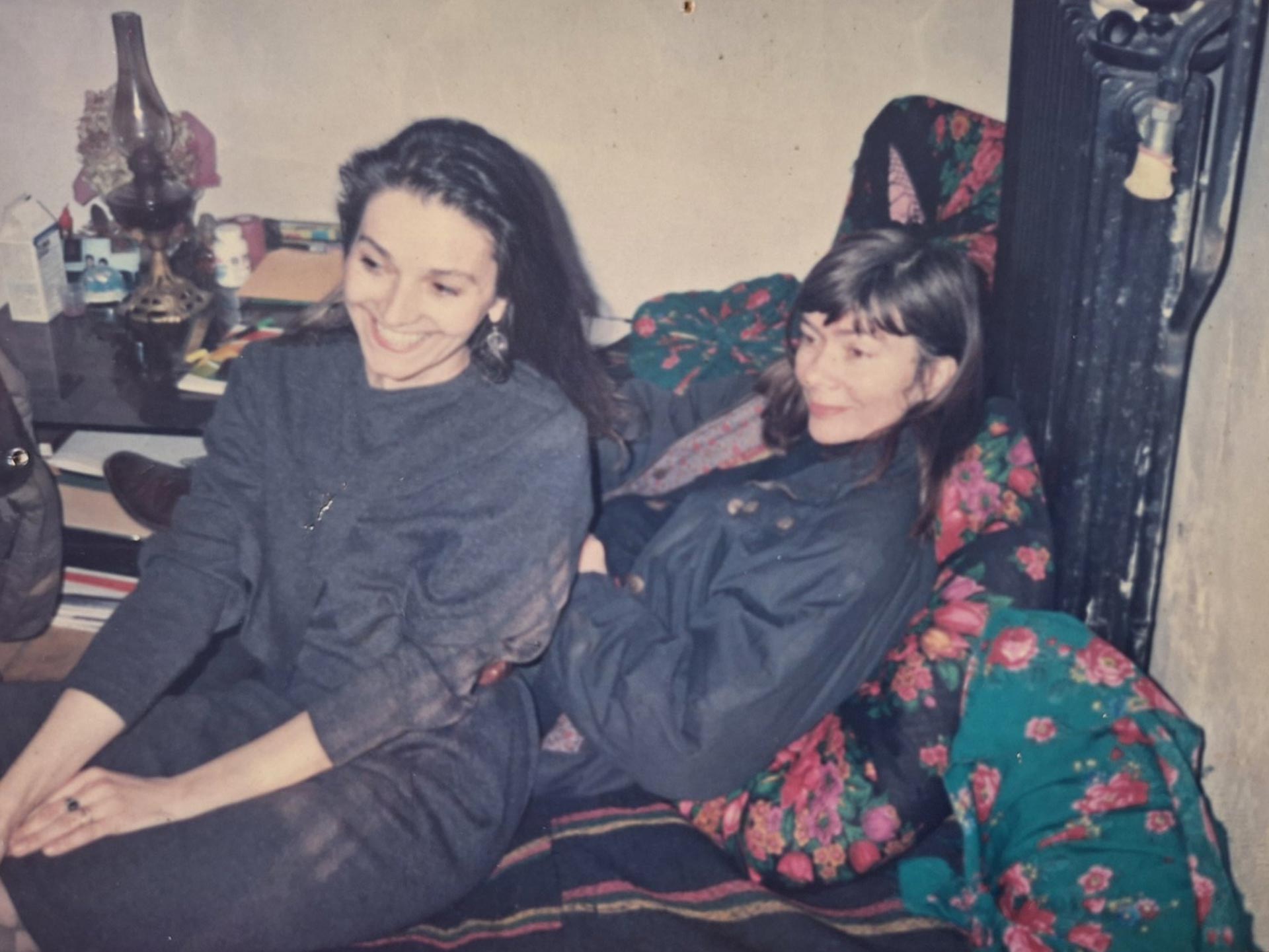
1992, Sarajevo under siege, Ognjenka Finci and Suada Kapić, preparations for the construction of the Bosnian House as part of the "Jelly Bomb" project
© FAMA Collection - Visual Archives 1992-1996
In June 1992, Suada Kapić launched the multimedia project "Jelly Bomb", a FAMA production, as a response to the real bombs, grenades, and sniper shots that terrorized and killed the citizens of Sarajevo. In collaboration with you, the idea of building the Bosnian House - the only building erected in Sarajevo during the siege, in real size, was born. In moments of absolute destruction, the idea of building the house was born. How did the initial process of developing this idea go?
Prof. Emeritus Ognjenka Finci: The idea of building a Bosnian house that Suada came to me with one June morning, then, just as it does today after more than 30 years, seems surreal and completely crazy. I remember that Suada was so convincing then in explaining her idea, claiming that right now, when everything around us is collapsing, we need to build. Her idea was to make a house that resembles a typical Bosnian house from our neighbourhoods, in real size, and to build it from materials from shelled and burned Sarajevo houses, in order to create a theatre in that house, a stage for various artistic activities. Although surprised by Suada's proposal, I agreed without hesitation and without unnecessary questions. My first thought was that a work occupation was salvation for us to preserve our sanity and the only possible way of our resistance to this unimaginable destruction in the midst of which we found ourselves.
My first thought was that a work occupation was salvation for us to preserve our sanity and the only possible way of our resistance to this unimaginable destruction in the midst of which we found ourselves.
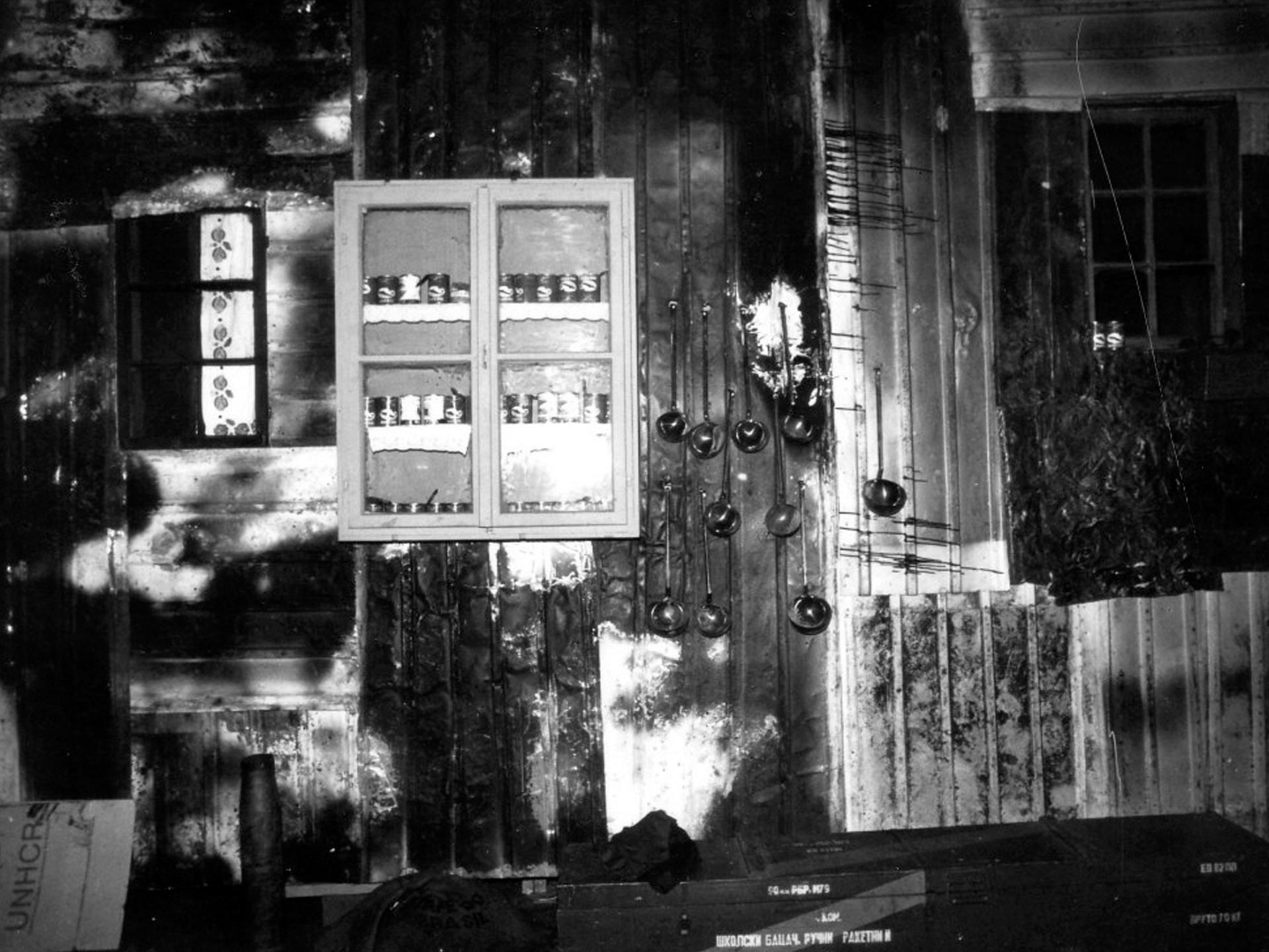
Project „Jelly Bomb" - Bosnian house, 1992 – architect: Ognjenka Finci
© FAMA Collection - Visual Archives 1992-1996
Our archive contains the original floor plan for the construction of the Bosnian House, which you drew. The floor plan was also printed on the project poster at the time. Can you explain the floor plan to us? What were the individual rooms intended for? How was the process of building the house conceived in that first phase of creation? How was the location finally chosen for the construction of the Bosnian House? Why Bosnian House?
Prof. Emeritus Ognjenka Finci: I got down to work and made a few variants of a possible floor plan and facades. The floor plan was relatively easy to define in terms of both dimensions and layout, because we knew that we wanted to have an auditorium and a stage area in the “Bosnian house” that would allow for different uses. Visualizing the facades was more difficult; apart from a representation at an adequate scale with defined positions of windows, verandas (doksat) and entrance doors, I was not able to show their realistic appearance. It would depend on the material that we would find and successively bring from the burned areas, cut it on site, and fix it to the structure. I tried to show the facades through a drawing - a collage, in order to at least somehow evoke the appearance of that future “patchwork facade”. The exterior of the house was to be a “real” Bosnian house in terms of composition and volume, with all the characteristic elements, veranda (doksat), hipped roof, small windows on the ledge of which there were flowerpots with blooming geraniums, and in the interior, atypical for Bosnian houses, a unique space without walls. We levelled the floor, creating an auditorium space at floor level and a raised stage space, which caused the "Bosnian house" to lose its expected residential attributes and become a theatre space that was to be used for various artistic performances.
At first glance, due to the chosen type of building, it seems to be a romantic reminiscence of our Bosnian house, which is synonymous with peaceful, harmonious family life, but at the same time it is a chilling testimony of destruction, because the material used to build this “new” Bosnian house are the remains of demolished and burned Sarajevo houses, with numerous scars from shells, shrapnel and arson.
Since the dimensions of this house-theatre were ambitiously conceived, as far as I remember it had between 50 and 60 m2 of surface area, it was necessary to find a “plot” for its construction. Of course, at a time when hundreds of shells were falling on the city every day, it was not possible to carry out this undertaking in an open space. Since the Scouts’ House is in my immediate neighbourhood, on Mejtaš, it occurred to us that the large hall of the Scouts' House would be an excellent “location” for our house. And from the moment we came up with this life-saving idea, the concretization of the idea began.
The floor plan was relatively easy to define in terms of both dimensions and layout, because we knew that we wanted to have an auditorium and a stage area in the “Bosnian house” that would allow for different uses. Visualizing the facades was more difficult; apart from a representation at an adequate scale with defined positions of windows, verandas (doksat) and entrance doors, I was not able to show their realistic appearance.
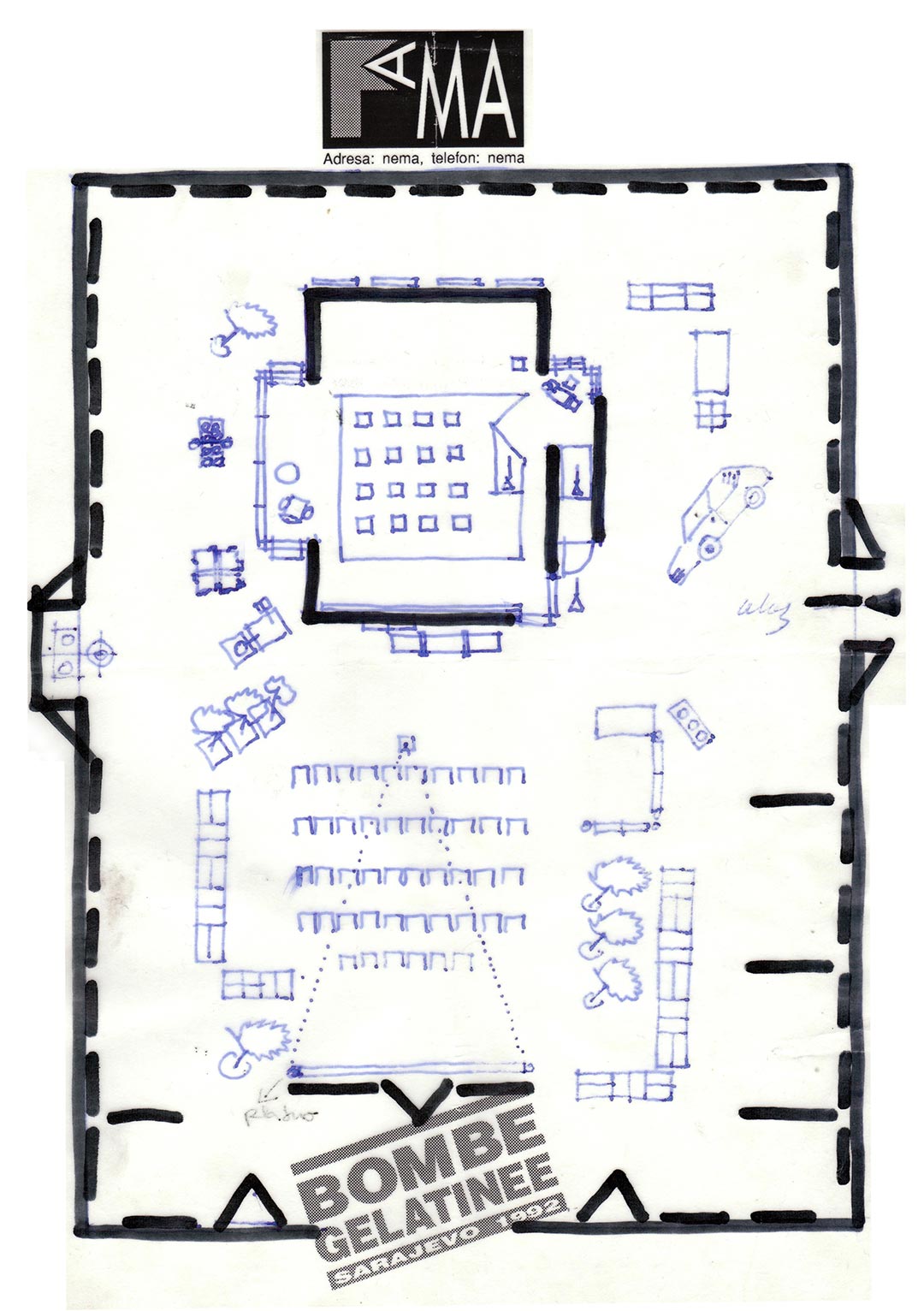
Project „Jelly Bomb" - Bosnian house, 1992 – architect: Ognjenka Finci
© FAMA Collection - Visual Archives 1992-1996
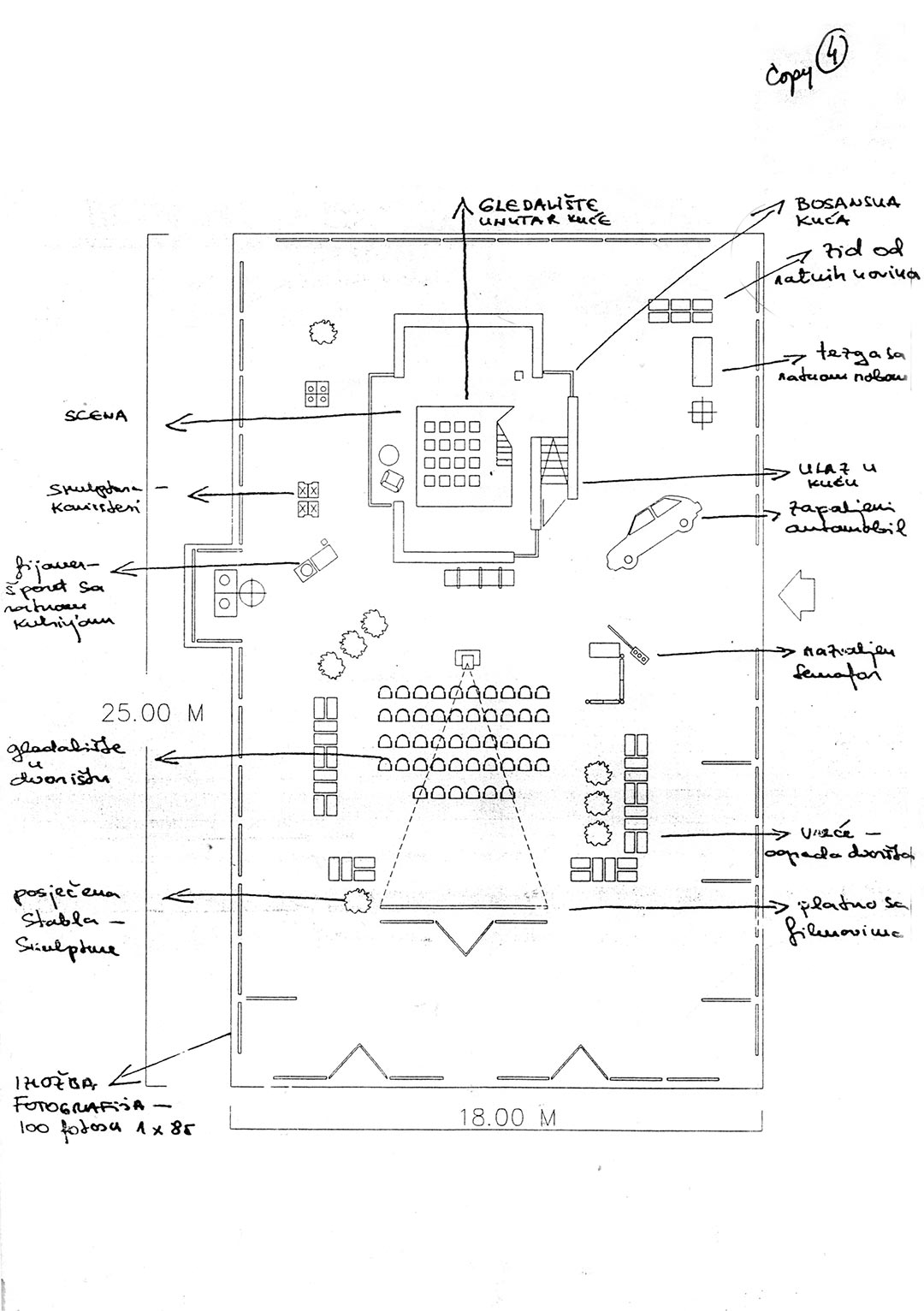
Project „Jelly Bomb" - Bosnian house, 1992 – architect: Ognjenka Finci
© FAMA Collection - Visual Archives 1992-1996
The next phase involved finding materials and delivering them to the Scouts' House? How many people were involved in this phase of the building? How was it possible to convince all participants to participate in the construction of this building at such an early stage of the siege? How was it possible to deliver the materials under shellfire? Where did you find them? How long did the construction take? How much time did you spend at the house construction site?
Prof. Emeritus Ognjenka Finci: I can't remember exactly what kind of "campaign" we resorted to in order to mobilize numerous participants in the implementation of the project. Certainly, Suada did the most with her convincing argumentation and the passion with which she explained it. But there are many who helped to realize the idea of the multimedia project "Jelly Bomb". Everyone animated someone, so the number of participants increased significantly. Everyone was in a euphoric mood then, you could almost feel the adrenaline in the air, and the revolt, because what we were exposed to was motivating. In the Scouts' House itself, we found some materials, first of all workable ones, which helped us to build a "platform" - the base of the house, on which we then placed the basic structure, using the bondruck system characteristic of the construction of Bosnian houses throughout the centuries. The material for the construction of the house, the wall coverings, the windows, the doors, all of this was brought from various locations, and mostly from the abandoned and destroyed complex of the Marshal Tito barracks (which is practically in the city centre and extremely exposed to enemy positions on the slopes of Trebević, from where there is constant shooting), by the guys from the Territorial Defence Mejtaš 2, led by Mirsad Huković - Boco, the commander of the Territorial Defence Mejtaš 2. Before the war, Boco was an employee of RTV BiH in the set design department, with extensive experience in the implementation of numerous TV and film projects. So he was the ideal person who understood our ideas related to the construction of a Bosnian house, because it was a true set design undertaking. Boco encouraged a couple of his friends who worked with him at BHTV before the war, Ismet Begtašević, Halid Patković, and the guys, Dragan, Toma, Gaši..., who had wartime assignments in the Territorial Defence Mejtaš 2, to help us. I remember that they accepted it very heartily and when they were not on their tasks, I can freely say that the "Jelly Bomb" project became a task as important to them as their war tasks. Of course, it was extremely risky, given the position of the abandoned Marshal Tito barracks, to enter that complex, remove burnt sheet metal from the military barracks, remove doors, windows... to drag - even though they were empty - heavy wooden military crates for weapons and ammunition, load them into some wrecked Caddy and often under sniper fire, driving at top speed from Pofalići, transport all that to Mejtaš. Whatever they brought, I tried to use and apply creatively, because I could not choose, but work with what I have, aware of the fact that what I have is worth its weight in gold because of the courage invested to bring that material.
When one day, in addition to the burnt sheets, they brought a dozen large, heavy green military crates, I was overjoyed. They helped me build a part of the wall of the house that was interesting because of the typography printed on the surface of the crates in bold black paint, numbers and letters, some mystical abbreviations - codes with which the JNA designated the types of weapons and calibers of ammunition stored in the crates. Thus, one wall of our Bosnian house was "strewn with JNA graffiti"!
As the material arrived, the house grew. There were days when it was not possible to build, or there was a shortage of material, or those who lived far away could not come due to heavy shelling. And I, since I lived practically three steps from the Scouts' House, was there constantly, Suada also came from Ciglane every day, because she believed that she must always be there at all costs, regardless of the often impossible circumstances and danger.
I don't remember exactly how long we built the house, a month, two. I only remember that it was summer, that the days were long, that it was hot, that there was no water or electricity, that the city was shelled almost every day, that sirens were blaring non-stop, that we hardly paid attention to the sound of snipers anymore and that we often sat in the sun on the south side of the Scouts' House, as ideal sniper targets, and longed for the sea! Suada used to dream out loud about the sea and Halid Patković, an extremely nice man and a very skilled painter, so that our wish would be fulfilled, painted in the Bosnian house, across an entire wall - the back wall, in a large dimension, I think somewhere around 4.5 x 2 m - the endless open sea. We called the painting "Longing for the Sea"!
The exterior of the house was to be a “real” Bosnian house in terms of composition and volume, with all the characteristic elements, veranda (doksat), hipped roof, small windows on the ledge of which there were flowerpots with blooming geraniums, and in the interior, atypical for Bosnian houses, a unique space without walls.
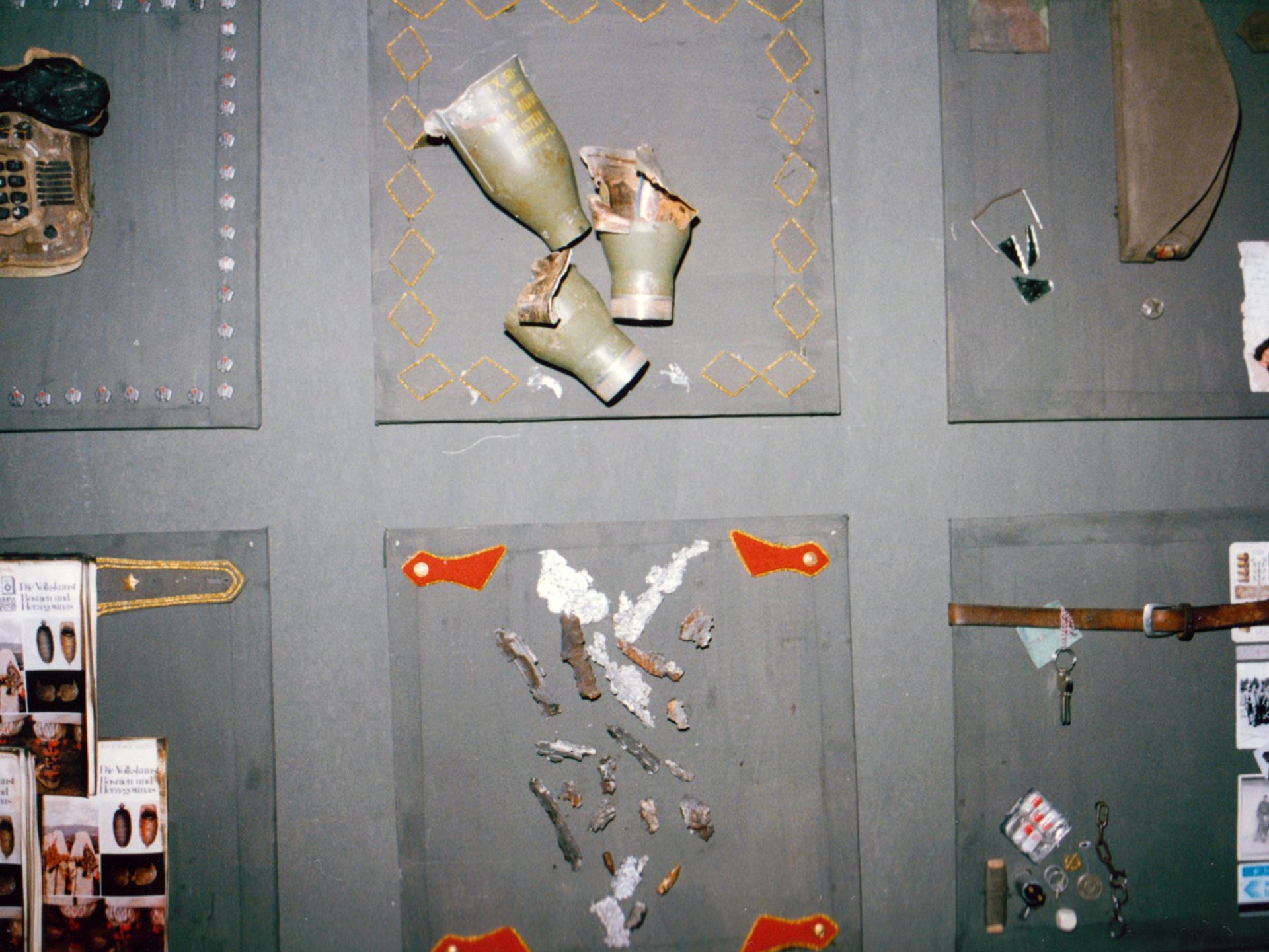
"Bosanian house, 1992", interior - exhibition of the works of Nedžad Begović
© FAMA Collection - Visual Archives 1992-1996
The Bosnian House later became, in parts, an exhibition of the Survival Art Museum, which housed artifacts, i.e. inventions and innovations created during the siege, an art exhibition, an exhibition of canisters, and micro-theatre performances. How did you, as authors, view this purpose of the house's space, and how did the citizens, visitors, and the audience react?
Prof. Emeritus Ognjenka Finci: When we finished building the house, the actors who were gathered around this project - Amina Begović, Mirza Halilović, Jesenko Selimović, Žan Marolt and others - and who also came to the Scouts' House almost every day, worked with Suada on a performance about the art of survival, which was an integral part of the "Jelly Bomb" project, and was shown when we officially opened the doors of the Bosnian house - the theatre house to numerous guests, friends, family members of the participants, and foreign journalists, many of whom were in the city during that first summer of war. The performance was excellent, the actors motivated, the audience delighted with them, but also with the unexpected building and the space inside it. All of us, both participants and guests, were in a special mood, happy and excited, and at the same time, looking at the result, in disbelief that we had succeeded.
The Bosnian House, as it was then built, was only briefly used for the function we intended for it, it was dismantled sometime in the late summer of 1992. It was never again erected in that form. In a way, a memory of it remained. When an exhibition was set up in the square in front of the National Theatre, today's Susan Sontag Square, back in 1995, which included some artifacts that spoke of the creativity and skill of the people of Sarajevo to survive, the Bosnian House was only exhibited in outline, set up as a smaller-scale construction, serving more as a reminiscence of the house we built in the summer of 1992. I was not in Sarajevo at the time, so I did not participate in that performance. I have seen photographs and it is difficult to call that installation the Bosnian House, which, as you say, actually functioned as an exhibition of the Museum of the Art of Survival. But regardless of that improvisation - because even in 1995 (Sarajevo was still under siege, the war was still going on), it was impossible to build this house in an open space, moreover, identical to the one we built in the summer of 1992 in the Scouts' House - it is valuable that its name and the very idea of the house were in a way the seed from which the idea of the Survival Art Museum was born.
There are many who helped to realize the idea of the multimedia project "Jelly Bomb". Everyone animated someone, so the number of participants increased significantly. Everyone was in a euphoric mood then, you could almost feel the adrenaline in the air, and the revolt, because what we were exposed to was motivating.
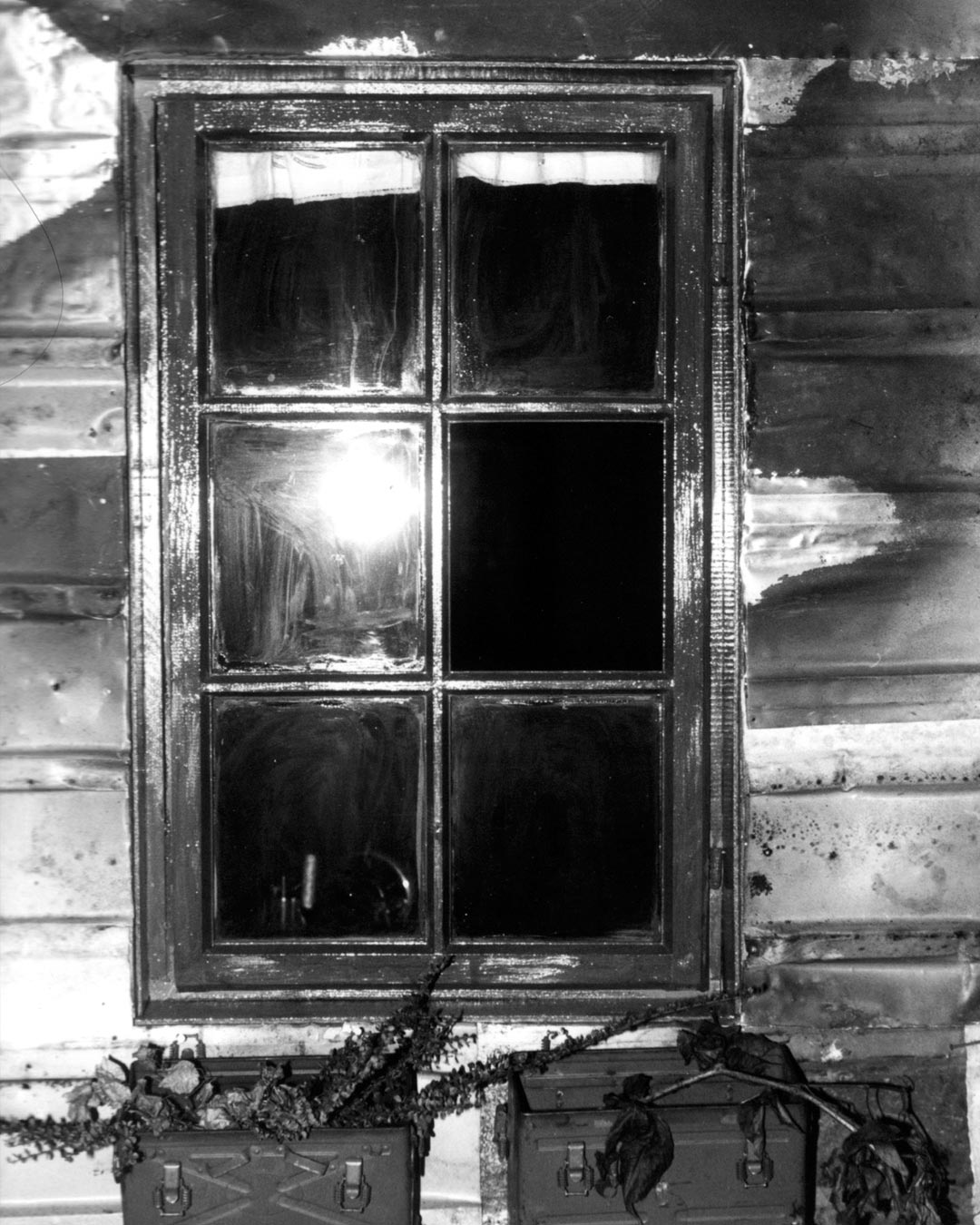
Bosnian house, 1992 – architect: Ognjenka Finci
© FAMA Collection - Visual Archives 1992-1996
Were you and the other participants in this project aware at the time that this was the first organized form of spiritual and cultural resistance to the mechanism of terror during the siege? What is your perspective about it today?
Prof. Emeritus Ognjenka Finci: We didn't think about it that way back then, we simply spontaneously mobilized, we felt that we had to do something, that we couldn't sit idly by. And when we were already deeply immersed in the project, we realized that we were drawing our energy, our enthusiasm, our motivation, and ultimately our courage, from our defiance, our resistance to the unimaginable terror we were exposed to every day. Today, with a distance of more than three decades, when I think about this, because you brought me back to that time with your questions, it seems just as surreal and crazy to me as when Suada came to me on that early June morning in 1992 with the idea of designing the Bosnian House - a theatre house.
As the material arrived, the house grew. There were days when it was not possible to build, or there was a shortage of material, or those who lived far away could not come due to heavy shelling. And I, since I lived practically three steps from the Scouts' House, was there constantly, Suada also came from Ciglane every day, because she believed that she must always be there at all costs, regardless of the often impossible circumstances and danger.
What was your personal motivation for participating in this project? What did "building within destruction" mean to you then and what does it mean to you today? Based on the experience from the siege of Sarajevo, how would you describe the significance of the creative power of architecture and construction as excellent indicators of human creativity, ingenuity, and ability of man to create something from nothing?
Prof. Emeritus Ognjenka Finci: Creating in the circumstances of an unimaginable siege is specific, and all of us, regardless of what branch of creativity or art we were involved in, have experienced these specific circumstances, especially these borderline and difficult to imagine circumstances; this stimulates in creators a special spark of creativity and the ability to discover previously unknown sides of their personality and push the limits of their possibilities. During this difficult time, I learned and became aware of many things about the world around me, about myself, and about the limits of freedom. I realized that even in wartime circumstances, it is creativity of the spirit that sets the limits of our freedom that go beyond the real world in which we lived at the time, and I know that this knowledge helped me to keep my sanity.
During this difficult time, I learned and became aware of many things about the world around me, about myself, and about the limits of freedom. I realized that even in wartime circumstances, it is creativity of the spirit that sets the limits of our freedom that go beyond the real world in which we lived at the time, and I know that this knowledge helped me to keep my sanity.
Describe your day during the siege of Sarajevo?
Prof. Emeritus Ognjenka Finci: This question is not easy to answer. At least for me, there was no routine, and in wartime circumstances, it is difficult for days to resemble one another. I had a work obligation at the Faculty of Architecture. Classes were held on two locations, at the Faculty of Medicine and in the premises of the Basketball Club Bosna, in a house on the corner of Marshal Tito Street and the then Maksim Gorki Street near the Alipašina Mosque, because the special unit of the "Lasta" detachment was located in the faculty building.
So, according to the schedule, I went to these two locations a couple of times a week to teach classes. I went to work, it was quiet, you could only hear the occasional sniper shot, I held consultations, there were few students, especially the young men were few, almost all of them were mobilized, and then suddenly the shelling would start, you would run for cover somewhere and wait, wait for it to stop so you can return home.
After the summer of 1992 and the completion of the “Jelly Bomb” project, new engagements followed. Suada Kapić conceived a new project, “Survival Guide”. I was working on the design of its first version, we worked in the building of the DOM design studio. We had good working conditions there, electricity was available for most of the time, and for me it was a lucky circumstance that the DOM building was only about a hundred meters from my house. It is peculiar how I felt a sense of protection and some inexplicable security when I was in my neighbourhood. I had no rational reason for it, because my neighbourhood had already been shelled in the first days of April 1992. The Olympic Museum, which is in my immediate neighbourhood, was set on fire, and from that night until the end of the war I did not have a single glass window, and after that terrible April night, a considerable number of shells fell on my neighbourhood. Thus, the work on Suada’s guide was marked by a sudden shelling. It was a quiet afternoon, I was sitting at my computer, next to me was my colleague architect Riad Drino, and suddenly we found ourselves on the floor, the building shook terribly, the computers shut down. We thought it was an earthquake, but it was a shell that hit the building we were in, luckily an empty office two floors above us.
For the Open Society of Bosnia and Herzegovina - Soros Foundation, I did the complete graphic design for the programs that the Foundation implemented. We printed most of these things at the Academy of Fine Arts, so running across bridges to the other side of the river was for a while my "routine" and a skill for not becoming a sniper target.
When Radio ZID was founded, I was there, if I recall correctly, every Thursday, in the evening, hosting a half-hour classical music show "Musica humana", so with a prepared text, cassettes and records in hand, I hurried from my house in Mejtaš to Ciglane, where Radio ZID's premises were. ZID was also starting a publishing house, so in impossible conditions I was working on the design of the first book published by ZID, "100&1 NOĆ", edited by Zdravko Grebo. The book was printed in the Oslobođenje printing house. Going to the Oslobođenje building in Nedžarići, to see the first prints of the book and to sign that they are good, is one of the war adventures that I cannot forget. Driving in a car riddled with bullets, because it was a moving target on its daily route as it transports journalists and printed newspapers, at unimaginable speed from the city centre to Nedžarići and back, with the driver warning me to keep my head down on dangerous sections of the road!
Haris Pašović returned to besieged Sarajevo via the airport runway sometime in the winter of 1992, and in the spring of 1993, we begin preparations for the play "Alkestis" at the Youth Theatre, I worked on the set design for the play. After that, Susan Sontag came to Sarajevo. I worked with her on the play "Waiting for Godot", the set design and costumes. In the destroyed Olympic Museum, at the initiative of Haris Pašović, and within the framework of MESS, we set up an exhibition by Lebbeus Woods inspired by the destruction of Sarajevo, "War and Architecture". In early 1994, we held a workshop with students of the Faculty of Architecture, mentored by American architects Lebbeus Woods, Thom Mayne, Eckhardt Reinfeld. I could go on and on about what was done, what was experienced, and how we spent the war days in Sarajevo... The only thing I can testify is that not a single day resembled the previous one, there was no daily routine, it was simply impossible to establish one. What all Sarajevans had in common was the struggle with water, electricity, and heating. But there was no routine, because you never knew when the water or electricity would come, for how long we would have them, and then you rushed to do a hundred things. And we also shared fear, because even with the shelling, you never knew when it would start or where you would find yourself, how long it would last, how much damage, misfortune, and sorrow it would bring.
It is difficult to describe a day during the siege of Sarajevo, because each one deserves a separate story.
IN MEMORIAM
Prof. Emeritus Ognjenka Finci
1949 - 2025